Pedro Sánchez announces that the government will begin the procedures for the new General State Budget for 2027 this week
President's News - 2026.6.3
The President of the Government of Spain, Pedro Sánchez, during the colloquium held at the closing of the 41st Annual Meeting of the Cercle d'Economia 2026 | Pool Moncloa / Fernando Calvo. 2026.6.3
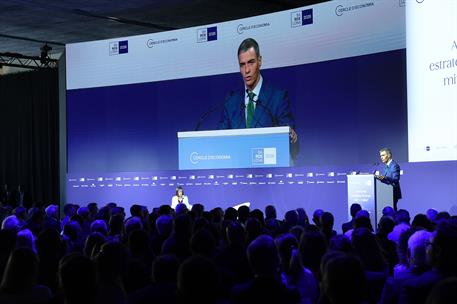
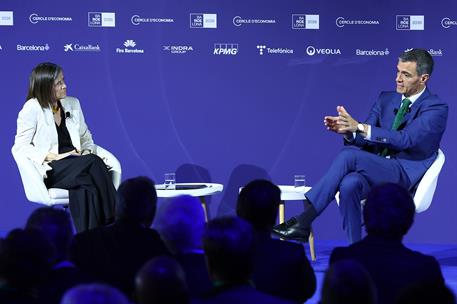








Catalonia Congress Palace, Barcelona
The President of the Government of Spain, Pedro Sánchez, announced that the Government will begin the process of presenting and approving the new General State Budget, "more ambitious, even more socially focused and even more responsible", for 2027. The drafting order will be published in the Official State Gazette (BOE) this week, and the macroeconomic framework will be updated throughout this month, with the aim of approving the new budget in coordination with the other parliamentary groups, he explained.
This was announced during the closing ceremony of the 41st Annual Meeting of the Cercle d'Economia, held at the Palau de Congressos de Catalunya, in Barcelona, and attended by the Minister for Industry and Tourism, Jordi Hereu, and the president of the Generalitat, Salvador Illa, with the participation of the president of the Cercle d'Economia, Teresa García-Milà. Pedro Sánchez stated that these public accounts will once again be "social budgets, further strengthening our welfare state", and that housing will be a "priority, with the largest deployment of public resources ever seen in the history of our democracy".
Strengthening the welfare state, housing, fiscal responsibility, and regional financing
He also indicated that the new General State Budget will "continue along the lines of fiscal responsibility", reducing the public deficit-which the OECD projects will be at 2.2% of GDP in 2026-and ending the legislature with public debt below 100% of GDP. "We are going to do all this, seeking ever closer integration and coordination with the EU and ever stronger and more diversified links abroad, with the reinforcement of European sovereignty in energy, technology and defence. Europe was not born to be anyone's vassal and its prosperity and freedom cannot be jeopardised when someone powerful writes something on social media", he explained.
The new public accounts, he noted, will also be used to resolve "the problem of regional financing, concluding the journey we have been on for some years now". In the case of Catalonia, the President of the Government of Spain highlighted that it has received an additional €60.7 billion compared to the previous administration, representing a 52% increase in resources. The Executive, which yesterday approved record payments of €158 billion for this year for the regions, wants to "go a step further, with the reform of regional funding, 12 years after its expiration, and the reduction of part of the autonomous communities' debt, around €83 billion, which will be assumed by the General State Administration".
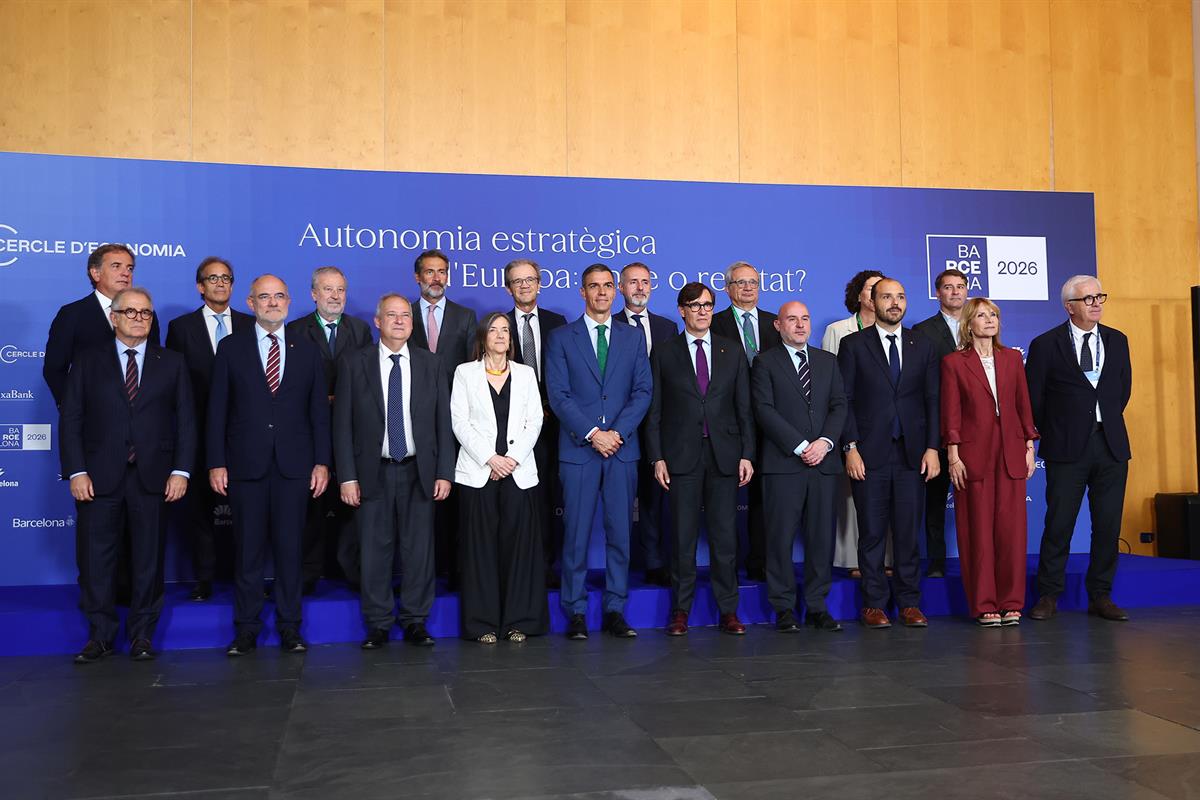 The President of the Government of Spain, Pedro Sánchez, together with the President of the Generalitat of Catalonia, Salvador Illa, and other authorities and members of the Cercle d'Economia, in the group photograph of the closing ceremony | Pool Moncloa / Fernando Calvo
Pedro Sánchez praised the OECD's confirmation today that Spain will remain the fastest-growing major economy in the eurozone, with a growth rate of 2.2% in 2026, leading for the third consecutive year in a "very turbulent" international context in which most countries are declining. He added that this is further supported by data published yesterday, which shows 22.3 million people affiliated with the social security system and the second-best May in history. "The data reflect an undeniable reality: Spain is moving forward, thanks to the efforts of our workers, the talent of our companies and two fundamental factors that we cannot ignore: stability and agreements", he added.
Completing the major economic modernisation of Catalonia and Spain
In this respect, he underlined the "extraordinary cooperation" with the Catalan Government in multiple areas and celebrated that Spain and Catalonia are experiencing "a very favourable moment economically, in terms of employment, and institutionally" thanks to the Government's actions in addressing problems and its "unequivocal commitment to the agenda of reconciliation between Catalonia and Spain, whose most significant milestone, pending the ruling of the European Court of Justice, will be the full and effective implementation of the Amnesty Law", which he hopes will be achieved during the current legislative term. "I am fully aware that the Amnesty Law, like the pardons, does not signify the end of our duty to resolve the political conflict. However, with the same conviction, I believe we cannot overlook the value these decisions have had in returning to the political arena what should never have been removed from it. We still have to tackle the roots of the territorial conflict" and consequently, he said, "move forward with the Brussels agreements with Junts per Catalunya, as well as fulfil the roadmap established with ERC".
"This understanding between different parties, whether with the progressive, nationalist, and/or pro-independence forces of Catalonia and the Basque Country, is proving beneficial to the entire Spanish State", he emphasised. Therefore, he championed the agreements and the stability derived from them as "essential instruments for achieving what has been accomplished and continuing this work in the coming years", moving towards "the overarching goal of completing the most significant economic modernisation in the recent history of Catalonia and Spain".
Free Trade Zone Consortium: streamlining real estate and land management
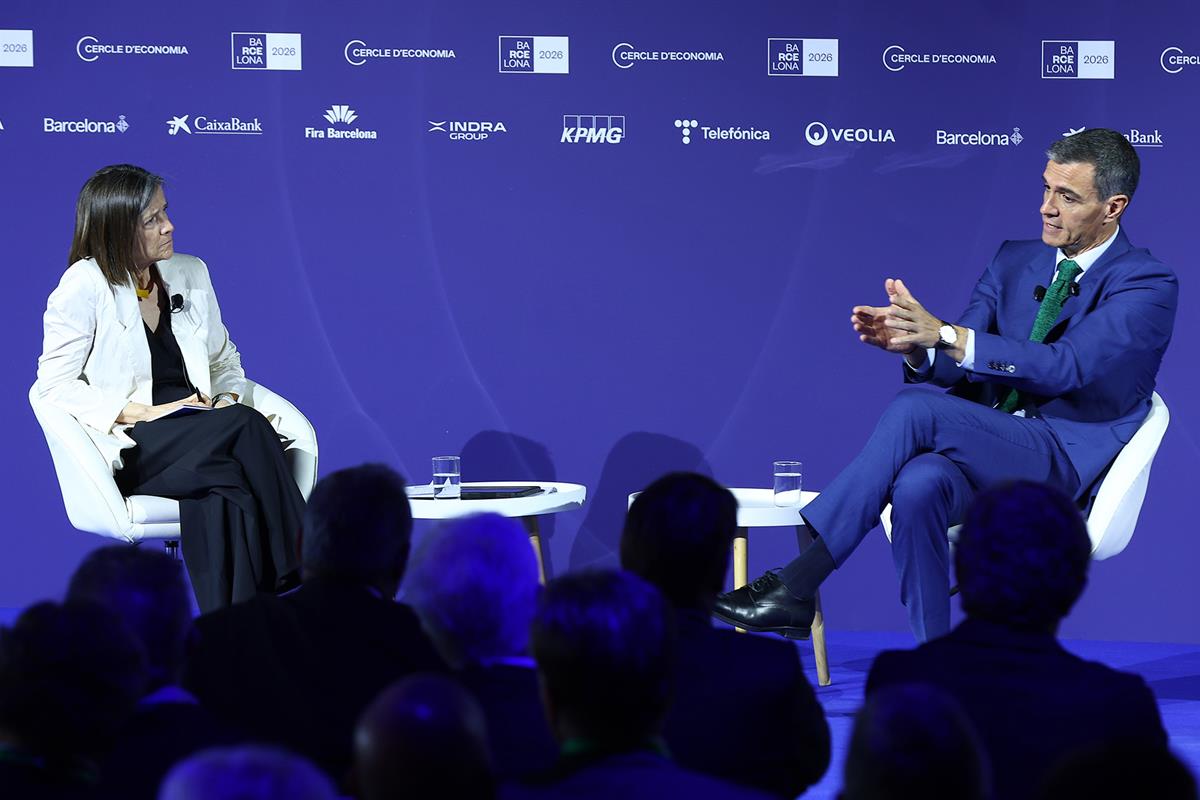 The President of the Government of Spain, Pedro Sánchez, during the colloquium held at the closing of the 41st Annual Meeting of the Cercle d'Economia 2026 | Pool Moncloa / Fernando Calvo
"Spain has prospered greatly in recent years, and Catalonia has prospered along with it", Pedro Sánchez emphasised, noting that Catalonia has surpassed €100 billion in exports for the third consecutive year, with 18,000 exporting companies.
To consolidate this record, he announced a "new milestone achieved through dialogue" at the latest Bilateral Commission meeting between Catalonia and the Spanish State: the modernisation of the Free Trade Zone Consortium, designed to streamline the management of real estate and land for logistics and industrial purposes. Therefore, the Catalan government's stake will be increased to 40%, and Barcelona City Council's to 15%, in "a key entity for Catalonia", crucial for its growth and industrial development.
Five pillars of progress for Spain and Catalonia
He stated that Spain and Catalonia will continue to advance based on five pillars, starting with an energy mix heavily reliant on renewables. This has contributed to electricity futures for 2027 being 55% cheaper in Spain than in Germany and almost 80% cheaper than in Italy. It has also made Spain the second country in the world in terms of greenfield energy projects and the host of one in four renewable hydrogen projects across the European Union. A "successful" model that will be further developed towards electrification and energy sovereignty.
Added to this is a commitment to training and attracting human capital, prioritising the "true goal" of "being an open and prosperous country, not a closed and impoverished one", with an "effective" immigration policy that recognises rights and fosters social integration and prosperity so that migrants contribute to the sustainability of the welfare state"; as well as the promotion of digitalisation and the reindustrialisation of territories. To ensure the continuity of the 'Next Generation' funds from the Recovery Plan, the Spain Grows Fund is being launched, with €120 billion to continue modernising the productive sector and keep it at the forefront globally, and Catalonia will play a "key role" in this, Pedro Sánchez affirmed.
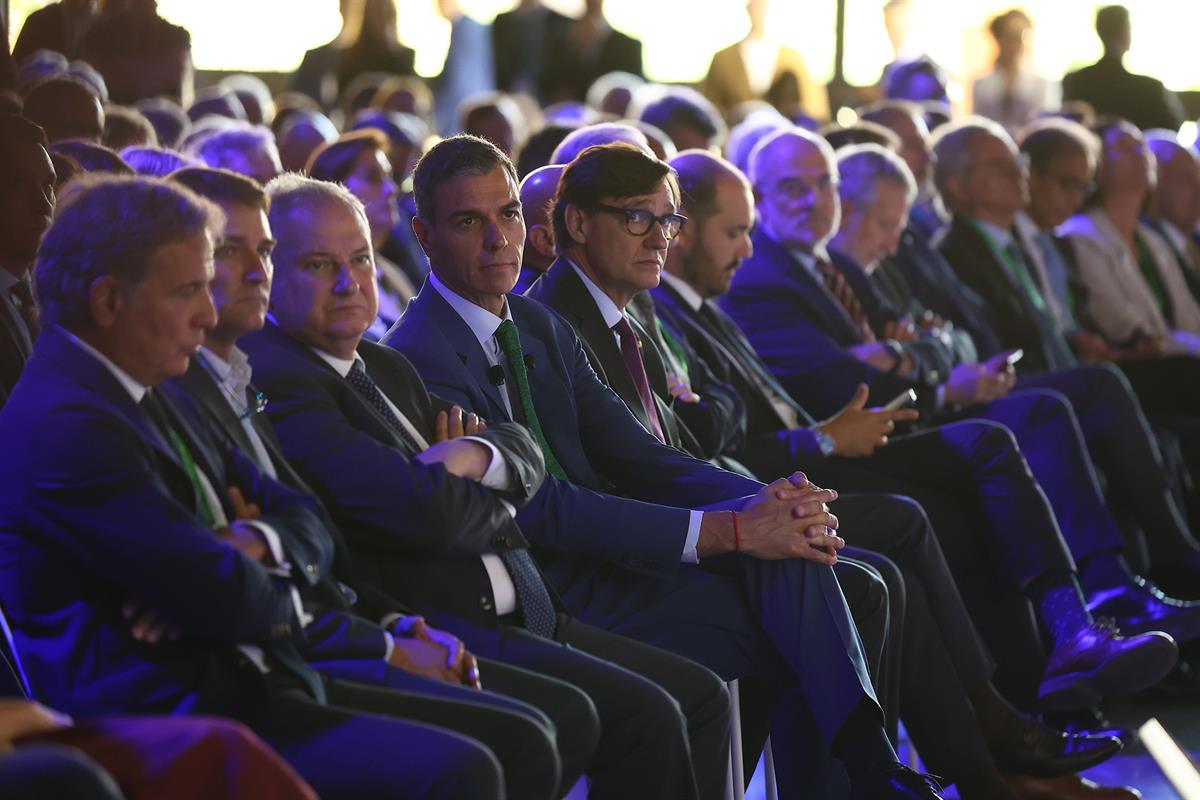 The President of the Government of Spain, Pedro Sánchez, together with the Minister for Industry and Tourism, Jordi Hereu, and the President of the Generalitat of Catalonia, Salvador Illa, at the closing of the 41st Annual Meeting of the Cercle d'Economia | Pool Moncloa / Fernando Calvo
Other key factors for progress, as outlined by the president, include continuing to stimulate domestic demand, given that real disposable household income has grown by 8.3% since the end of the pandemic-more than double that of France, triple that of Italy and four times that of Germany. "Pay your workers well, it's good for them, it's good for you and your business, it's good for everyone," he reiterated to the business leaders present. He also referred to fiscal solvency, given the reduction in the deficit and public debt.
"We are implementing a formula that truly believes in the talent of our workers, in the potential of our companies, that is committed to innovation, training, clean energy, open trade and the industries of the future. One that is not afraid to compete with large corporations and that has no qualms about sharing with small and medium-sized economies around the world, a formula in which the focus is not a city or a territory, but a concept: shared prosperity", he stated. This formula, he argued, "is proving successful, and it is our duty to maintain it to complete this change of model and reap the enormous social and economic benefits it will bring if we persevere in this direction of stability, agreements, trust and ambition". "That is our promise and our plan," he concluded.
Non official translation