Council of Ministers
The Government of Spain maintains its economic growth forecast at 2.2%, despite the war in Iran
Council of Ministers - 2026.4.28
Moncloa Palace, Madrid
 The Ministers for Finance, Arcadi España, for Economy, Trade and Business, Carlos Cuerpo, for Inclusion, Social Security and Migration, Elma Saiz, and for Labor and Social Economy, Yolanda Díaz, at the press conference after the Council of Ministers (Pool Moncloa/Borja Puig de la Bellacasa)






The Council of Ministers has agreed to send the Annual Progress Report for 2026 to the European Commission on 30 April, in compliance with the new fiscal rules framework.
The document, presented by the First Vice-President of the Government of Spain and Minister for Economy, Trade and Business, Carlos Cuerpo, reflects the complex situation facing the Spanish economy as a result of the energy crisis triggered by the war in Iran.
During his presentation, Carlos Cuerpo argued that the Spanish economy is better prepared than on previous occasions in the energy, economic and budgetary spheres to deal with this situation. Moreover, Spain continues to meet its commitments to Europe, consolidating its public finances, steadily reducing the deficit and debt, and adhering to the expenditure rule.
Greater energy sovereignty
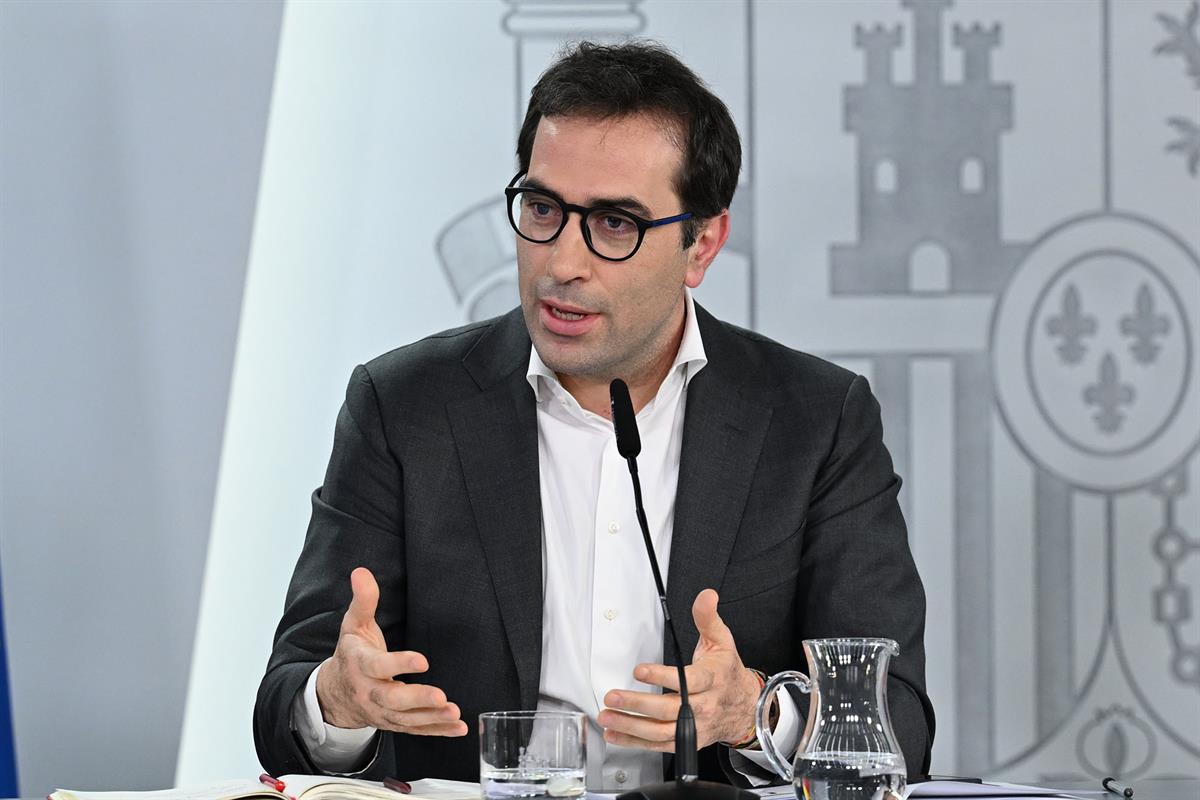 The First Vice-President of the Government of Spain and Minister for Economy, Trade and Business, Carlos Cuerpo, at the press conference after the Council of Ministers | Pool Moncloa/Borja Puig de la Bellacasa
The first vice-president pointed out that since the beginning of the conflict in Iran, wholesale electricity prices have risen less than in other countries: "We are the third country where these prices have risen the least, on a par with Finland and close behind Sweden".
The additional element of energy sovereignty provided by the current energy mix in Spain and the strong presence of renewables have contributed to this, according to the minister. Moreover, international companies want to continue investing in our country, as evidenced yesterday at the second edition of Invest in Spain.
Carlos Cuerpo also pointed out that the recovery of the Spanish economy is outperforming that of the Eurozone and its major economies, both in terms of Gross Domestic Product (GDP) growth and job creation: "Spain's growth was more than double the eurozone average; and we created 40% of the jobs in the eurozone, despite accounting for just 10% of the single currency's total economic output."
In this context, the Minister for Economy recalled that the Labour Force Survey for the first quarter of 2026 shows that, in seasonally adjusted terms, the rate of job creation remains at half a million jobs every 12 months, and that there are more than 22.5 million people in employment. This means 19 million employees, more than 16.2 million of whom are on a permanent contract.
Cuerpo also advanced that, for the first time in history, around 22,060,000 total workers (not seasonally adjusted) will be contributing to the Social Security system by the end of April. "We are managing to incorporate more people effectively into an increasingly dynamic labour market and in higher value-added sectors," he emphasised.
Budgetary improvements: deficit and debt reduction
The vice-president indicated that the Government expects the public deficit to close at around 1.6% in 2026, after adjusting for the so-called "one-offs", i.e., specific expenses linked to a particular event, such as, for example, the DANA. He also stressed that the primary balance - the difference between revenues and expenditures, excluding interest payments - is in balance or shows a balance surplus, which will help to reduce public debt in the coming years.
To this effect, Cuerpo forecast that by the end of 2026, the public debt-to-GDP ratio will stand at 99.3%, thereby bringing forward by one year the target set for the end of the parliamentary term to bring it below 100%.
According to the vice-president, this economic momentum, together with a responsible fiscal policy will allow Spain to comply with European fiscal rules.
Economic growth continues amid uncertainty
In his speech, the vice-president stated that in the current climate of enormous uncertainty, it is difficult to make forecasts for the coming months. He said that, in fact, leading analysts are not making forecasts, but rather presenting scenarios associated with the duration of the war in Iran. As indicated by Carlos Cuerpo, the impact of the war could be between one and eight tenths of a percentage point on GDP.
Against this backdrop, the Minister for Economy announced that the Government is maintaining its growth forecasts in real terms at 2.2% of GDP, as published in November 2025: "They remain unchanged, pending an update in the coming weeks, as we gain greater certainty about how the war is unfolding."
In his opinion, these forecasts remain within "a prudent range" and in line with those being made by different analysts, both public and private.
The Annual Progress Report does include an automatic upward adjustment for inflation, via the GDP deflator, of one percentage point, bringing it from 2.1% to 3.1%.
Fiscal and financial support to victims
The Council of Ministers has approved a Royal Decree-law which eliminates the tax burden on certain forms of aid and compensation, improves various benefits for the victims of the Adamuz and Gelida accidents, and incorporates tax measures for the self-employed, companies, autonomous communities and local councils.
The Minister for Finance, Arcadi España, argued that victims should always be at the centre of any public policy, without any partisan calculations. "Fiscal policy cannot be detached from people, especially when we are facing some kind of disaster," España said.
Exemption from compensation for victims of abuse in the Church
 The Minister for Finance, Arcadi España, at the press conference after the Council of Ministers | Pool Moncloa/Borja Puig de la Bellacasa
The text stipulates that compensation for victims of sexual abuse within the Catholic Church will be exempt from income tax. These compensations are in accordance with the agreement signed by the Ministry of the Presidency, Justice and Parliamentary Relations, the Ombudsman, the Episcopal Conference and the Spanish Conference of Religious to establish a system of reparation for the victims of these abuses.
The Minister for Finance pointed out that although "no amount of money can heal the deep wounds caused by this tragedy", the agreement is an achievement for the victims' associations, the Government, the Holy See and other ecclesiastical institutions. "If we support and stand by the victims, we are making our country a better place, and the tax system cannot remain indifferent to this issue," he said.
Better benefits for Adamuz and Gelida accident victims
Furthermore, the Royal Decree-law improves the benefits payable in respect of the rail accidents in Adamuz and Gelida, treating these incidents in the same way as workplace accidents. This change will increase the benefits received by victims, including those for temporary incapacity as well as pensions for permanent incapacity, widowhood and orphanhood.
Funding to address the damage caused by the DANA
The text also strengthens the measures to mitigate the damage caused by the 2024 DANA. Arcadi España explained that the Government had established a mechanism to provide the Valencia Regional Government with the necessary "financial muscle" to cover these extraordinary expenses, which required legal authorisation. To this effect, in 2024 and 2025, the Government of Spain made over €3.06 billion available to the Valencia Regional Government, which used €1.6 billion The Regional Government's request for the year 2026 amounts to €1.3 billion, but the legal authorisation for the contribution was included in another Royal Decree-law that was rejected by the Lower House of Parliament. The Minister for Finance has asked the opposition to support the new bill, which must be passed within a month at the latest.
Arcadi España also highlighted the Government's financial support for the local councils affected by the DANA, to which €1.745 billion has already been transferred. The Ministry of Finance is now acting on another request from these mayors' offices: to relax the fiscal rules so that expenditures arising from the DANA are not counted for compliance purposes.
In total, the reconstruction measures adopted in 2024 and 2025 amounted to just short of €9.23 billion, of which almost 80% was funded by the central government. "The Government of Spain has taken direct action, has supported the Valencia Regional Government and the local councils, and has led the social, economic and financial response," said España.
Excluding donations for the DANA and aid for the fires
Last, the Royal Decree-law sets out a number of tax exemptions. Among them, the Minister for Finance highlighted that donations made by non-profit organisations such as Caritas and the Red Cross to people affected by the DANA are exempt from taxation. These organisations, he added, complement and extend the work of public authorities, "and it was only fair that they should be treated in the same way as other types of aid".
Another exemption applies to the financial assistance received by victims of forest fires such as those that occurred last summer. "When a disaster or a tragic event has occurred, the Government will first and foremost stand by the victims, as well as all the authorities, regardless of their political colour, in the recovery, reconstruction and, when possible, repair of the damage," he concluded.
Comprehensive reform of occupational health and risk prevention
 The Second Vice-President and Minister for Labour and Social Economy, Yolanda Díaz, at the press conference after the Council of Ministers | Pool Moncloa/Borja Puig de la Bellacasa
The Council of Ministers has discussed the reform of the Occupational Risk Prevention Law, with a view to modernising this legislation, which recently celebrated its thirtieth anniversary. The Second Vice-President and Minister for Labour and Social Economy, Yolanda Díaz, pointed out that this law was revolutionary because it introduced the concept of prevention in Spain, but that it needs to be amended to bring it into line with today's reality and to continue expanding workers' rights.
The vice-president recalled that in 2025, 735 people died in accidents at work. "We have reduced these accidents by 40%, but it is one of the main problems we have in Spain today," she said. Yolanda Díaz also pointed out that temporary sick leave due to emotional symptoms has risen by 500%. "This is what this law is all about, that no one gets sick and, of course, that no one dies in the workplace," she stressed.
The second vice-president stated that the draft bill is the outcome of over two years of social dialogue, and thanked the Ministry of Labour, employers' organisations, trade unions and the National Institute for Health and Safety at Work for their contributions.
Gender perspective, digitalisation, age and mental health
A first "radical change" highlighted by the vice-president is that the previous law was designed for a "male-dominated" workplace, while the new law redresses this inequality and takes into account whether the worker is a man or a woman in the monitoring of occupational health and assessing workplaces.
Second, the reform addresses technological advances, e.g., in health monitoring in digital environments and the effects of always-on connectivity.
The text of the draft bill also obliges companies to adjust prevention to the age of the worker. "It's common sense: it is not the same being a cleaner at 25 as at 60, nor is it the same for someone to be a draughtsman at 25 as at 50," said Díaz.
The regulation also incorporates risks related to climate change and focuses on psychosocial risks, musculoskeletal disorders and mental health. The Minister for Labour and Social Economy emphasised that the forthcoming legislation will make it easier to take steps to prevent workers from falling ill, rather than blaming employees for absenteeism.
Incorporation of the self-employed and changes in preventive services
Yolanda Díaz explained that the regulation will apply to all workers, that is to say, employees, public sector workers and, for the first time, the self-employed and self-employed workers who work in coordination with others. The vice-president recalled that the accident rate among the self-employed has risen by 71.4%.
The draft bill also amends the Law on Infringements and Penalties in the Social Order to prevent "early payment", i.e., the offender reducing the amount of the penalty by 40% if they pay it in advance.
The change also extends to the regulations governing prevention services: the text advocates for these services to be in-house, professionalised and specialised, "making occupational health and risk prevention a core component of the world of work", stated Yolanda Díaz.
Safety at work, a human right
The Minister for Labour and Social Economy informed that today, World Day for Safety and Health at Work, Convention 191 of the International Labour Organisation (ILO) enters into force in Spain. The text declares occupational health and risk prevention to be a human right, said Díaz, who recalled that Spain is the country that in the shortest time - just six years - has registered the most ILO conventions.
Proposal for the territorial distribution of the Joint Responsibility Plan
Among other agreements approved by the Cabinet, the Minister for Inclusion, Social Security and Migration and Government Spokesperson, Elma Saiz, highlighted the approval of the proposal to distribute €142.5 million among the Autonomous Communities and the cities of Ceuta and Melilla for the implementation of the Joint Responsibility Plan, which will be submitted to the Sectorial Conference on Equality. This initiative aims to support work-life balance and help families manage their time, based on a shared responsibility between women and men.
Elma Saiz emphasised that the plan seeks to "consolidate care as a right. To this end, it finances professionalised care services, awareness-raising actions, training in co-responsibility and gender-equitable masculinity, as well as studies and mechanisms for monitoring and evaluating the plan itself".
Current affairs: Spain exceeds 25 million people in the labour force
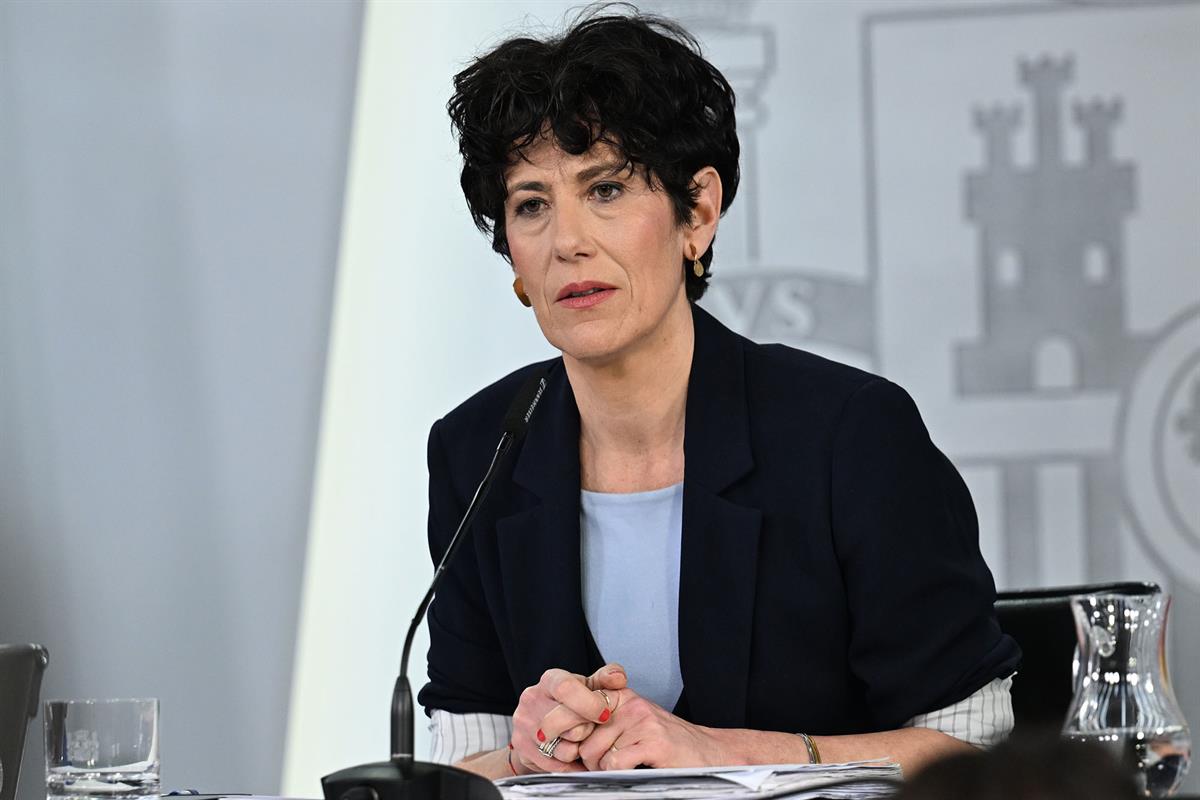 The Minister for Inclusion, Social Security and Migration and Government Spokesperson, Elma Saiz, at the press conference after the Council of Ministers | Pool Moncloa/Borja Puig de la Bellacasa
During her speech, Elma Saiz also referred to the data from the Labour Force Survey (EPA), corresponding to the first quarter of 2026, published by the National Statistics Institute (INE).
Elma Saiz pointed out that "Spain has reached a historic milestone" because "for the first time we exceeded 25 million people in the labour force in a country of almost 50 million people". However, the minister said that "there are also challenges" for the government. "We are not going to rest on our laurels, but in the current complex and unstable context, we cannot deny that Spain is managing to create more jobs and, moreover, better quality jobs", said Elma Saiz.
For her part, the second vice-president emphasised that, of the 19.1 million people in employment, 16.4 million have a permanent contract. She also stressed that temporary employment in the private sector is still falling, and now stands at 11.9%, whereas before the labour reform this percentage ranged between 35% and 26%.
Investment by international companies in Spain
The Minister for Inclusion, Social Security and Migration also recalled the holding of the second edition of the International 'Invest in Spain Summit'. The meeting brought together representatives of 75 international companies from 25 countries in Madrid and was inaugurated by the President of the Government, Pedro Sánchez. "Our country is establishing itself as a true international hub, with more than 22,000 foreign companies already operating in Spain and generating more than two million jobs," said Elma Saiz.
Non official translation