Pedro Sánchez: "This Government is working effectively and is driving Spain forward, putting it in a much better position than the one we found in 2018"
President's News - 2026.7.28
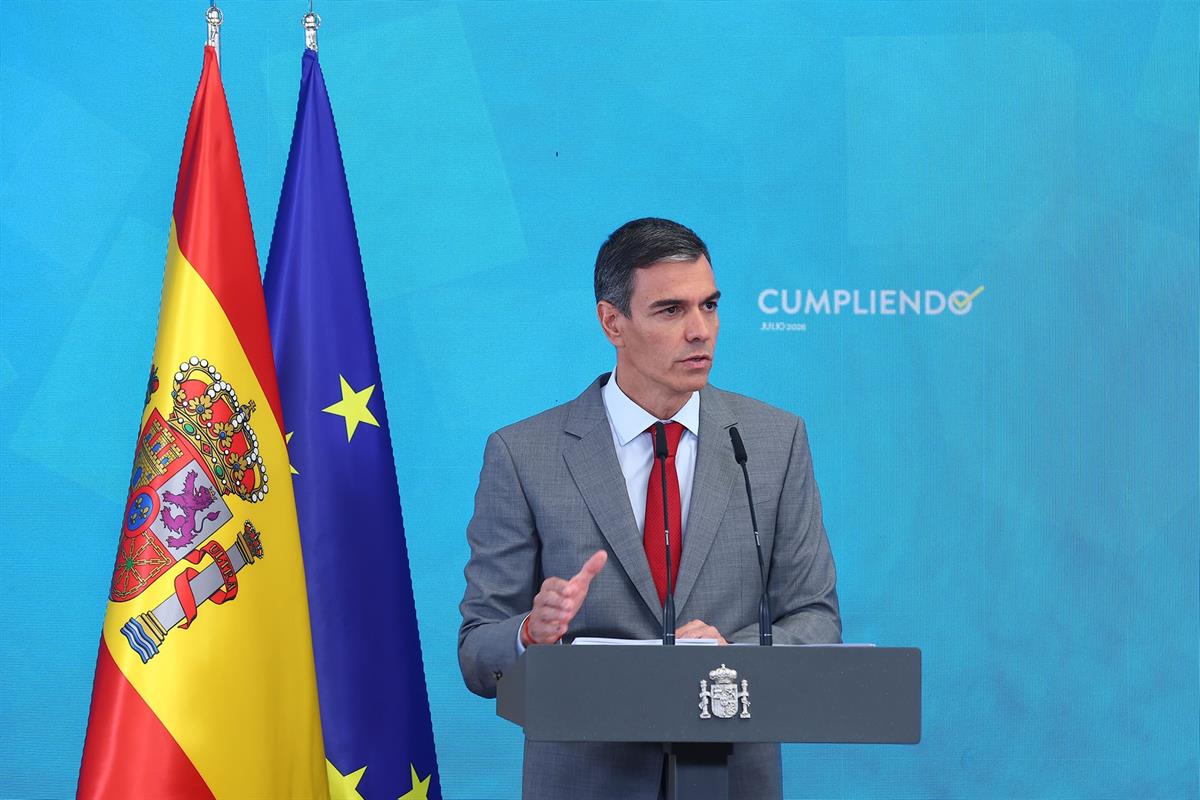
The President of the Government of Spain, Pedro Sánchez, presents the political year assessment and the periodic accountability report "Cumpliendo" | Pool Moncloa/ Fernando Calvo. 2026.7.28
-
 The President of the Government of Spain, Pedro Sánchez, arrives at the presentation of...
-
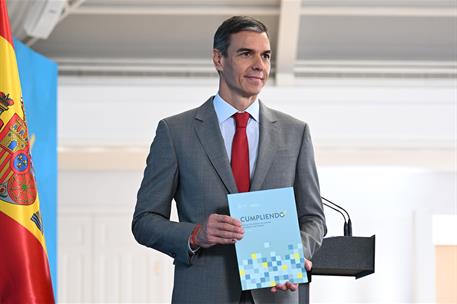 The President of the Government of Spain, Pedro Sánchez, displays the document "Complying"
-
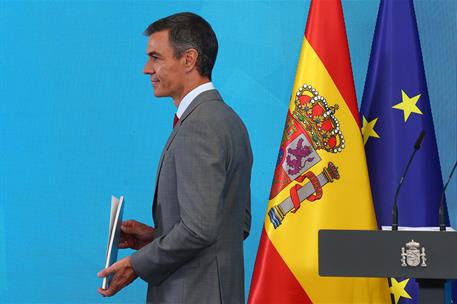 The President of the Government of Spain, Pedro Sánchez, during the presentation of the...
-
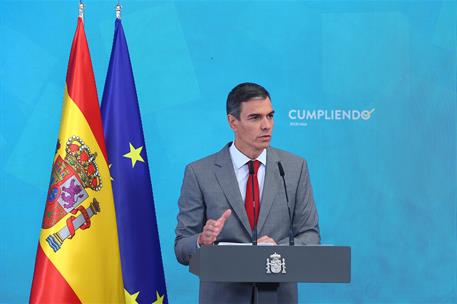 The President of the Government of Spain, Pedro Sánchez, presents the political year...








Moncloa Palace, Madrid
The head of the Executive, Pedro Sánchez, has emphasised that the reality is that this Government "is working" and is "moving Spain forwards to a much better position than the one we found in 2018". A Government that "has turned every challenge into an opportunity to transform the country" and which, when difficulties arise, "stands by the people" - something that "was not always the case".
At a press conference at Moncloa Palace to review the political year, during which he presented the regular accountability report "Cumpliendo", Pedro Sánchez emphasised that "in this parliamentary session alone, we have secured the passage of 26 pieces of legislation, more than a third of all those passed so far this parliamentary term". However, "there is still a lot of work to be done". "There is one year left to bring this parliamentary term to a close, to complete reforms, to continue making progress and to demonstrate that Spain is charting its own course and does not have to choose between growth and protection, between modernisation and maintaining social cohesion, or between being strong at home and respected abroad," he explained.
Convention for a State Pact on the Climate Emergency
The head of the Executive began his address by sending a message of support to those who have had to leave their homes or are currently confined as a result of the eight major forest fires still burning in Spain, as well as to those who have lost loved ones in other fires. He also wished to express his gratitude to the public servants who "fight the fires and protect the population under extraordinarily difficult conditions".
The president warned that we must not let our guard down, because "the coming days will be particularly challenging", given the gradual rise in temperatures, which will hamper fire-fighting efforts and raise the risk of fires to extreme levels across large parts of the country.
In light of this situation, he pledged that the Government of Spain, in coordination with other public institutions, "will continue to mobilise all necessary resources, for as long as it takes, until the last flame is extinguished". He announced that the Council of Ministers has declared the areas affected by the fires to be zones seriously affected by a civil protection emergency. With this, all the aid measures designed to alleviate personal and material damage are beginning to be rolled out, and the way is being paved for additional support, such as tax relief, exemptions from social security contributions and grants to repair infrastructure, amongst other measures that the Executive will be implementing.
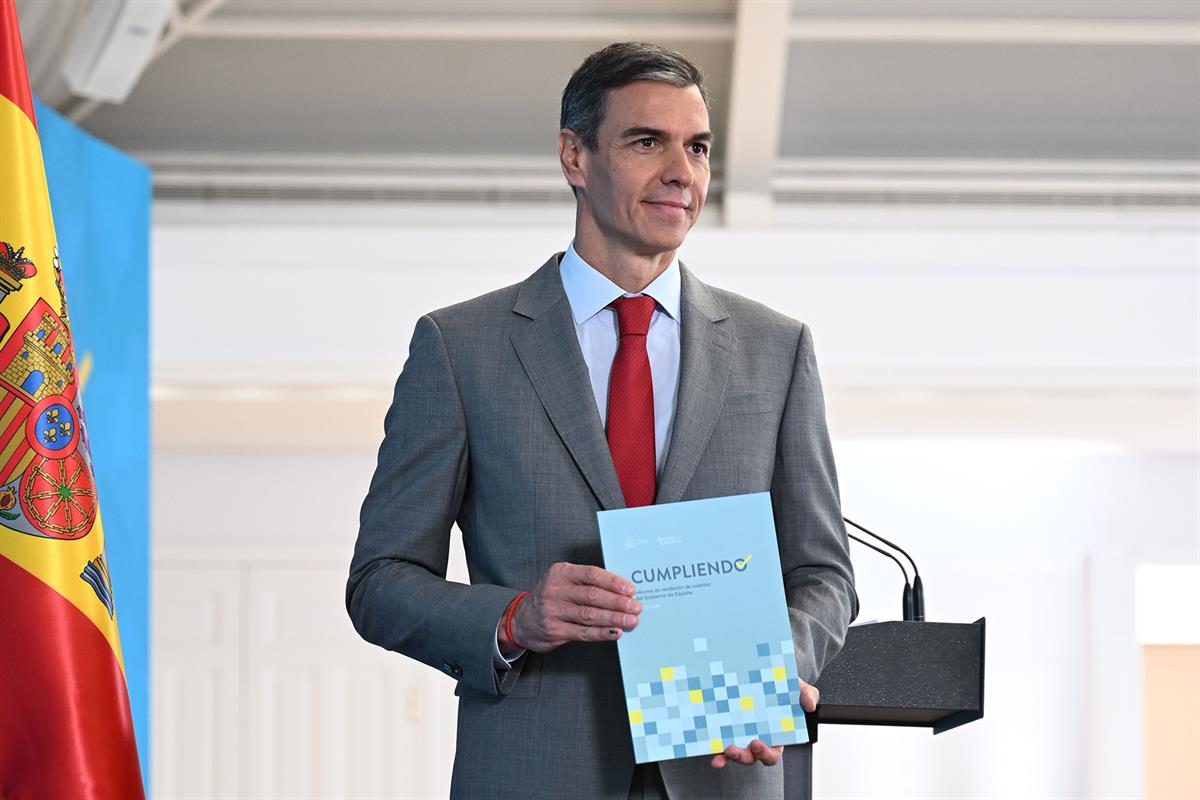 The President of the Government of Spain, Pedro Sánchez, displays the document "Complying" | Pool Moncloa/ Borja Puig de la Bellacasa
The president emphasised the need for "all public authorities, all professionals and society as a whole to act together to combat the fire". That is why he has once again called - "with greater conviction and stronger arguments than ever" - on all political actors and regional, provincial and local governments to reach "the national agreement that Spain needs most, namely the State Pact on the climate emergency". "It is imperative; it is not a choice but an obligation," he emphasised. "We must stand united in our response, as we are doing now, but also in our efforts to prevent further damage and rebuild the affected areas." In his view, "climate denial is the worst possible fuel for the climate emergency." Denying reality and the warnings from the scientific community does not prepare us. "On the contrary, it makes us more vulnerable and insecure."
The head of the Executive began his overview of his Government's five priority areas by referring, specifically, to what the Government has done in the field of climate change adaptation and mitigation. He insisted that "the reality cannot be denied" and pointed out that, so far this year, more than 170,000 hectares has already been burnt - six times the number of hectares burnt during the same period last year - and that there have been more than a dozen fatalities. "What else needs to happen for us all to get behind the state pact on the climate emergency that we have put forward?" he asked. For this Government, he emphasised, "the fight against the climate emergency is not only a priority, but a commitment to our country's future." "And we will never skimp on resources in that regard."
At this point, he highlighted the "courageous decisions" that have made Spain better prepared to withstand energy crises, such as the measures to mitigate the effects of the war in Iran, which have resulted in "a saving of 18 cents per litre on petrol and 10 cents on diesel, providing relief for families and professionals", or the reduction in VAT on electricity from 21% to 10%, which has saved families 8 euros a month on their electricity bills and up to 20 euros in the case of large households or businesses.
"The question is: Would others have responded in the same way? "Given what they did when they were in power, the answer is clear: no," he declared. "Because those who yesterday put the brakes on the roll-out of renewable energy through the 'sun tax' are the very same people who today are colluding with the far right - wherever it is in power - to halt the expansion of renewables," he explained.
We are the fastest-growing major economy in the EU
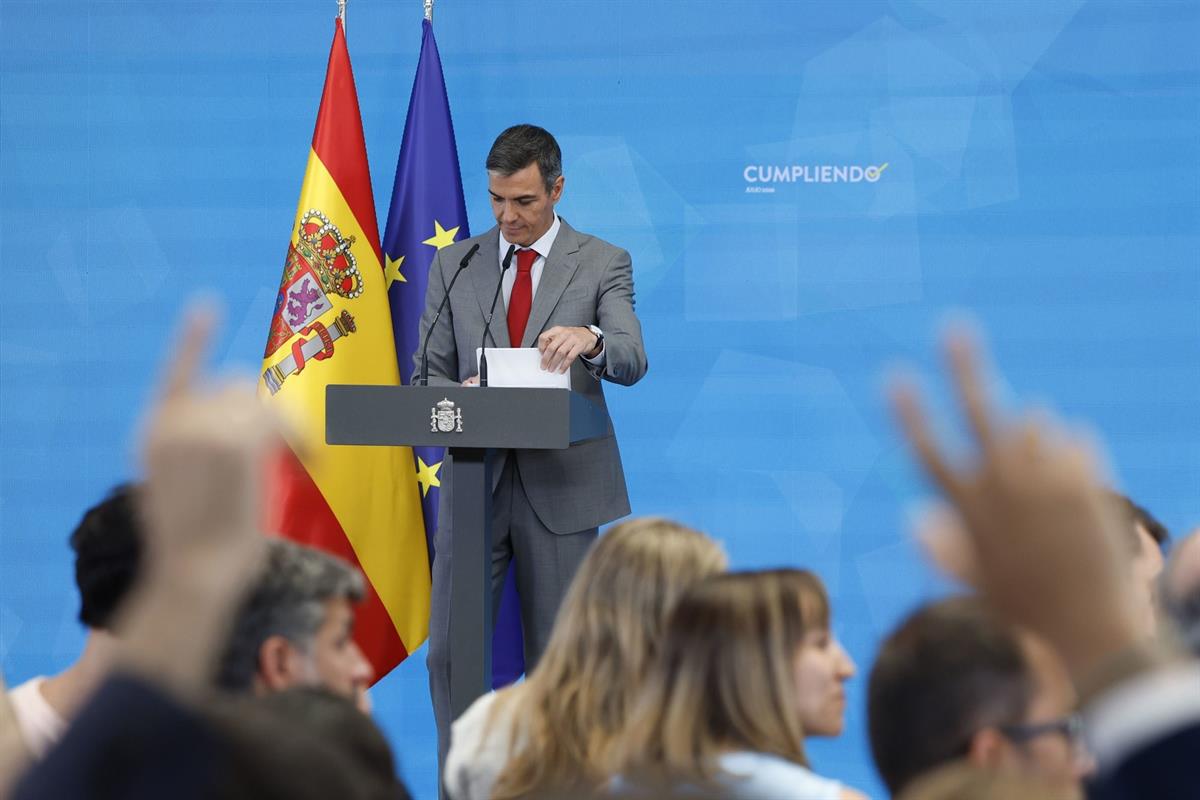 The President of the Government of Spain, Pedro Sánchez, answers questions from the media after the presentation of the political year assessment | EFE
On the economic front, the president pointed out that, despite a challenging context, "for almost three years we have been the fastest-growing major economy in the European Union" and we will end 2026 having grown five times faster than Italy, four times faster than Germany and three times faster than France. Growth that enables the creation of "more and better jobs". In fact, Spain today accounts for nearly half of all the jobs created in the EU, reaching a record high this half-year: 22.5 million national insurance contributors. That is 3.4 million more than when we took office, with 34% more jobs for young people than in 2018. Furthermore, we are talking about quality and decent work, with an 11-point reduction in temporary employment and a 58% increase in permanent jobs.
He also referred to the Labour Force Survey (LFS) for the second half of 2026, "which confirms the acceleration in job creation" in our country. "This this, there have been six consecutive LFSes in which employment has grown by more than half a million jobs a year. "And once again, the unemployment rate is below 10 per cent - the lowest level in the last 18 years." Sánchez has stated that, in "this national success", the NextGenerationEU funds "have been a key driver", with 100 billion euros having been disbursed.
Increase in welfare state spending
With regard to strengthening our welfare state, Pedro Sánchez emphasised that "over the past eight years, we have increased spending on the welfare state and social benefits by a further 145 billion euros for healthcare, education and public services".
In health, particular mention was made of the creation of almost 500 new places on specialist healthcare training programmes, and the increase from 7 to 23 in the number of neonatal screening tests covered by the National Health Service. A He also announced that the Council of Ministers has approved the decision to locate the new headquarters of the National Health Agency in the city of Zaragoza. With regard to education, he highlighted the record-breaking 2.6 billion euros in grants, which will benefit around one million students in the 2026-27 academic year, and the creation of more than 400,000 new vocational training places, amongst other measures.
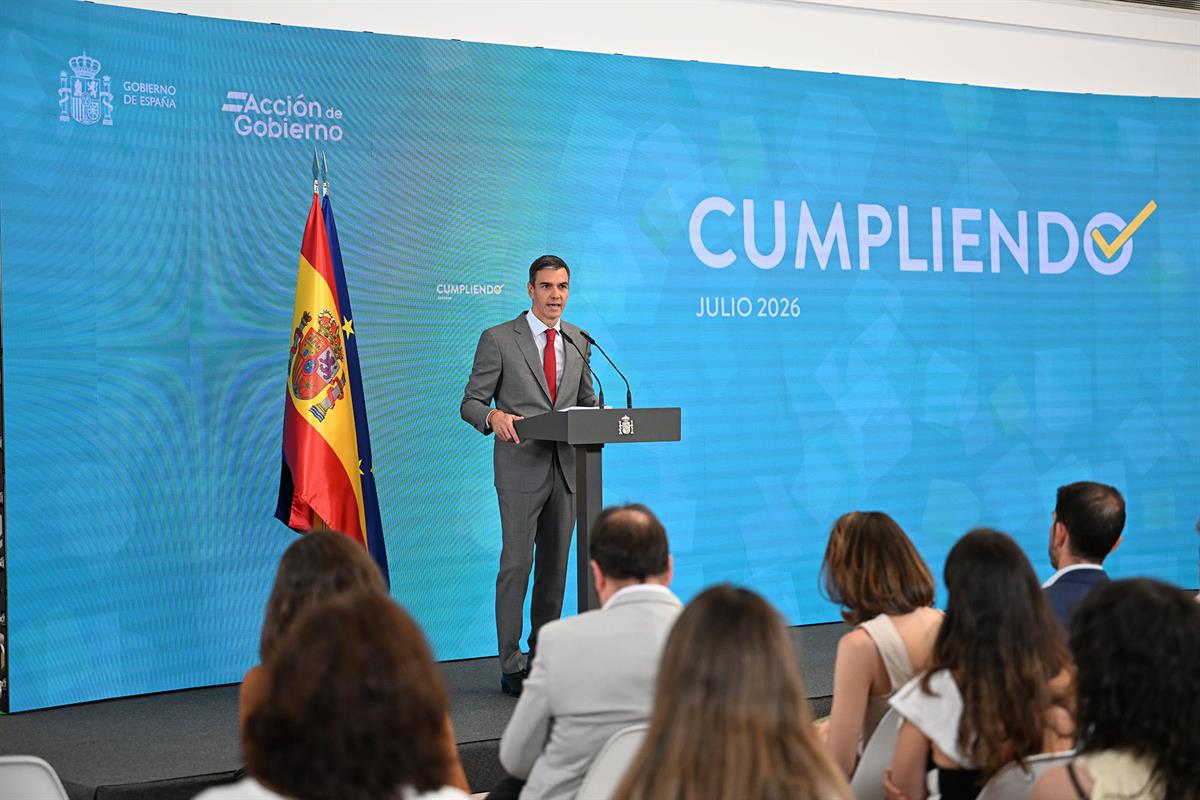 The President of the Government of Spain, Pedro Sánchez, during the presentation of the political year assessment and the periodic accountability report "Delivering" | Pool Moncloa/Borja Puig de la Bellacasa
On the subject of care, he wished to emphasise that the progress made over the last six months is unprecedented, as "we have overhauled the system, with an additional investment of 6.2 billion euros, which will enable us to increase benefits from 290 to 660 euros a month for those with a Level III dependency and from 130 to 260 euros for those with Level II".
"There can be no well-being without fair access to decent housing," he said, and pledged that the Government "will continue to promote the construction of social housing", although there is still much to be done. He recalled that during the last parliamentary term we reached a milestone with the passing of the first Housing Act of our democracy, a piece of legislation that works wherever it is implemented, bringing down rents without affecting supply, as is the case in Barcelona and A Coruña. "I hope other major cities such as Madrid or Málaga will follow suit, but that depends on certain regional governments putting their partisan interests aside and finally putting their people first. "That really is a national priority." "Housing should be a right for everyone, not a business for the few. "And, of course, it cannot be held hostage by partisan strategies," he warned.
Defending our democracy and greater regional cooperation
With regard to the fourth priority of this parliamentary term - defending our democracy and moving towards greater territorial cohesion - the president of the Government of Spain noted that, over the past six months, we have set in motion, through three bills, virtually all the measures we announced a year ago in the State Plan to Combat Corruption. Just this morning, the Council of Ministers approved the draft Organic Law on Public Integrity, a law that will establish the new Independent Agency for Public Integrity, and which will now go through the parliamentary process. "I hope that all the groups will show the vision and willingness to engage in dialogue that this moment demands, so that this project can go ahead. "The government will have it," he said.
He also highlighted that the Executive has managed to "increase the number of agreements with other regions by almost 70%". In the case of Catalonia, he highlighted the "institutional normality between the State and Catalonia", as well as the Court of Justice of the European Union's endorsement of the amnesty law, which "has confirmed that we are acting in accordance with the law to promote reconciliation". "It was a courageous but necessary decision, which allows us to look to the future together once again," he said
A foreign policy based on consistency and common sense
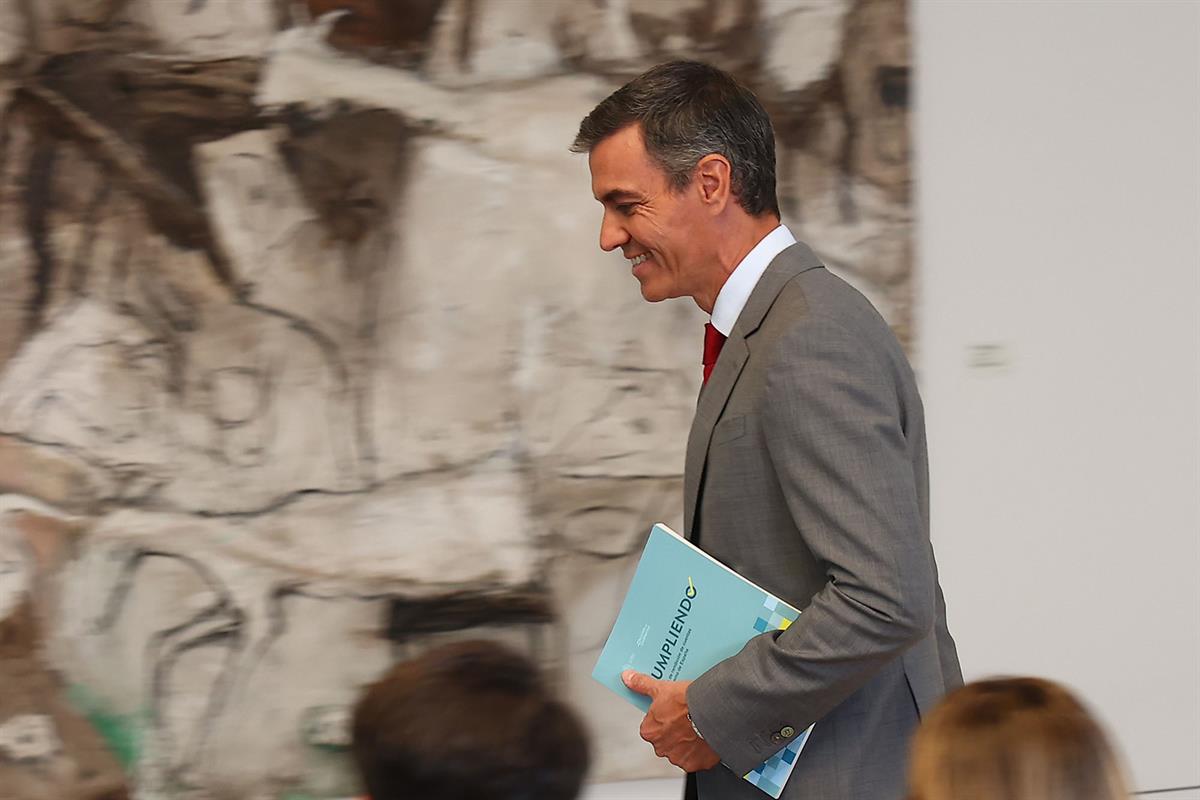 The President of the Government of Spain, Pedro Sánchez, arrives at the presentation of the political year assessment and the periodic accountability report | Pool Moncloa/ Fernando Calvo
Finally, he referred to Spain's "ambitious" foreign policy, based on "consistency and common sense", as we have demonstrated in the wars in Ukraine, Gaza and Iran, and in bringing about historic agreements such as that on Gibraltar. In his view, in a context where the logic of withdrawal prevails - closing borders, curtailing rights, turning security into an endless arms race, imposing tariffs, undermining international rules - "Spain is demonstrating that we can protect ourselves without shutting ourselves off, maintain order without dehumanising, defend ourselves without compromising the welfare state, and be competitive through collaboration and by extending a helping hand to others".
"We are clear on this: we do not want war; we want peace. We do not want tariffs; we want rules-based international trade. We do not want genocide; we do want human rights. "We do not want the law of the jungle; we want a strengthened and reformed multilateralism," added Pedro Sánchez, who also spoke of his solidarity with the people of Venezuela.
After outlining these key areas of his Government's work, Pedro Sánchez concluded by pointing out that "behind each of these policies and figures there are people whose lives are a little better. There are jobs that offer greater stability and better prospects. There are families who feel more secure. There are young people who are finding new opportunities. There are older people who face life with greater confidence and dignity," he said. "That is the true assessment of these years: the tangible changes that make a difference to people's lives."
"There is a lot of work ahead. But after eight years in government, our objectives are very clear. We are the Government of the people. "We are the progressive coalition government, and this is the Government of Spain," he concluded.
Non official translation