Council of Ministers
The Government of Spain is rolling out aid to tackle the fires and has approved special employment protection measures for those affected
Council of Ministers - 2026.7.28
Moncloa Palace, Madrid
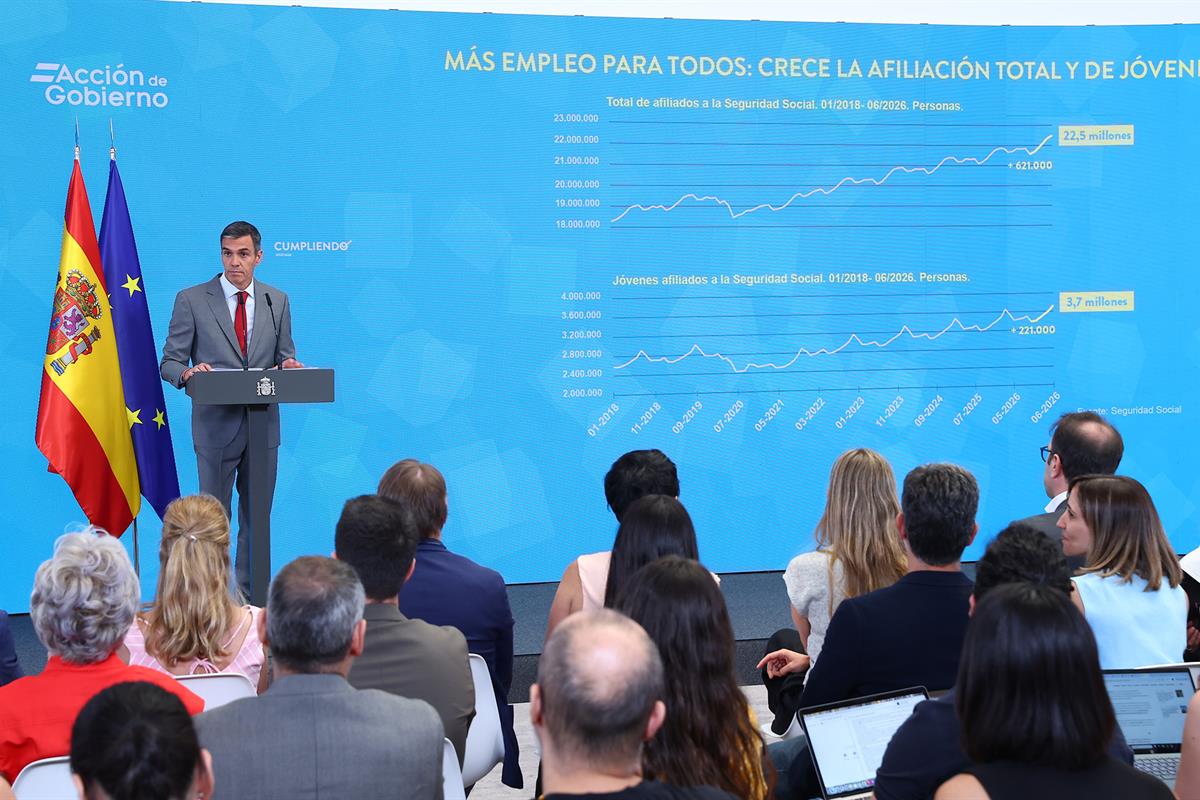 The President of the Government of Spain, Pedro Sánchez, during his appearance to present the political year assessment and explain the agreements of the Council of Ministers (Pool Moncloa / Fernando Calvo)






The Council of Ministers has declared the areas affected by a total of 211 catastrophic events that occurred between 31 March and 27 July 2026 in regions across 14 autonomous communities to be areas affected by a civil protection emergency. In most cases, the emergencies have been caused by forest fires. These include those that have broken out in recent days in the Community of Madrid, in the provinces of Ávila and Toledo, and in the town of Vall d'Uixó (Castellón), where fire-fighting operations are still ongoing. The statement also mentions the fire in Los Gallardos (Almería), in which 14 people died.
During his address, in which he reviewed the political year and outlined the Council's decisions, the President of the Government of Spain, Pedro Sánchez, pointed out that, with this statement, "we are beginning to roll out aid aimed at alleviating personal and material damage". These include measures in the agri-food and industrial sectors, tax, employment and social security benefits, and support for local authorities to repair their infrastructure, "among many other forms of assistance that we will roll out as we carry out a more accurate assessment of the disaster", he added.
The declaration also covers emergencies caused by coastal phenomena, rain and storms, fires at industrial sites and accidents involving the transport of dangerous goods, amongst other incidents.
New aid for workers affected by the fires
Also in relation to the fires, the Council of Ministers has approved a Royal Decree-law setting out extraordinary and urgent labour measures for those affected by forest fires that have led to evacuations, access restrictions, lockdowns or other types of restrictions imposed by the authorities. Eligible workers and businesses may benefit from this protection from 23 July last until the end of the annual high fire risk season in 2026.
The decree-law introduces a new benefit, limited to a maximum of four months, which will not require any minimum contribution period nor will it count towards future benefits. People who are unable to access their usual place of residence or who need to make it habitable, and those who have to provide care for themselves or their family members as a result of the fires, will be eligible to suspend their employment contract and receive this Extraordinary Benefit for Extreme Emergencies.
The extraordinary measures extend to the area of Social Security. Firstly, self-employed workers who cease their activity, either partially or permanently, in the municipalities affected by the forest fires, may apply for the cessation of activity benefit without having to prove force majeure. Secondly, companies with their registered office in the affected municipalities that have implemented a temporary workforce reduction plan (ERTE) due to the fires may benefit from a 100% exemption from their Social Security contributions for the period from August to November 2026.
Organic Law on Public Integrity
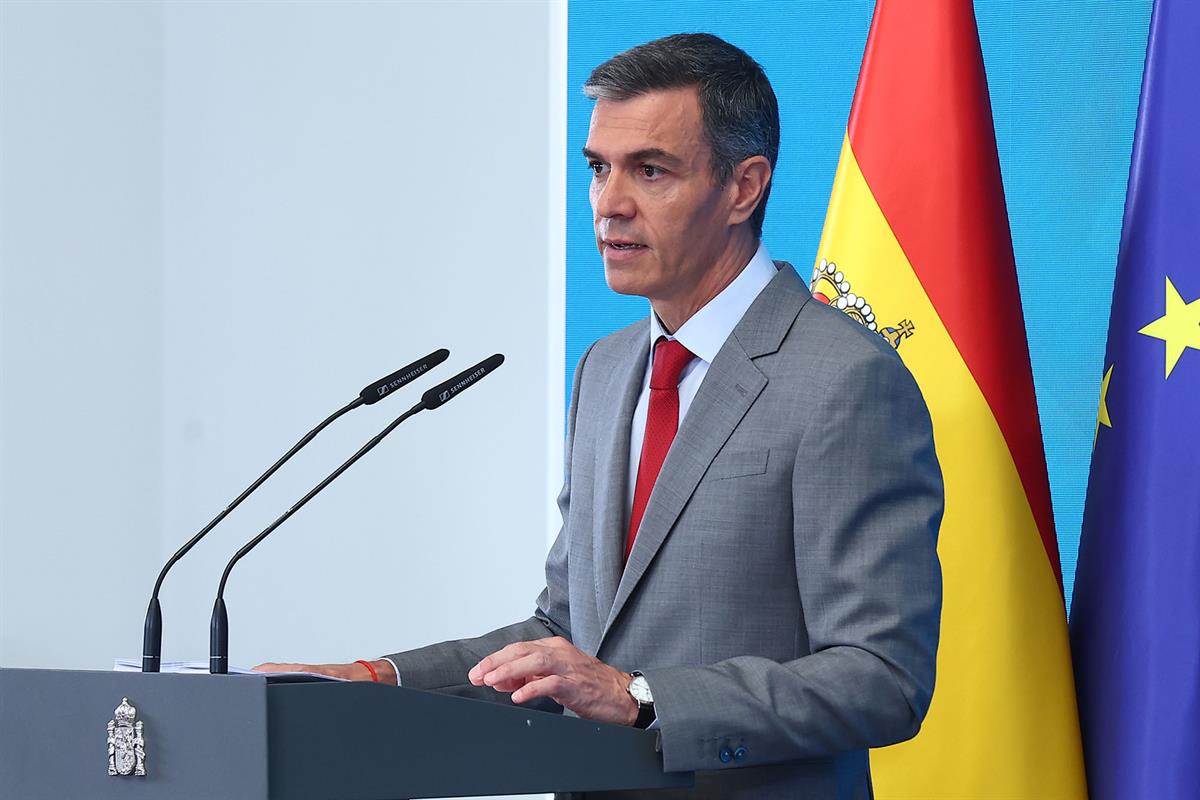 The President of the Government of Spain, Pedro Sánchez, during the presentation of the political year assessment and the periodic accountability report "Delivering" | Pool Moncloa/ Fernando Calvo
The Council of Ministers has approved the submission to Parliament of the Draft Organic Law on Public Integrity, a piece of legislation that forms part of the State Plan to Combat Corruption approved by the Government in 2025 and will help to combat political and economic corruption in the public sector.
The proposed law amends various provisions to tackle corruption at every stage of the cycle. It includes measures to detect corruption, protect whistleblowers, impose tougher penalties and strengthen bans on contracting with the public sector. Furthermore, it promotes a culture of integrity through institutional campaigns and training for public sector employees.
Similarly, the legislation introduces new obligations to improve transparency regarding donations received by parties, prohibits them from being funded through crypto-assets, and makes external audits mandatory.
Furthermore, in the business sector, it is now compulsory to register transfers and encumbrances of company shares in the Commercial Register.
Pedro Sánchez has emphasised that the forthcoming law improves on the draft bill presented on 17 February, by incorporating contributions from state and regional bodies, as well as from civil society. He also pointed out that the OECD had provided advice during its drafting to "put Spain at the forefront of international best practice".
The head of the Executive has also stated that the legislation provides for the creation of the Independent Public Integrity Agency, which, amongst other things, will be responsible for strategy, analysis, investigations and sanctions, the protection of whistleblowers, public procurement, grants, conflicts of interest, training and the promotion of a culture of integrity.
The president has urged the parliamentary groups to "show the vision that the situation demands and a willingness to engage in dialogue so that this project can go ahead".
Zaragoza, the physical head office of the State Public Health Agency
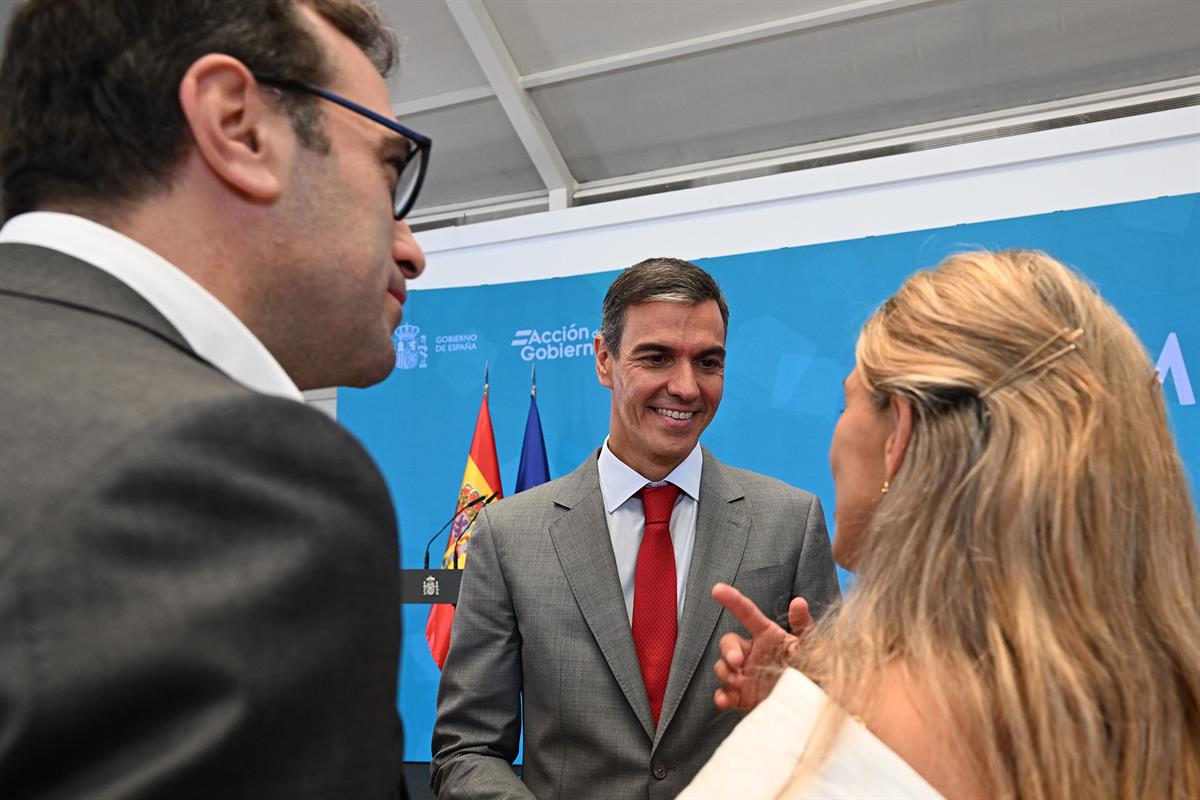 The President of the Government of Spain, Pedro Sánchez, talks with Yolanda Díaz after the presentation of the political year assessment | Pool Moncloa/ Borja Puig de la Bellacasa
The Council of Ministers has approved locating the head office of the State Public Health Agency (AESAP) in the city of Zaragoza.
Zaragoza's bid was rated the highest of the eight submitted, as it was the most comprehensive, enjoyed institutional, political and social consensus, and is set to play a key role in bringing the whole region together.
In this regard, the president of the Government of Spain emphasised that this decision is "a further example of what it means to commit to territorial cohesion in Spain" and benefits both the people of Zaragoza and the country as a whole. "A state public health agency will enable us to have all the resources we lacked during the first, fateful months of the pandemic, so that we can respond much more effectively," he said.
Closing Addendum to the Recovery Plan
The Government has approved the Closing Addendum to the Recovery, Transformation and Resilience Plan to facilitate its final assessment by the European Commission and to optimise the use of available resources before 31 August, the deadline for the implementation of these European funds.
The Addendum refines the wording of 121 milestones and targets and 101 measures to bring greater clarity to the evaluation process, reduce administrative burdens and provide greater legal certainty, without altering the substantive objectives of the reforms and investments.
During his speech, the president of the Government of Spain emphasised that "all levels of the State Administration have more than lived up to expectations in their management of European funds" and that these funds have contributed to the structural transformation of the economy.
"We are one of the two countries that have been most successful in implementing the NextGenerationEU funds. We have just received approval for the sixth tranche, which we are due to receive in the coming weeks. And in total, we will have received around 100 billion euros, earmarked for the self-employed, SMEs, businesses, industries, educational establishments and to improve our country's national care system," said Pedro Sánchez.
Non official translation