Pedro Sánchez advocates "taking action" in the housing sector by "focusing on accessibility", prioritising residential use over tourist use and increasing the supply of affordable housing
President's News - 2026.9.28
Presentation of the report "Future Lives: A Day in 2050" | Pool Moncloa / Jorge Villar - 2026.9.28







DHub Barcelona
The President of the Government of Spain, Pedro Sánchez, has defended the need to "regulate the housing market so that demographic trends do not hinder people's life plans, particularly those of young people". "We must take action in the housing sector and focus, once and for all, on accessibility": prioritising the residential use of housing over its use for tourism - which is one of the levers provided for in the Housing Act - and increasing the supply of affordable housing adapted to new social realities, he noted.
He made this statement in Barcelona, at the close of the event to present the report "Future Lives: A Day in 2050". The report examines how "societies are changing: our families, our relationships, the way we work, look after one another and live together", and how "institutions must be able to change alongside them and anticipate these changes".
"It is an exercise to help us look further ahead. And to ask ourselves a very simple question: if we know that certain things are changing, what can we do today to be better prepared for that future?", the president said. In this regard, Sánchez pointed out that "a responsible government does not merely manage the present. It has a duty to look ahead and anticipate change, to adapt legislation to these social transformations and to ensure that certain laws do not become a snapshot of a world we no longer recognise".
The president emphasised that "Future Lives", coordinated by the National Office for Foresight and Strategy, "identifies the major transformations that will change our daily lives and shape our future life paths". We will therefore see more diverse ways of living together; new ways of caring for one another and of relating to one another will emerge, and we will witness structural transformations, such as increased longevity, digitalisation, artificial intelligence and the climate emergency. Changes that "will turn our daily lives on their head".
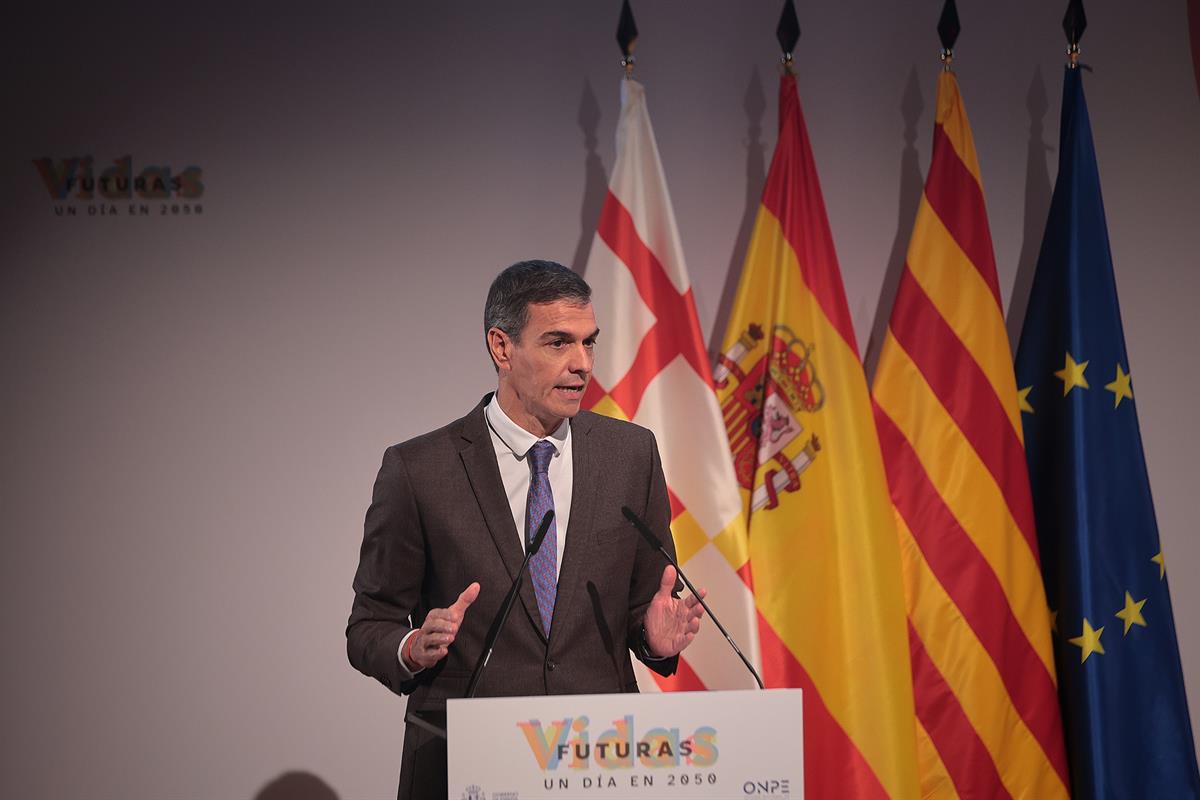 The President of the Government of Spain, Pedro Sánchez, speaks at the closing ceremony of the presentation of the report "Future Lives: A Day in 2050" | Pool Moncloa / Sandra Armada
For this reason, the head of the Executive emphasised the importance of "governing for the people". "Governing in such a way that digitalisation does not widen the gaps between workers, but rather helps to close them". "Governing in such a way that, in an increasingly ageing society, the care we will need is available to everyone and is not in short supply, nor limited to just a few." And regulating the housing market.
In his view, the real challenge we face is not merely "to identify and respond to the changes we are already seeing in our societies, but to anticipate those yet to come". He also warned that "every right that seems self-evident to us today once had someone saying it was too soon or that we were going too far", because "some people - it's always the same ones - are slow to embrace progress". "In the end, everyone benefits, and what was once a battle ends up becoming the everyday life of our sons and daughters. That is the wonderful meaning of the word 'progress', which opens doors even to those who tried to keep them shut," he said.
"That is also what 'Future Lives' is about: opening up possibilities, anticipating them, staying one step ahead. Believing in progress. That is the country we want to leave to those who come after us. A country in which the future does not limit our options for living, but rather broadens them", concluded Sánchez.
Non official translation