Óscar López asserts that "the Spanish economic renaissance owes much to digital transformation"
News - 2026.5.27
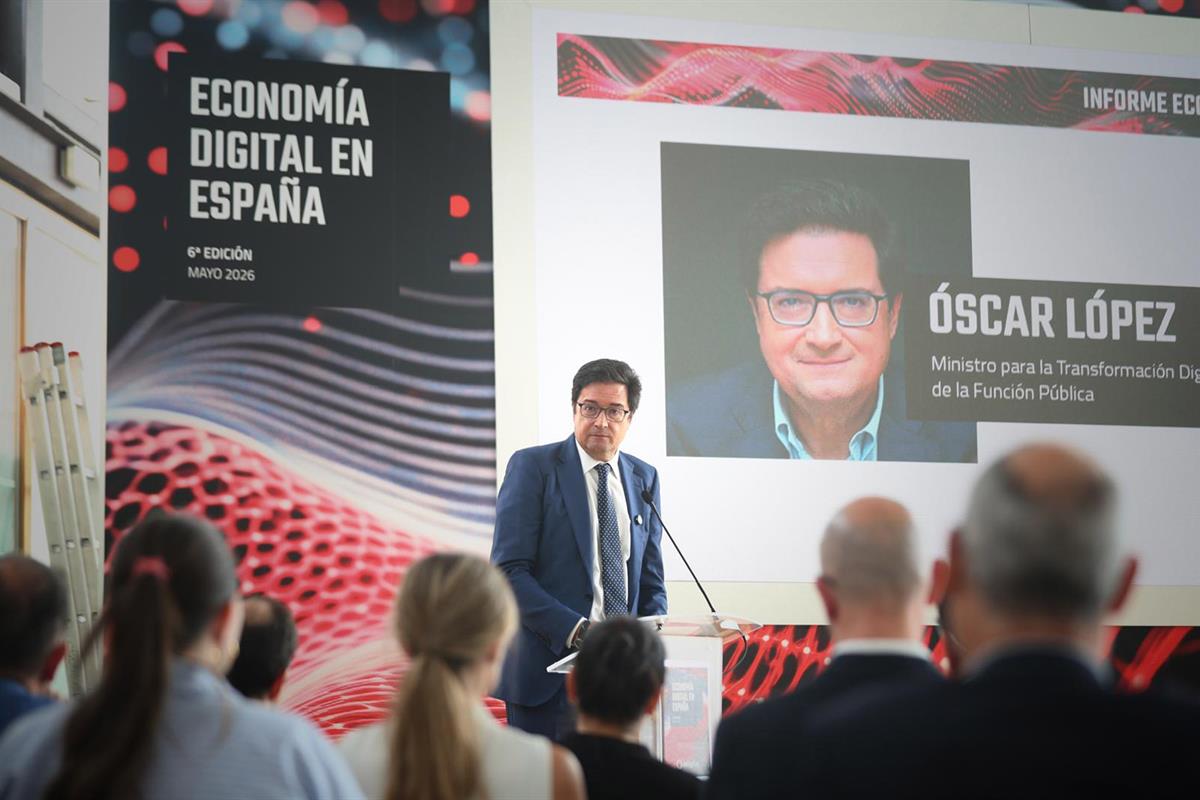 The Minister for Digital Transformation and Civil Service, Óscar López, speaks at the presentation of the sixth edition of the Digital Economy in Spain report





The Minister for Digital Transformation and Civil Service, Óscar López, has spoken at the presentation of the sixth edition of the Digital Economy in Spain report, prepared by ADigital, the Spanish Association of the Digital Economy, which details that the digital economy represented 27% of Spanish GDP in 2025, 1.01% more than in 2024 and 8.3 points more than in 2019, with a total impact of 455,300 million euros, which is 10% more than the 414,000 million recorded the previous year.
According to the authors of the document presented this Wednesday, the growth of the digital economy's weight in GDP is occurring at a faster pace than the economy as a whole and across all sectors, reinforcing the structural role of the digital economy in the transformation of the production model.
This was highlighted by the minister in his address, in which he asserted that "the Spanish economic renaissance owes much to the digital transformation" and emphasised the figure for the total impact of the digital economy, more than €455 billion, which, he pointed out, "is four times the total GDP of Luxembourg". "Spain is the major European economy with the greatest digital capacity," he said, referring to the latest European Digital Capability Index produced by Politico.
ADigital's report breaks down the total impact into direct impact, indirect impact and induced impact. The direct impact measures digitised economic activity within each sector, which reached 13.42% of GDP in 2025, representing a 9.8% increase in absolute terms and 0.52 percentage points higher than in 2024.
The indirect impact measures the effect of digitisation throughout the supply chain, reaching 12.49% of GDP in 2025, 0.19 percentage points higher than in 2024 and 3.39 percentage points higher than in 2019. According to the report, this reflects the "pull factor" of digitisation on other economic sectors.
Finally, the paper analyses the induced impact, i.e. the increase in economic activity linked to the increase in activity generated by the increase in income and consumption of workers in digitised sectors. Of the three components, this saw the largest increase, with a 45% growth in absolute terms, representing 1.10% of GDP in 2025.
"Digital Spain is making headway"
The report indicates that the pace of digitalisation varies across sectors, with retail being one of those in a phase of digital maturity, where one in three euros of sales resulted from a digital process (31%). Other sectors, such as the automotive sector, are still in the process of integration, with a gross value added of 4%, but with an investment of more than 1.3 billion euros in their modernisation between 2023 and 2025.
On the other hand, the document indicates that the fintech and insurtech ecosystem (finance and insurance companies that use digital innovation to offer financial services) will have entered "a phase of accelerated maturity" by 2025, such that digitalisation is the structural core of business models, which are already almost entirely digital and are undergoing a transition from serving the end consumer to developing layers of digital infrastructure used by traditional companies in the financial and insurance sectors. It also highlights the audiovisual and broadcasting sector, which in 2025 had a turnover of 34 billion and generated some 72,000 direct jobs, demonstrating the cross-cutting and structural nature of the digitisation process.
"Digital Spain is making headway, producing more and better goods and services than ever before", said the minister in reference to this section of the report. "None of this is by chance. Companies, universities, and public institutions are achieving the impossible thanks to our shared vision and ambition for the country," he stated. For this reason, he highlighted the multi-billion euro investment the government has made in connectivity; the reach of the Digital Kit aid programme, which has benefited more than 937,000 SMEs and self-employed individuals; and the National Strategies for AI and Quantum Technologies. He also mentioned public investments in leading companies such as Multiverse, Aurora Media and Nu Quantum; and the deployment of European funds to promote digital policies, which will continue thanks to the sovereign wealth fund Spain Grows.
"Regulation favours competitiveness"
The report also indicates that strategic decisions and the regulatory environment play a role in the growth of the digital economy. He identifies three key levers to sustain it: regulatory simplification ("which is not the same as deregulation"); AI governance; and the promotion of sandboxes to facilitate innovation.
In this regard, López recalled that the government "supports and enhances the EU's regulatory simplification efforts" in processes such as the AI Omnibus; and leads multilateral AI governance with tools such as the UN Scientific Panel or the AI Governance Lab for Humanity, also of the United Nations, based in Valencia. Furthermore, the minister noted that Spain has been a pioneer in supporting companies by including the AI Sandbox in the Organic Law for the proper use and governance of AI, approved this week by the Council of Ministers.
Therefore, the minister asserted that "Europe must empower itself" and "be aware" of the importance of creating "a standard, a norm, a seal of what constitutes trustworthy AI". "Regulation not only doesn't harm our competitiveness, but it will ultimately benefit us. Regulation is not a bad thing, it is a good thing", he said.
Non official translation