Council of Ministers
The Government of Spain regulates artificial intelligence to ensure its reliable, ethical and guaranteed use
Council of Ministers - 2026.5.26
Moncloa Palace, Madrid
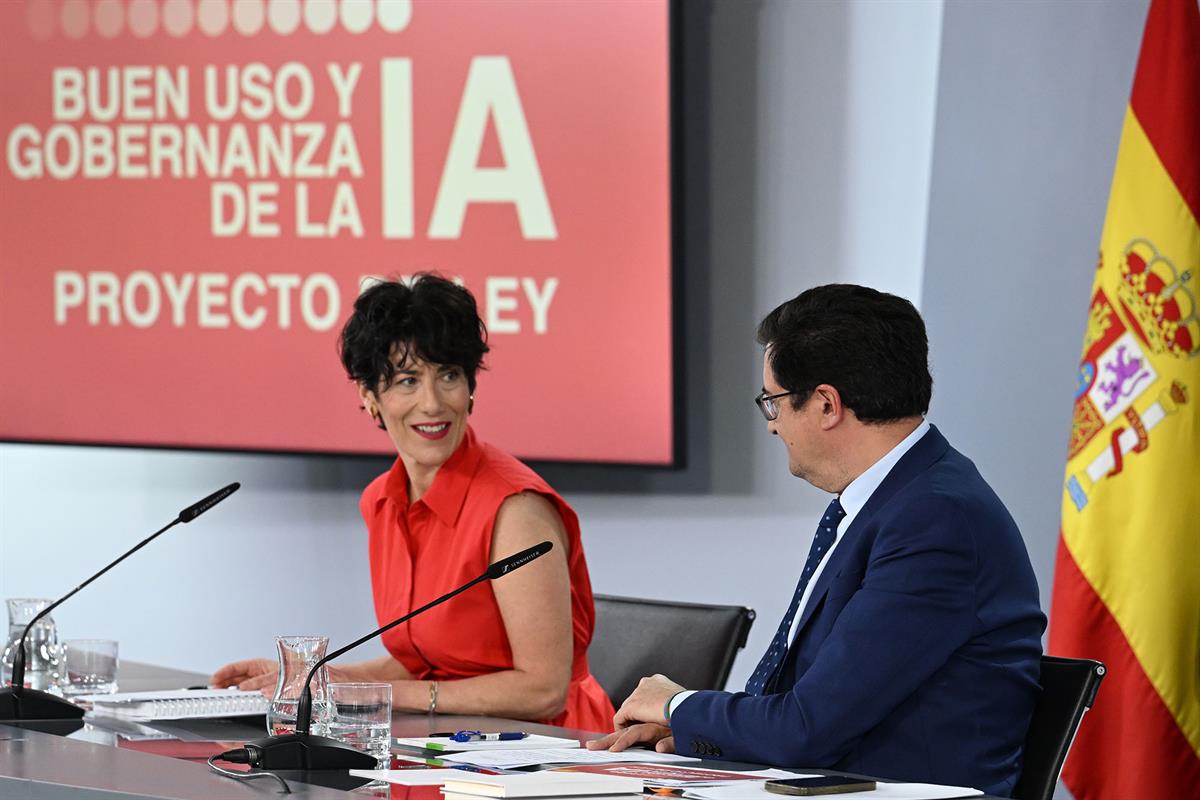 The Minister for Inclusion, Social Security and Migration and Government Spokesperson, Elma Saiz, and the Minister for Digital Transformation and Civil Service, Óscar López, during the press conference after the Council of Ministers (Pool Moncloa/Borja Puig de la Bellacasa)






The Council of Ministers has approved the draft Organic Law for the proper use and governance of artificial intelligence (AI). As explained by the Minister for Digital Transformation and Civil Service, Óscar López, the regulation develops the European regulation on this matter adapting it to the national framework.
López has highlighted the importance of the bill, which is sent to Parliament to start its processing. The regulation of artificial intelligence, he pointed out, is one of the main current debates around the world, since the development of this technology affects the present and future of employment, energy, cybersecurity, the development of minors and democracies themselves, among other fields. The minister thanked the contribution to this debate of the latest papal encyclical, which defends a humanist vision of artificial intelligence that respects human rights.
Óscar López has also rejected the dichotomy between regulation and competitiveness. Spain, he argued, is one of the leaders in adopting AI, according to reports such as that of Stanford University or Microsoft: it has two artificial intelligence factories, leading companies in this field, a national strategy in which 1.5 billion euros has been invested and a public and open AI language model (ALIA).
At the same time, Spain is the most advanced country in the world in regulating AI to create a "reliable model" that protects the rights of citizens, according to the minister. López stressed that Spain promoted the first European AI regulation, approved a Digital Rights Charter, launched the Digital Rights Observatory, was the first country in Europe to develop a state agency for the oversight of AI and hosted the inaugural meeting of the first scientific panel on AI constituted by the United Nations.
Content of the AI regulatory law
Óscar López has detailed that the future law requires responsibility from artificial intelligence providers: "It establishes something essential that is in all debates about artificial intelligence, which is the mandatory nature of human supervision of models."
The Minister for Digital Transformation recalled that the President of the Government of Spain, Pedro Sánchez, was the first to claim, at the Davos Forum held two years ago, the responsibility of managers who develop AI, human supervision, transparency of algorithms, protection of minors and data privacy. López has indicated that this is the path that other countries later followed and that the bill responds to that philosophy.
 The Minister for Digital Transformation and Civil Service, Óscar López, during the press conference after the Council of Ministers | Pool Moncloa/Borja Puig de la Bellacasa
The regulation adapts a classification of artificial intelligence to legislation based on risk and establishes a system of sanctions, model governance, trusted authorities and good use in the Administration.
The European AI Regulation, promoted by the Spanish presidency, established eight prohibitions related to subliminal techniques, vulnerability exploitation, biometric classification, social scoring, predictive surveillance, emotion recognition, face scrapping or real-time identification. The minister stressed that, at the request of Spain, the EU agreed on 7 May to two new prohibitions: artificial intelligence systems that generate sexual 'deepfakes' (realistic identity theft) and make child pornography, which is "a very significant advance in the protection of minors and, especially, girls, the main victims".
Governance framework
The regulation establishes a governance framework by designating authorities in charge of overseeing compliance. The central body is the Artificial Intelligence Oversight Agency (AESIA), based in A Coruña (Galicia). The minister has indicated that there are also a series of market oversight authorities. For example, Banco de España will oversee matters related to the financial system, the Spanish Data Protection Agency will oversee matters relating to data, and the general council of the judiciary will be responsible for matters relating to justice.
Another of the contributions of the law pointed out by Óscar López is the promotion of the good use of AI in the state public sector: "We have raised the bar for self-demand and, in addition to redoubling the demand on the artificial intelligence and transparency models that the Public Administration can use, the figure of the AI delegate is being promoted".
The standard also determines how to articulate the governance of sandboxes and establishes measures to make it easier for AI providers to comply with the legislation.
New digital terrestrial television licence
Also within the scope of the Ministry for Digital Transformation and Civil Service, the Council of Ministers has resolved the tender to grant of a new digital terrestrial television (DTT) licence, which was announced last October.
 The Minister for Digital Transformation and Civil Service, Óscar López, during the press conference after the Council of Ministers | Pool Moncloa/Borja Puig de la Bellacasa
Óscar López recalled that radio and television stations operate with a licence because radio frequencies are finite and that, every time there is a technological change and space is freed up, the Administration is legally obliged to call a tender to distribute it. This is what happened in 2005 with the transition from analogue to digital television and in 2015 with the change from DTT to high-definition DTT. In 2025, as Óscar López pointed out, with the implementation of ultra-definition, the signal was compressed again and there was free space.
Two bids were submitted to tender, one from the Mediaset group and the other from a group called Integrated Television Entertainment Services. This second company has been awarded the licence.
Improving access to flexible retirement
The Minister for Inclusion, Social Security and Migration and Government spokesperson, Elma Saiz, explained the new features of the royal decree approved by the Council of Ministers that regulates flexible retirement. The rule will go into effect three months after its publication in the official state gazette.
Saiz recalled that this modality, agreed at the Social Dialogue Table, "offers the possibility for people who are already retired, voluntarily, to return to work and make their pension compatible with part-time employment or also self-employment".
Among the new features of the "improved flexible retirement", she stressed that those who want to carry out a self-employed activity will be able to benefit from it, provided that they have not been registered in this modality in the three years prior to the retirement date. Likewise, the new framework extends the working day as an employee compatible with receiving a pension, allowing working between 33% and 80% of the day. Before the reform, the margin was between 25% and 75%. "In addition, those who decide to return to work six months after retiring, will be able to improve the amount of their pension with additional incentives," the spokesperson emphasised.
 The Minister for Inclusion, Social Security and Migration and Government Spokesperson, Elma Saiz, during her speech at the press conference after the Council of Ministers | Pool Moncloa/Borja Puig de la Bellacasa
Saiz pointed out that these measures "continue the path of reforms that we already started in 2021 to make the transition from employment to retirement more flexible" and assured that the changes are yielding results. As an example, she pointed out that the average retirement age stood at 65.5 years in April 2026, compared to 64.4 years in 2019.
In the minister's opinion, this data reflects the creation of "a broader and more attractive framework, more adapted to modern times for workers", which makes it possible to take advantage of the "senior talent" of those who wish to remain active "on a voluntary basis" and face the transition between working life and retirement in a more flexible way.
Health Technology Assessment, Primary Care and Oral Health
The Government spokesperson also reported on the approval of the royal decree that regulates the assessment of health technologies, "a standard that will establish a regulatory framework for the first time in Spain to analyse medicines, medical devices and other tools used in the National Health System".
As Saiz indicated, the measure adapts the Spanish model to European regulation and reinforces decision-making based on scientific evidence, with the aim of guaranteeing a more effective, safe and transparent incorporation of new technologies and treatments.
Also related to the health portfolio, Elma Saiz reported on two initiatives approved by the Executive to strengthen primary care and expand oral health coverage through greater provision of resources.
On one hand, the Council of Ministers has authorised the territorial distribution of more than 172 million euros aimed at the autonomous communities and the National Institute of Health Management (INGESA) to strengthen primary and community care during 2026. Among other actions, these funds will improve the diagnostic capacity of sexually transmitted infections, as well as promoting community health programmes and health schools aimed at citizens.
Likewise, the spokesperson referred to the authorisation of another 60 million euros, also managed by the autonomous communities and INGESA, to expand oral health services within the National Health System. The measure seeks to continue increasing the dental coverage of prioritised groups and to progressively include people over 65 as a beneficiary group of these benefits.
Events of Exceptional Public Interest
The Minister for Inclusion, Social Security and Migration and Government Spokesperson, Elma Saiz, and the Minister for Digital Transformation and Civil Service, Óscar López, during the press conference after the Council of Ministers | Pool Moncloa/Borja Puig de la Bellacasa
The Council of Ministers has declared 26 new initiatives as events of exceptional public interest. E This figure recognises the relevance of these events as cultural, sporting, scientific or social assets. Saiz pointed out that this allows, for example, "activating tax incentives provided for in the patronage law, which makes it easier for companies and private entities to support cultural projects throughout the country".
Among the activities that will be able to benefit from this measure are the celebration of Goya's bicentenary, the Trio of Eclipses 2026-2028, the anniversary of the Teatro Real or the imminent trip of Pope Leo XIV to Spain, which will take place from 6-12 June 2026.
The Government spokesperson stressed that this is the first trip that Leo XIV has made to an EU country and has defined it as "a historic event", since "fifteen years have passed since a pope visited our country".
Saiz said that this visit is an opportunity "to project to the world the values that constitute the basis of our democracy: coexistence, pluralism, solidarity or welcoming, values that clearly connect with the message that the pontiff has been defending".
Actions for the visit to Spain of Pope Leo XIV
The Ministry of the Presidency, Justice and Parliamentary Relations has submitted a report to the Council of Ministers with all the actions prepared by the Government to guarantee the normal development of Pope Leo XIV's visit to Spain.
As Elma Saiz has highlighted, the Ministry of the Presidency has coordinated more than 80 meetings around different working groups. Among them, with the organising committee of the Spanish Episcopal Conference, with representatives of the main ministries involved, with the Government delegates in the autonomous communities in which the visit will take place and with regional and local leaders. "The Government is fully committed to managing an event of this relevance with solvency, and we are convinced that this effort will bear fruit," said the spokesperson.
In terms of security, 10,500 members of the National Police and 2,190 of the Civil Guard will be activated, in addition to those made available by the Mossos d'Esquadra and the respective local police forces. With regard to mobility, Renfe will deploy a device to facilitate commuter and medium-distance travel, increasing the available seats and the frequency of trains, especially in cities such as Madrid.
Current Affairs
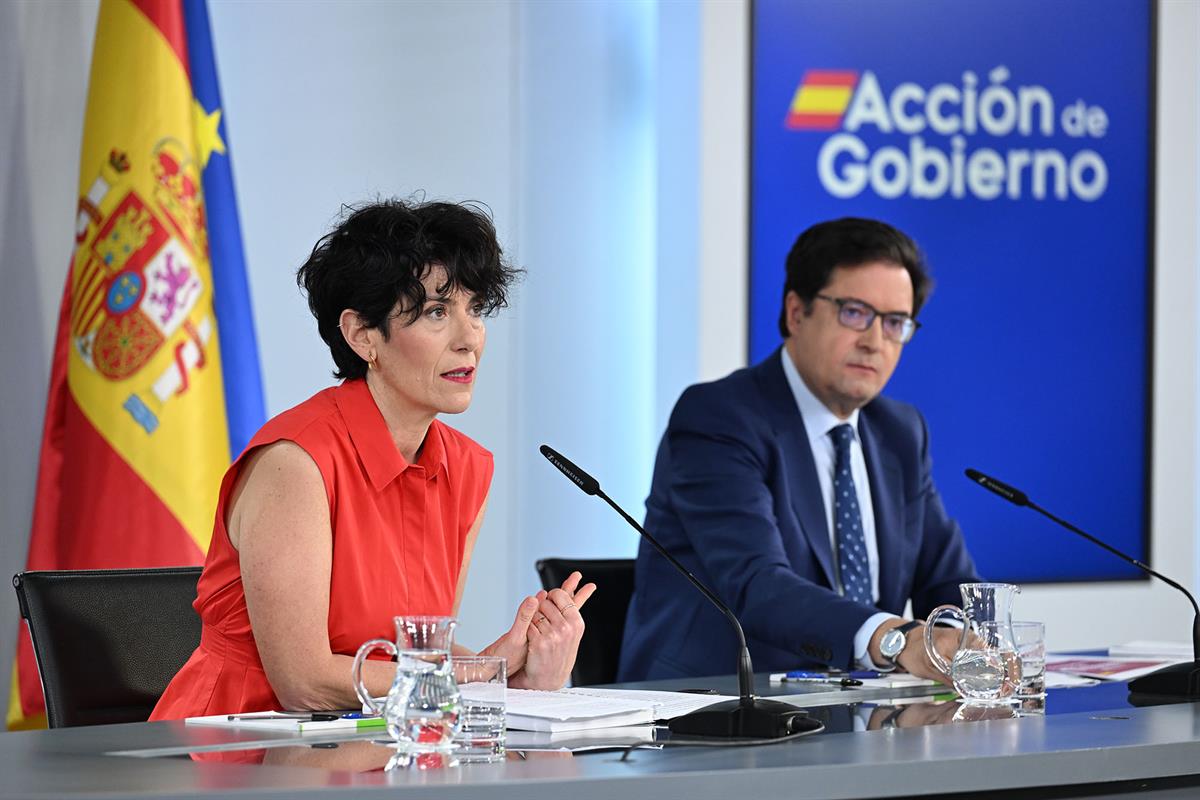 The Minister for Inclusion, Social Security and Migration and Government Spokesperson, Elma Saiz, and the Minister for Digital Transformation and Civil Service, Óscar López, during the press conference after the Council of Ministers | Pool Moncloa/Borja Puig de la Bellacasa
The Minister for Inclusion, Social Security and Migration and Government spokesperson began the press conference by conveying, on behalf of the Executive, her condolences and "absolute and total condemnation" for the three sexist murders confirmed last week, in Alicante, Navarre and Girona.
Saiz recalled that, with the murder of these women, the number of victims of sex-based violence has risen to 22 in 2026 and to 1,363 since 2003, the year since which records have been kept. "These are very painful figures. Each murder of this type challenges society as a whole to give a forceful response. Curbing sex-based violence has to be a priority for the country," said Elma Saiz.
Finally, the Government spokesperson wanted to congratulate the Spaniards Javier Calvo and Javier Ambrossi for the Best Director Award they won at the 79th Cannes Film Festival. Elma Saiz has pointed out that their film "La bola negra", inspired by an unfinished work by the writer Federico García Lorca, "talks about memory, identity, repression and the still very current need to live love without fear".
Non official translation