UN Independent International Scientific Panel on AI
Pedro Sánchez calls for a "responsible, humanist" artificial intelligence "governed by common rules for all"
President's News - 2026.4.22
Pedro Sánchez attends the first meeting of the United Nations Panel of Experts on AI | Pool Moncloa / Carlos Herrero - 2026.4.22
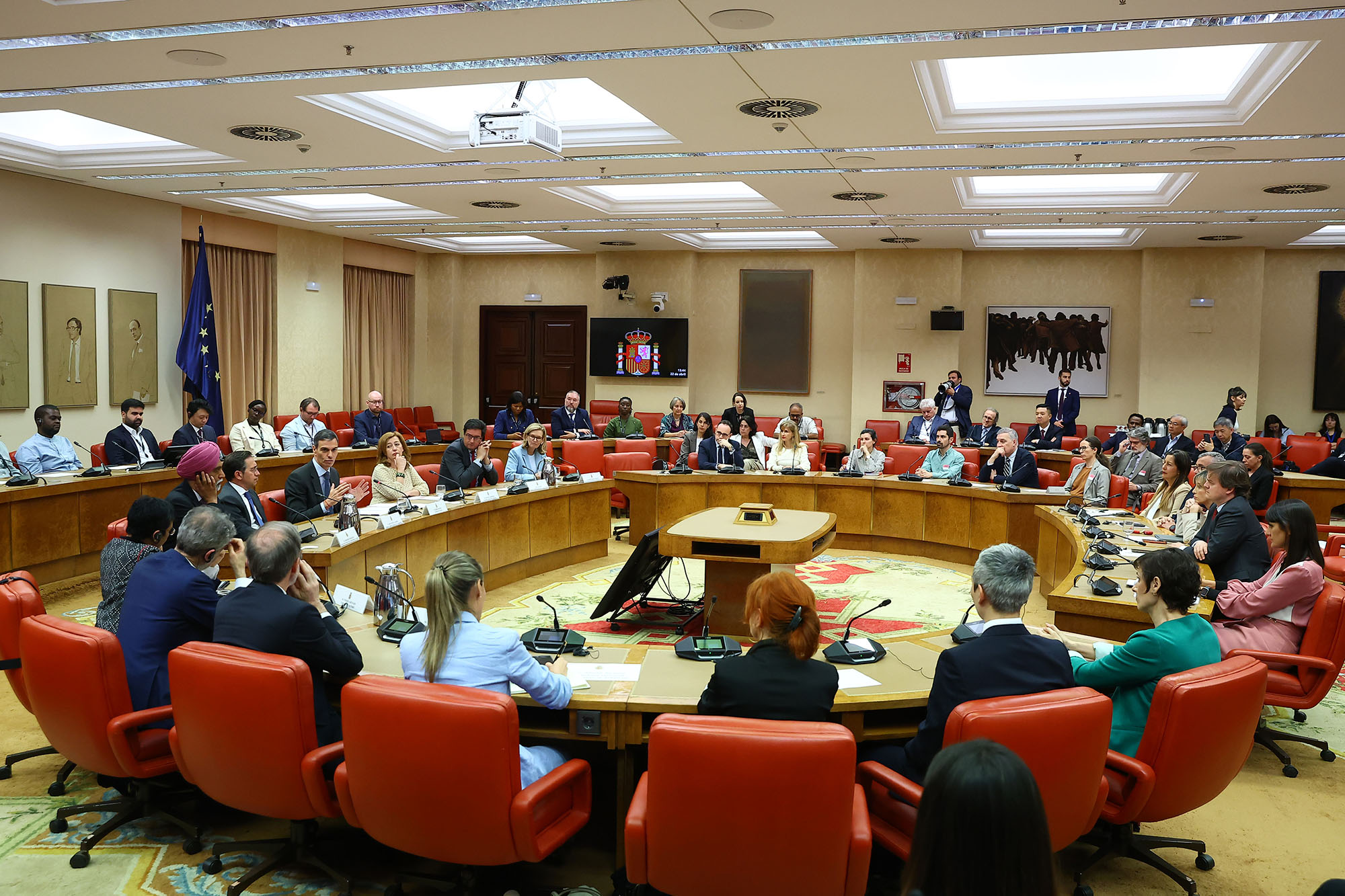






Lower House of Parliament, Madrid
Pedro Sánchez called for an artificial intelligence that is "responsible, humanist, that serves the well-being of all without leaving anyone behind" and "governed by common rules for all." He made these remarks during the opening of the first meeting of the United Nations Independent International Scientific Panel on Artificial Intelligence, held in the Lower House of Parliament, which was also attended by the Minister for Foreign Affairs, European Union and Cooperation, José Manuel Albares, and the Minister for Digital Transformation and Civil Service, Óscar López.
In this first meeting, which included the participation of the Speaker of the Lower House, Francina Armengol, and, via teleconference, the Secretary-General of the United Nations, António Guterres, the President of the Government of Spain emphasised the importance of the UN Independent International Scientific Panel on AI as "an act that strengthens the multilateral system, which is under attack, in an area where we clearly need a global multilateral response where all nations feel on equal footing and where there is an alliance between businesses, academia, the scientific community, and the legislative and executive branches." "It is a crucial milestone in Spain's commitment and to multilateralism in responding to top-priority challenges such as the development of AI," he stressed.
Pedro Sánchez pointed out that the direction of AI is currently "determined by a small group of companies," comprised of five companies that control almost 60% of the global market for generative artificial intelligence. "The United States controls 74% of the world's AI computing power, while the European Union doesn't even account for 5%. Silent colonialism is taking place all over the world. It's not a concentration of capabilities, it's a concentration of power; it's not a market. We're seeing the construction of an oligarchy that responds solely to its own interests," he denounced. In this regard, he pointed out that, in 2025, the US private sector invested $286 billion in AI, the equivalent of 17% of Spain's GDP, 14 times more investment than Europe, and 23 times more than China.
AI: "a historic turning point" with "unprecedented benefits and risks for humanity"
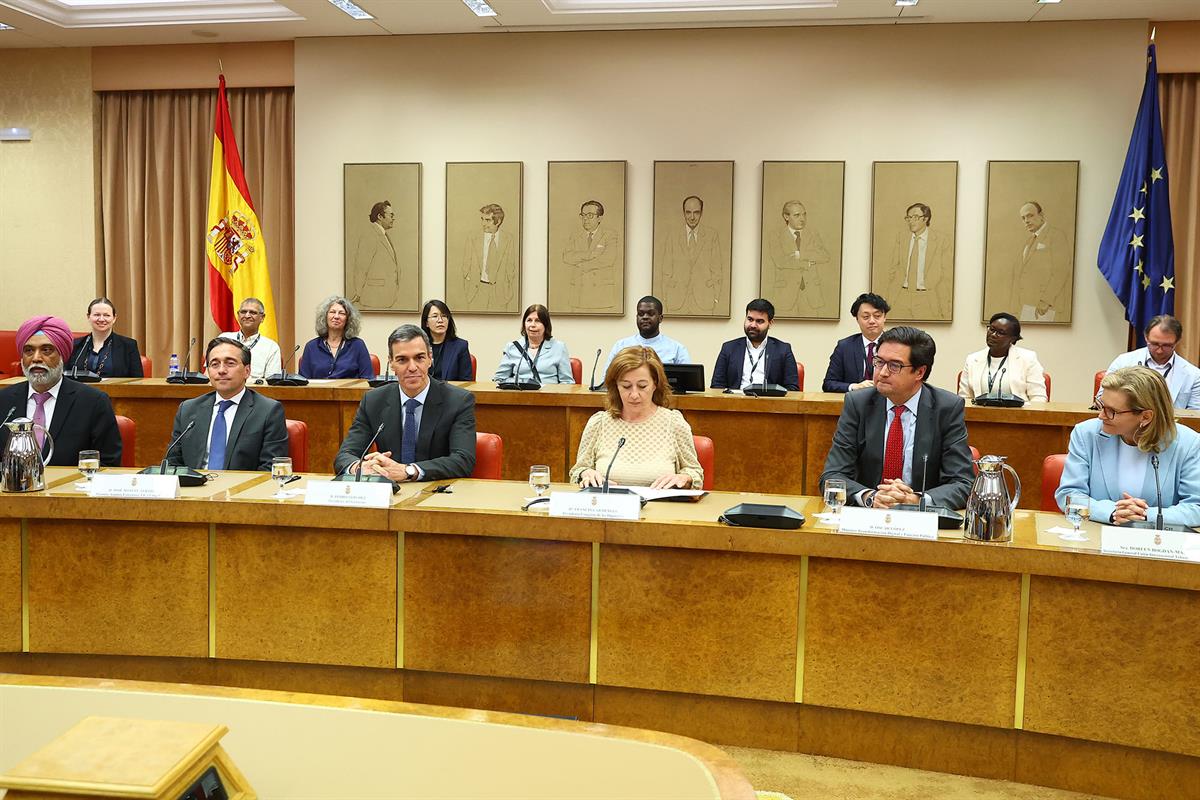 Image of some of the Government members participating in the meeting | Pool Moncloa/Fernando Calvo
He therefore urged people to question who will benefit from this technology and how, considering that "many believe that technology, in and of itself, generates social progress, but this is not entirely true," since "it is people who build it and governments, along with legislative powers who ensure that technological progress does not imply setbacks in other areas," as has happened in previous advances, such as the "failed state" of social media. In this regard, he recalled that "it was unions and workers who transformed the industrial revolution into prosperity" and "governments and science who limited the use of nuclear energy." "It must be the public authorities, together with businesses, academia, science, and social representatives, who transform the digital space into what was promised to us, because no technology is neutral: it depends on who controls it, how it is regulated, and what it is used for," he asserted.
Faced with a "historic turning point" with a technology "with profound and difficult-to-anticipate effects, capable of generating incredible benefits, but also of amplifying unprecedented risks and threats to humanity," he opined that "we must morally rearm ourselves to face technological challenges" and that it must "be governed with common rules for all, with shared principles and with ethical and democratic responsibility, with effective multilateralism."
Reaffirming the role of the UN
According to Sánchez, this is the vision of the European Union, the first to establish a common framework, under the Spanish presidency, to "channel it with a humanist and moral perspective, so that the most transformative technology of our time advances in the same direction as our democracies: with protected rights, with legal certainty, and with trust." All this at a time when "not even the creators of the most powerful models believe that the market can govern this alone," which is why he urged action "with courage, decisiveness, and without fear."
The President of the Government of Spain reaffirmed the role of the UN, recalling that, in 2014, the Secretary-General of the United Nations, António Guterres, established the diagnosis with his report on AI governance, and that same year 193 states adopted the Digital Global Compact as a framework for action. Furthermore, the General Assembly created the Scientific Panel and the Global Dialogue, which it considers "the most ambitious architecture to date for collectively governing artificial intelligence." "Spain shares this vision, and it is an honour for our country to host this first meeting of the Scientific Panel," he emphasised.
A commitment to multilateralism and designing the AI architecture
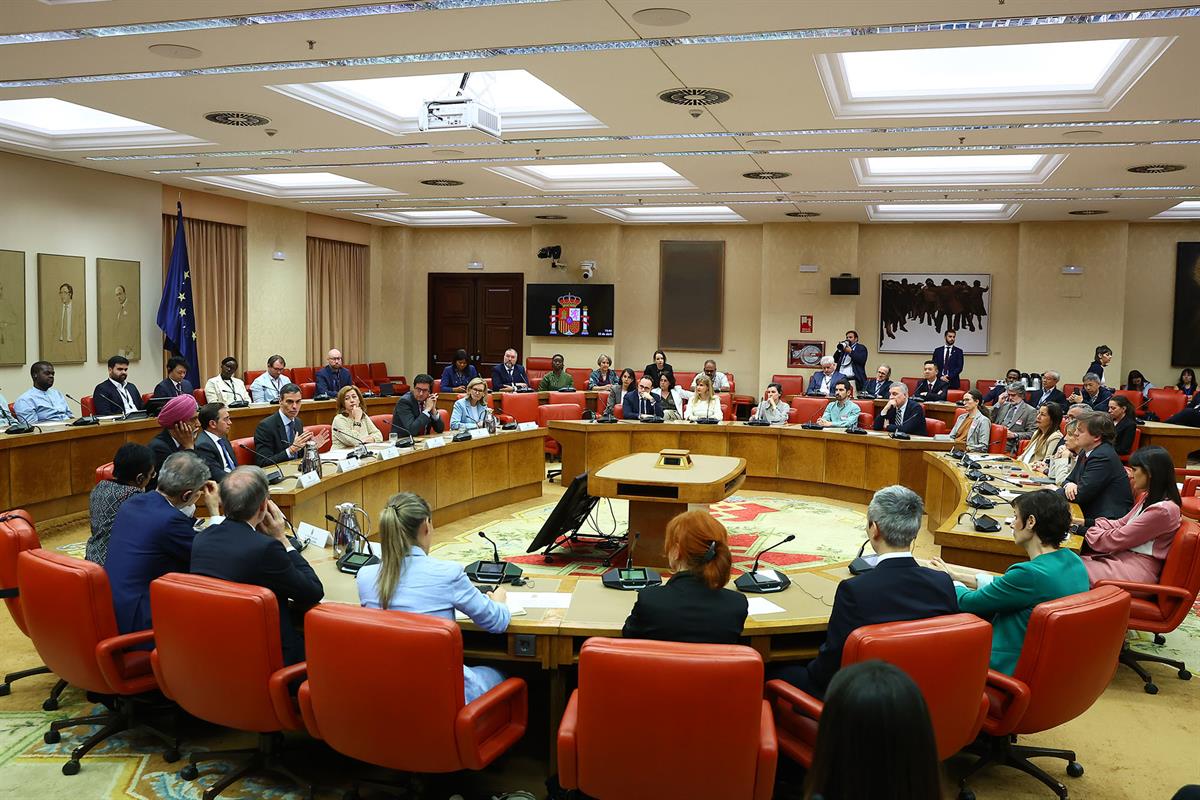 The President of the Government of Spain, Pedro Sánchez, during the meeting of the United Nations Panel of Experts on Artificial Intelligence | Pool Moncloa/Fernando Calvo
"We believe in scientific rigour and the value of multidisciplinary expertise, and we maintain that the governance of artificial intelligence should be in the hands of the people, not a small group of individuals. We don't want to be mere observers; we want to participate in designing its architecture," he declared. For this reason, he explained, Spain has launched, together with the United Nations, the AI Governance for Humanity Lab, where governments and businesses are jointly defining the standards for ethical and trustworthy AI. "The regulations we can implement at the national and European levels are important, and hopefully at the multilateral level, but without the agreement of businesses, the participation of science, academia, and all sectors of society, it will be very difficult to channel and direct AI toward our intended goals through regulation alone," he stated. To move forward, he noted that specific programmes are being deployed so that AI "improves people's lives." "Spain does not want to participate in the AI race, but rather humbly contribute to a responsible, humanistic AI that serves the well-being of all without leaving anyone behind," he declared.
"We will not be mere observers. We will not limit ourselves to observing how the most powerful artificial intelligence in history decides for itself when to follow the rules and when to ignore them. We must be leading actors through cooperation, leveraging the multilateral tools we have to defend the common good and all the virtues of a technology that will undoubtedly change the destiny of the world." "It is up to us to ensure that this change is for the good and for the good of humanity" because "the future of our species depends on it," he concluded.
Non official translation