8th edition of the 'La Toja-Vínculo Atlántico Forum'
The President of the Government of Spain calls for order based on "the values of advancement and progress"
President's News - 2026.10.1
La Toja Island, Pontevedra
 The President of the Government of Spain, Pedro Sánchez, during his speech at the inauguration of the 'La Toja-Vínculo Atlántico Forum' (Pool Moncloa / Borja Puig de la Bellacasa)






The President of the Government of Spain, Pedro Sánchez, has called for order to be based on "the values of advancement and progress", to prevent "others from deciding for us simply because they have more power", whilst pushing ahead with regulation to address the "collapse" of the international order and the multilateral system, economic and trade uncertainty, the climate emergency, and to ensure the responsible deployment of artificial intelligence.
He made this point during his opening address at the 8th edition of the 'La Toja-Vínculo Atlántico Forum', held under the theme 'A world in disarray' in Illa da Toxa (Pontevedra) and presided over by His Majesty the King. The forum was attended by the Minister for Finance, Arcadi España, and former Presidents of the Government of Spain Felipe González and Mariano Rajoy, with the President of the Xunta de Galicia, Alfonso Rueda, also taking part.
Pedro Sánchez pointed out that "chaos is not neutral", because "when international law loses its force, the winner is whoever has the most weapons; when markets abandon the rules, the winner is whoever has the most power to impose their conditions; when labour rights are weakened, the winner is whoever holds the stronger hand in negotiations; and when technology advances without limits, the winner is whoever controls the algorithms". The fact is that "disorder has its beneficiaries, and they are almost never those who need protection the most". For this reason he called for order - "a word mistakenly associated for far too long with conservative thinking" - based on "the values of advancement and progress".
In this regard, he explained that "order consists of establishing rules and preventing others from deciding for us simply because they have more power, and in updating those rules in keeping with the spirit of the times", something achieved through "labour rights, the welfare state and market regulation", which, in his view, is "the very essence of democracy".
International order and the multilateral system
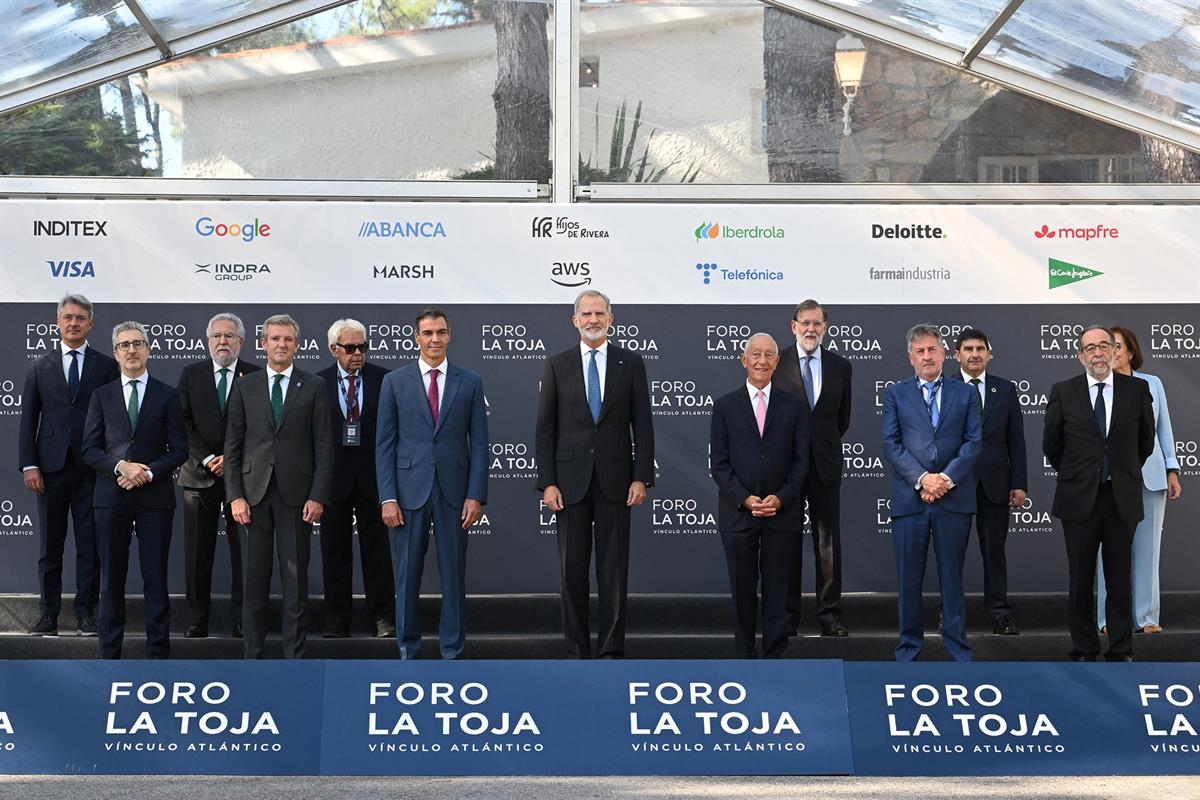 Group photograph of the inauguration of the 'La Toja-Vínculo Atlántico Forum', presided over by H.M. the King. | Pool Moncloa / Borja Puig de la Bellacasa
With this, he said, we must "look to the world that lies ahead and the one we are in" in order to make progress in four areas, such as tackling the "collapse of the international order and the multilateral system", citing the war in Ukraine, the "genocide" in Gaza and the armed conflicts that "claimed more than 150,000 lives worldwide last year alone", seven times more than in 2002, with 117 million people forcibly displaced - three times as many as at the start of this century. "Many because of conflicts, others simply fleeing poverty. The tragedy of irregular migration reminds us of this, and what happened in Ceuta this summer is proof of it," he added, arguing that "no wall or barrier, however high or insurmountable it may be, will be able to contain people's desperation to have a better life".
The head of the Executive stated that the United Nations system is "absolutely essential" and "the best tool we have ever had - and will probably ever have - for tackling global challenges and preventing present and future conflicts", as he argued last week at the UN General Assembly, although it requires "far-reaching reform to reflect today's world", with a "more representative Security Council, more agile and effective organisations, and an international justice system capable of ensuring that crime has consequences and that there is no impunity". "A rule that only the weak must obey is not a rule; it is another form of power", he argued, in defence of multilateralism. "Today we are paying the price for unjust, utterly unjustified and illegal wars which Spain has firmly opposed: Putin's war in Ukraine; Netanyahu's war, with his genocide in Gaza and occupation of Palestinian territory; and the immense mistake of the war in Iran", he lamented.
Economy and trade
Another area in which global turmoil is at play, as cited by Sánchez, is that of the economy and trade, where he emphasised that, in the face of "years of uncertainty and upheaval", Spain "continues to grow and is demonstrating quite commendable resilience", with growth of around 2.6 per cent this year - almost triple the forecast for the euro area - where Spain accounts for 85 per cent of salaried employment, with over 22.5 million national insurance contributors, whilst the proportion of temporary contracts has fallen to 12.3 per cent. "These figures illustrate a model of success in very adverse conditions, but they do not allow us to turn a blind eye to the serious difficulties that still persist", he pointed out, particularly in terms of ensuring access to housing and tackling the housing crisis.
The President of the Government of Spain called on the Lower House of Parliament and the parliamentary groups to show "broad-mindedness" in order to ratify the decrees at this Friday's sitting, following the agreement - "the result of dialogue with the parliamentary groups" - reached on Tuesday. "I ask that we set aside ideology and party politics and focus on an issue that is purely a matter of humanity", he added. However, he referred to other challenges, such as the rise in fuel prices and its impact on the cost of living, with inflation standing at 4.9 per cent in September, due to the impact of energy prices, particularly fuel and gas. "To tackle this 'cost of turmoil', the Government has approved extending protection for families and businesses against the price rises caused by the war in Iran, the pandemic and the invasion of Ukraine, and we will do so again in the face of each and every crisis." With the third Royal Decree-law, a total of more than 12 billion euros is being mobilised, which prevents half of the price rise that would otherwise have occurred, he noted.
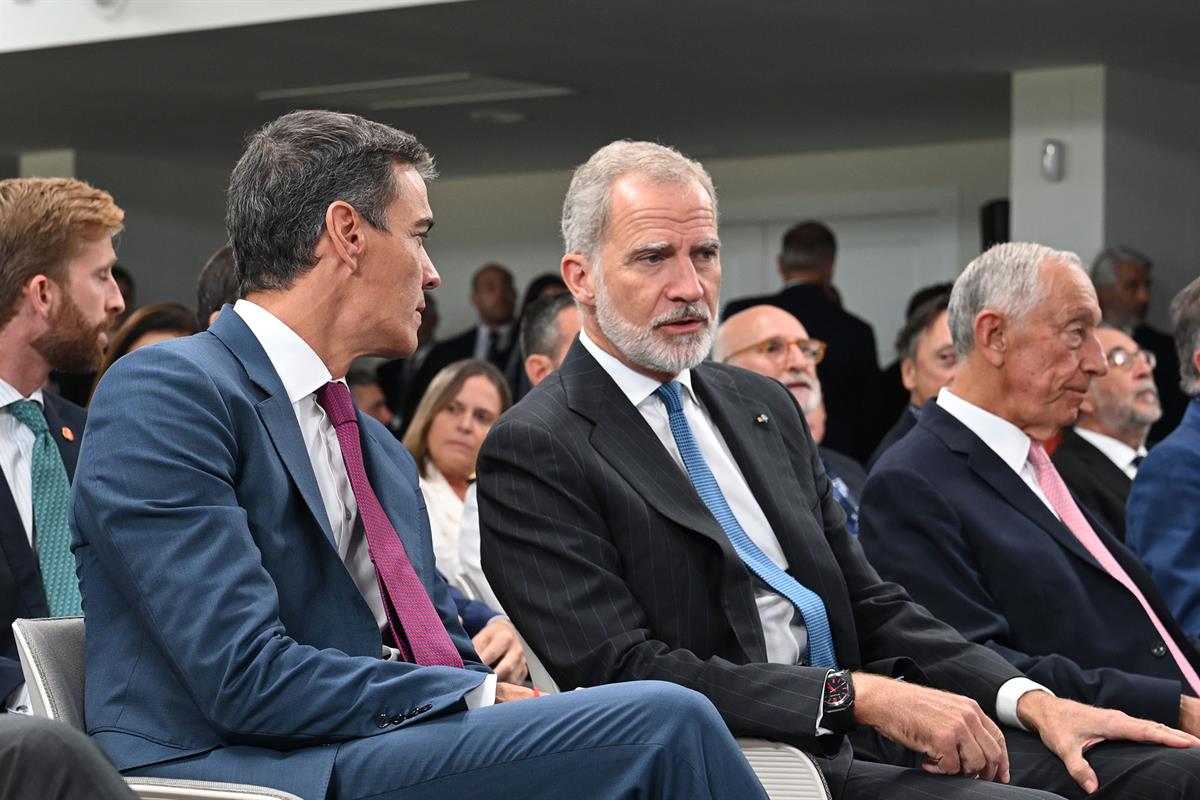 The President of the Government of Spain, Pedro Sánchez, talks with King Felipe VI at the opening ceremony of the 'La Toja-Vínculo Atlántico Forum' | Pool Moncloa / Borja Puig de la Bellacasa
He also criticised the use of tariffs as a "tool of coercion", despite the fact that "in a trade war, there are never any winners, only losers". In response, Spain has advocated a rules-based multilateral trading system, managed by the World Trade Organisation (WTO), which "favours the countries most in need". Within the current framework of trade negotiations between the EU and China, he made it clear that "trade and investment that bring jobs and technology are welcome, but it is imperative to rebalance this relationship between Europe and China, with 'balance and common sense', alongside 'clear and predictable rules'".
Climate emergency
Similarly, the President of the Government of Spain referred to the climate emergency as one of the areas in which it is urgent to reverse the global crisis so as not to take a step backwards, as "climate change kills and impoverishes us", bearing in mind that "Europe is not prepared for the climate emergency; it is warming at twice the global average rate, and its dependence on fossil fuels - exacerbated by wars - makes it doubly vulnerable". In fact, since the start of the war in Iran, Europe has paid an extra 100 billion euros for the fossil fuels it imports - over 3 billion more each week - a figure equivalent to a quarter of all direct grants from the 'Next Generation' funds.
"What Europe built to emerge from the pandemic has been snatched away from us by the chaos of war", he emphasised, which is why Spain advocates "relying less and less on decisions made by others on our behalf" and is therefore promoting renewable energy, which already accounts for nearly 60 per cent of electricity generation. "Sun, water and wind rather than the Strait of Hormuz", he added, particularly given that extreme temperatures in Europe could reduce European GDP by more than 1 per cent and, between 2021 and 2024, the cumulative losses associated with disasters and extreme weather events are estimated at over 200 billion euros for European countries. Consequently, he argued that adaptation and resilience policy should be "the second major pillar of European climate policy, alongside decarbonisation" and that future budgets should include a substantial allocation of resources for adaptation to the climate emergency. In short, "we need the order of reason and science, which are currently being challenged by the chaos leading to the disaster of the climate emergency".
Responsible deployment of artificial intelligence
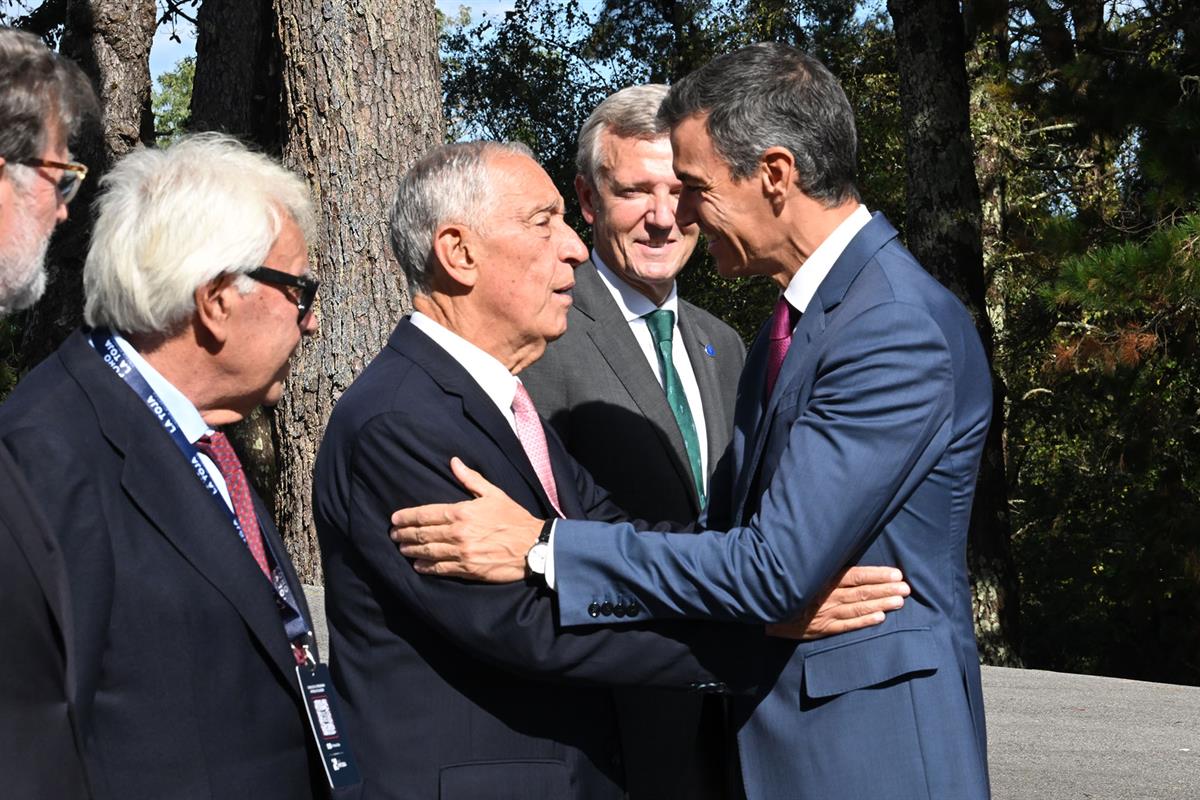 The President of the Government of Spain, Pedro Sánchez, greets the former President of the Portuguese Republic, Marcelo Rebelo de Sousa, who was awarded a prize at the opening ceremony of the La Toja Forum | Pool Moncloa / Borja Puig de la Bellacasa
The head of the Executive also called for order to ensure a 'responsible' roll-out of artificial intelligence, with rules that anticipate potential issues and the 'capacity to govern it'. "Yesterday we saw a photo which I personally found clearly inadequate. The US President telling the techno-oligarchs that they must regulate themselves. I believe it is a mistake to put the fox in charge of the hen house. This is not about voluntary agreements between tech oligarchs and self-regulation", but rather about "legal obligations, public scrutiny, social control, government oversight and the assumption of responsibility, including criminal liability", he emphasised. In this vein, he recalled that Spain was the first country to establish an Artificial Intelligence Supervisory Agency and has just presented the AI 360 Plan, a national roadmap focused on responsible deployment to capitalise on all opportunities. Drawing on this "moral authority to champion AI with a humanist ethos", he called for "robust regulatory frameworks" at national, European and multilateral levels to guarantee safety and the protection of human rights.
He also stated that "progress has never meant abandoning the rules; it has meant establishing rules that are equal to the challenges facing each society at any given time". "The powers we are trying to govern have taken on a global scale; there has never been a level of inequality in the history of humanity like the one we are seeing right now", he warned, and therefore argued that, "in the face of the forces of disorder, Spain advocates a Europe with a greater capacity for action", with a "far more ambitious" European budget to address the funding of European public goods (security, defence, the climate emergency, science, the CAP and the social pillar). "Who stands to gain from a world in disarray? The answer is clear: those who know that, when the rules disappear, they can impose their own", he warned, emphasising the need for "fair rules".
Non official translation