'A green and digital Spain Impact of the Recovery Plan'
Pedro Sánchez announces that Spain has already implemented 9 out of 10 reforms of the Recovery Plan agreed with the European Commission
President's News - 2026.6.22
Images from the event | Pool Moncloa/Carlos Herrero - 22.06.2026
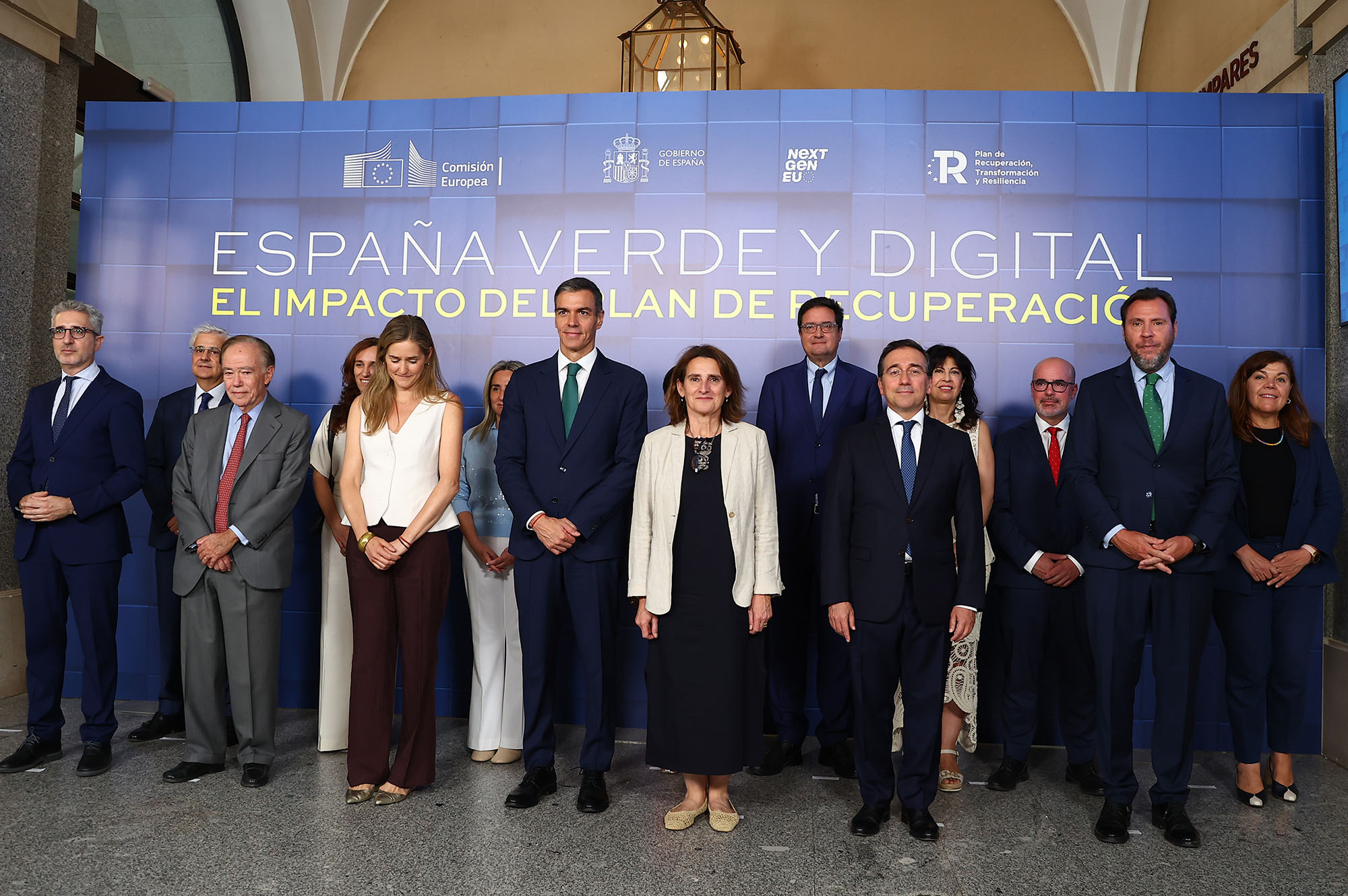






Royal Theatre, Madrid
The head of the Executive, Pedro Sánchez, has announced that Spain has now implemented 9 out of 10 reforms agreed with the European Commission under the Recovery Plan and has assured that, by 31 August, Spain will have unleashed "the full potential" of the Recovery Plan and the economy will have "completed an unprecedented process", with two out of every three euros being channelled into the green and digital transitions.
He made this point during the closing ceremony of the event 'A Green and Digital Spain'. 'The Impact of the Recovery Plan', at the Teatro Real in Madrid, which was opened by the First Vice-President of the Government of Spain and Minister for Economy, Trade and Business, Carlos Cuerpo, alongside the Minister for Culture, Ernest Urtasun, and the European Commission's Executive Vice-President for a Clean, Just and Competitive Transition, Teresa Ribera.
Also in attendance were the Third Vice-President of the Government of Spain and Minister for Ecological Transition and Demographic Challenge, Sara Aagesen; the Minister for Foreign Affairs, European Union and Cooperation, José Manuel Albares; the Minister for Finance, Arcadi España; the Minister for Transport and Sustainable Mobility, Óscar Puente; the Minister for Education, Vocational Training and Sports, Milagros Tolón; the Minister for Housing and Urban Agenda, Isabel Rodríguez; the Minister for Health, Mónica García; the Minister for Equality, Ana Redondo; and the Minister for Digital Transformation and Civil Service, Óscar López.
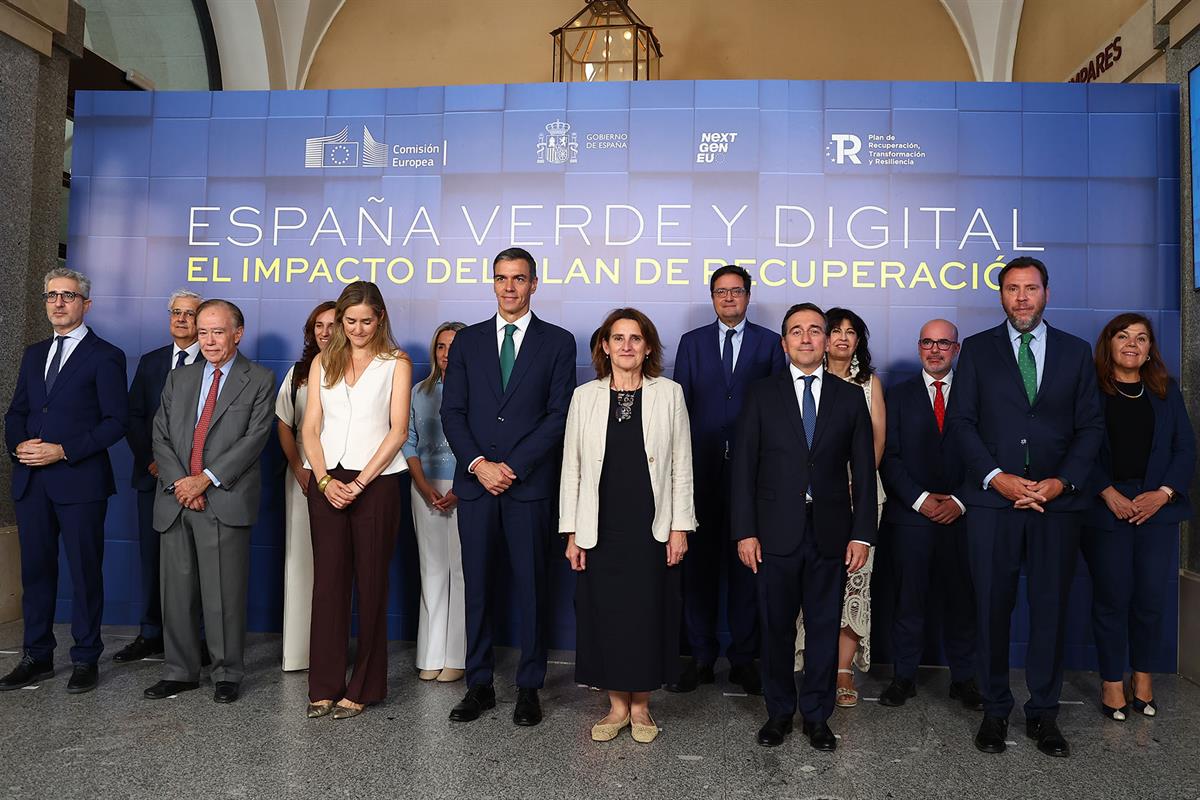 The President of the Government of Spain, Pedro Sánchez, along with members of the Cabinet and other authorities in the closing family photo of the event | Pool Moncloa/Fernando Calvo
Pedro Sánchez remarked that, in the wake of the 2020 pandemic, "Europe reconnected with its true self and launched the 'Next Generation' funds". "Spain believed in Europe and Europe came to believe in itself again, and it wasn't easy," he admitted, although he asserted that "by 31 August, we will have unleashed the full potential of the Recovery Plan", so that "our economy will have completed an unprecedented process of transformation", placing Spain "at the forefront of Europe".
Although the battle for European funds took place six years ago, he pointed out that "the real victory lies not in having secured them, but in having used them wisely". He explained that two out of every three euros have been allocated to the green and digital transition and that "the Spain of get-rich-quick schemes has given way to the Spain of hard work", with the Plan having achieved "the three objectives that give it its name: recovery, transformation and resilience".
Recovery: Spain is the European economy that has grown the most since pre-Covid levels
As for the recovery, Sánchez pointed out that Spain had to cope with an unprecedented shock in the wake of the pandemic, with the economy contracting by double-digit percentages of GDP in just one year; yet, "we have never bounced back so quickly and so strongly from it". The fact is that "Spain is currently the European economy that has grown the most since pre-Covid levels", with growth of 8.5 per cent, which is 40 per cent higher than the eurozone average and 22 times higher than Germany's. "Today, we are the undisputed driving force behind the single currency bloc. With barely 10 per cent of GDP, we contribute a fifth of the growth and create more than half of the jobs. "In the last year alone, 600,000 new jobs have been created and we have just passed the 22.5 million mark for Social Security contributors," he explained.
In this regard, he emphasised that "Spain always surpasses itself" and will continue to do so, and so he announced that the Government "will fight tooth and nail" to push through the 2027 National Budget, which "must once again be fiscally rigorous, socially expansive and transformative in digital and environmental terms, the best tool for continuing to grow and improve people's lives".
Green and digital transformation
He emphasised that, thanks to the 'Next Generation' funds, unprecedented levels of investment have been mobilised, aimed at accelerating the transition towards a 'greener, more innovative and competitive' production model, driven by renewable energy, energy efficiency, sustainable mobility and emissions reduction, which is "complemented by a firm commitment to what must be our main asset: training in human capital". As he stated, thanks to the driving force of the funds and the link to the need for reforms, Spain now has a regulatory framework that is "modern and tailored to the needs of our businesses", with 400,000 new vocational training places, 200,000 people under the age of 25 working in the digitalisation sector and 40,000 in the green economy. Furthermore, thanks to the Recovery Plan, he pointed out that Spain is currently ranked seventh in Stanford University's Global Vibrancy AI ranking, and sixth worldwide in terms of AI adoption, according to Microsoft.
He also highlighted that Spain is "the major European economy that has received the most transfers relative to its GDP: more than 60 billion euros, with the sixth payment of the funds expected in the coming weeks". And beyond the administrative aspects, he explained that the Plan's implementation has been carried out "with the aim of bringing about transformation throughout the entire country," conceiving social and territorial cohesion as another of the Plan's cross-cutting themes, in order to reduce inequalities with projects such as the large battery plants in Sagunto, Navalmoral de la Mata and Figueruelas.
He also pointed out that NextGen funds have reached all regions and all stakeholders, with around 43 per cent of the funds - approximately 30 billion euros - going to SMEs and the self-employed. The President of the Government of Spain stated that "there will be no funds without reforms", announcing that Spain has already implemented 9 out of 10 reforms agreed with the European Commission. This is a condition for receiving the money and an "indispensable lever for structural change". In this regard, he made it clear that the "national project" of structural reforms and strategic investment "is here to stay and will continue beyond the NextGen programmes, thanks to the 'Spain Grows' Fund, with an unprecedented mobilisation of public and private resources".
Resilience: support is needed to renew the social safety net
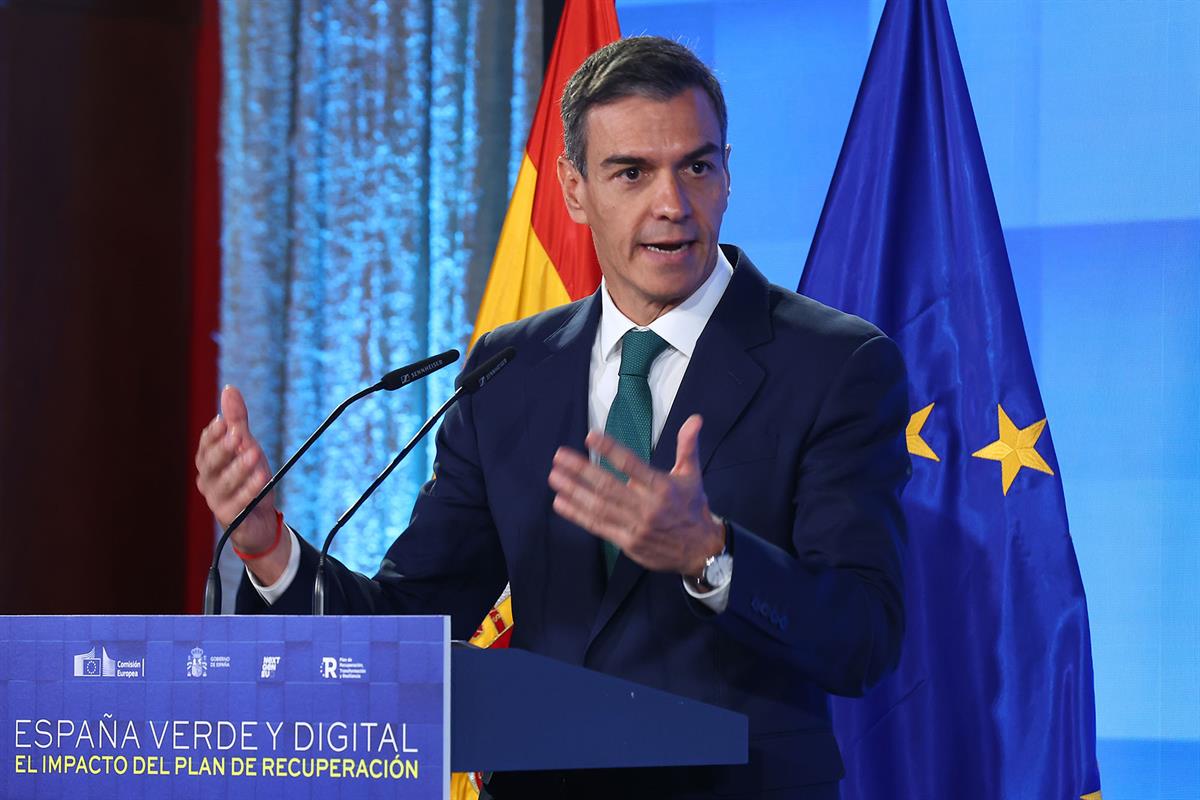 The President of the Government of Spain, Pedro Sánchez, during his speech at the closing of the event | Pool Moncloa/Fernando Calvo
On the subject of resilience, he praised the wisdom of investing in renewable energy, given that electricity in Spain is now half the price of that in Germany and almost three times cheaper than in Italy. "We have turned a chronic weakness - the cost of energy - into a driver of competitiveness for our businesses." "During the pandemic crisis, we were the European economy that suffered the biggest slump, just as we always did whenever things went wrong." "In the current crisis, we are the one showing the most improvement", he stated. And yet, after four COVID variants, two wars - one of them on Europe's doorstep - a trade war and two inflationary spirals, "the number of social security contributors has reached 22.5 million, real household income has risen by 8.4 per cent; poverty and inequality are at record lows; and the IBEX 35 has tripled in value, smashing all previous records". "Spain no longer wavers; Spain is the safest bet. "No economy in the world has been able to develop that level of protection and resilience in the face of uncertainty in just six years," he said.
In this regard, he recalled that in recent months the government has deployed a €5 billion aid package to mitigate the impact of "an illegal war that only brings ruin and death". "We are confident that the war is finally over, but we know that its effects will be felt for months to come", which is why the Council of Ministers will renew the social safety net next Monday. "I give you my word: no family, no business, no self-employed person… no one will be left without support. For as long as necessary", he guaranteed. In this regard, he took the opportunity to appeal to the political groups, asking that "we all rise to the occasion and serve the country". "I ask you to support the Royal Decree-law when it comes before the General Courts."
The chead of the Executive concluded his speech by emphasising that Spain "is growing faster and better, with increases in productivity, a firm commitment to innovation and a solid position in the sectors that will shape the economy of the future", and emphasising that the 'Next Generation' funds are "one of the best ideas the EU has launched in its seventy-year history". "That is the way forward, and we must not stray from it," he concluded.
Carlos Cuerpo: "The Plan's legacy is a model of success and transformative fiscal stimulus"
During the opening of the event, the First Vice-President of the Government of Spain and Minister for Economy, Trade and Business, Carlos Cuerpo, stated that the Recovery Plan "is a success that not only mitigated the impact of COVID-19, but also boosted the modernisation of the productive sector" and addresses "imbalances that we have been carrying for decades", such as structural unemployment and low productivity. "Spain is a success story," he emphasised, pointing out that, by the end of 2025, Spain had recorded 10 percentage points of real growth compared to pre-pandemic levels, leading the Eurozone. He highlighted some reforms and their effects, such as the labour reform, which has contributed to Spain generating around 50% of new jobs and bringing the temporary employment rate in line with European levels, creating employment in high value-added sectors.
Thanks to the'Crea y Crece' Act, the gross rate of business creation has increased by 50%, reaching 13,000 per month; the Startups Law has multiplied the development of the innovation ecosystem by 2.3%, making Spain the second fastest-growing country in Europe over the last five years; the Digital Kit programme has reached more than 900,000 SMEs and self-employed individuals in 90% of municipalities; and between 2018 and 2025, Spain has been the second-largest destination for new greenfield renewable energy investment projects. Against this backdrop, "Spain is strengthening its position as an investment hub", with a 22.6 per cent increase in productive foreign investment in the first quarter. Cuerpo also emphasised the transformative momentum of the Recovery Plan, which will continue with the Spain Grows Fund, mobilising up to €120 billion in public and private sector resources.
Ernest Urtasun: "It is proving to be very important for the cultural sector"
For his part, the Minister for Culture, Ernest Urtasun, hailed the "success" of the launch of the Recovery Plan, citing as an example the installation of solar panels on the roof of the Teatro Real, which has become "the world's most sustainable theatre" thanks to European funding. "The Plan is proving to be very important for the cultural sector", with more than 500 million euros earmarked for strengthening cultural industries and more than 1.6 billion euros channelled through the audiovisual 'hub'. "We must work to ensure that the idea of shared borrowing for shared future investments can continue", he added.
Teresa Ribera: "Spain is a fine example of the Plan's successful implementation"
The European Commission's Executive Vice-President for a Clean, Fair and Competitive Transition, Teresa Ribera, also highlighted - six years after the launch of the Next Generation funds - the wisdom of having decided to "act together", thereby better preparing Europe for new shocks. She also highlighted that Spain is a "great example of success" in implementing the Recovery Plan and urged the development of its own capabilities in terms of competitiveness and security-precisely "the direction in which Next Generation EU funds set us, to close the technological gaps in strategic sectors".
In her view, "Europe's future depends on greater innovation, leveraging our resources and trusting in the capabilities of Europeans. It involves removing unnecessary barriers and offering businesses the scale they need to compete globally, but this must be done while upholding our values". In this regard, she emphasised that the principle of 'do no significant harm' should be upheld in the EU's next budgetary framework, and that support should continue for social cohesion, sustainability, strategic autonomy and industrial and energy resilience. Regarding the contribution of the funds to Spain, she cited the narrowing of the digital divide, improved productivity, the acceleration of digitalisation in businesses and public administrations, and investment in connectivity, justice, education and, above all, in people.
Non official translation