Culture calls on European leadership to provide legal protection for the cultural sector in the face of artificial intelligence
News - 2026.5.12
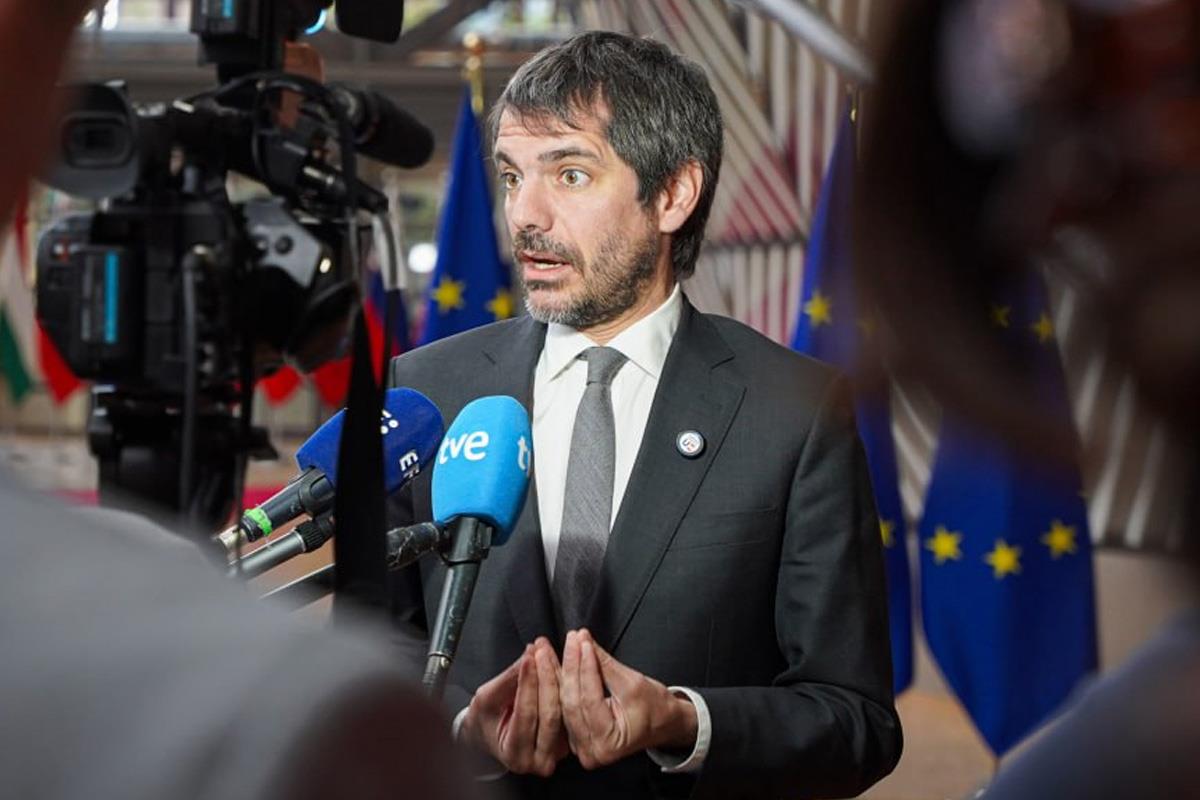 The Minister for Culture, Ernest Urtasun, upon his arrival at the Council of Ministers for Culture of the European Union held in Brussels





The Minister for Culture, Ernest Urtasun, took part in the meeting of the EU Council of Ministers for Education, Youth, Culture and Sport.
At Spain's suggestion, the meeting included a debate on the legislative review process for the European copyright law in light of the impact of artificial intelligence. The Spanish Minister for Culture argued that this review of copyright protection legislation should be implemented in an ambitious manner with regard to AI and cultural industries.
Along these lines, during his address to the Council of Ministers, Urtasun stated that this review should focus on three areas: the limits of text and data mining for the training of AI models for commercial purposes; the legal certainty surrounding the intellectual property rights involved in the training and generation of content by AI; and transparency regarding the content used for AI training.
Urtasun pointed out that "Spain is engaging with all European bodies to advocate a clear position on the regulation of AI and the protection of copyright and our cultural sectors". He added that "we want Europe to lead on ambitious regulation that protects cultural creation and ensures that technological innovation serves the public interest and is not a tool to boost the profits of certain multinationals".
Meetings with representatives of the Commission and the European Parliament
While on his trip to Brussels, Ernest Urtasun met with the European Commission's Commissioner for Intergenerational Equity, Youth, Culture and Sport, Glenn Micallef, with whom he discussed the impact of AI on the employment and working conditions of creators in the cultural and artistic sector.
The Minister for Culture also extended an invitation to Glenn Micallef to take part in the International Conference on the Cultural Reconstruction of Palestine, which is being organised by the Ministry for Culture in conjunction with the Palestinian National Authority, to be held in Madrid this summer. This conference was announced by the Minister for Culture, Ernest Urtasun, at the meeting of the EU Council of Ministers for Culture held last November, where, for the first time and at Spain's request, the reconstruction of Palestine's cultural heritage was discussed.
Urtasun's schedule in the European capital will be rounded off with meetings with the Executive Vice-President for Technological Sovereignty, Security and Democracy of the European Commission, Henna Virkunnen, and with the Executive Vice-President for a Clean, Just and Competitive Transition of the European Commission, Teresa Ribera. Finally, the Minister for Culture will meet with the President of the European Parliament, Roberta Metsola.
Presentation of a sculpture by Luisa Roldán
The Minister for Culture, Ernest Urtasun, will take part in the closing ceremony of the second campaign of the 'Twin it! 3D for Europe's Culture' project. This is an event organised by the Europeana Foundation and the European Commission in which the Ministers of Culture of the EU Member States will showcase the contributions made by each country to this campaign for the 3D digitisation of cultural heritage and share their vision for the reuse of digitised heritage assets.
The Spanish Minister for Culture will present the 3D digitalisation of the 'Tránsito de la Magdalena', a work by the Baroque sculptor Luisa Roldán, known as La Roldana, which is kept in the National Sculpture Museum in Valladolid. The piece is one of the great benchmarks of 17th-century Spanish sculpture and an example of the technical virtuosity and expressive sensitivity of the first woman to hold the title of legislative chamber sculptor at the Spanish court. The digitisation of this work, available on the Europeana platform, reflects Spain's commitment to the preservation and digital dissemination of its cultural heritage on a European scale.
The 'Tránsito de la Magdalena' is not the only Spanish contribution to this second campaign. Through Hispana, the national aggregator to Europeana of data and digital objects from Spanish museums, archives and libraries, and through the Eureka 3D platform, Spain has contributed a total of four pieces: in addition to the work by La Roldana, the Magic Lantern kept at the Filmoteca Española, as well as the Puerta de Alcalá and the Monument to Velázquez, provided by the Madrid local entity.
Twin it! 3D for Europe's Culture' is an initiative of the European Commission, supported by the EU Council Presidency, in the framework of the European Commission Recommendation (EU) 2021/1970 on a common European data space for cultural heritage. This recommendation urges Member States to accelerate their efforts to digitise and conserve cultural assets, with the aim of having monuments at risk, as well as the most visited ones, fully 3D digitised by 2030.
Non official translation