Grande-Marlaska outlines at the United Nations the model that has placed Spain "among the countries with the best road safety records in the world"
News - 2026.7.21
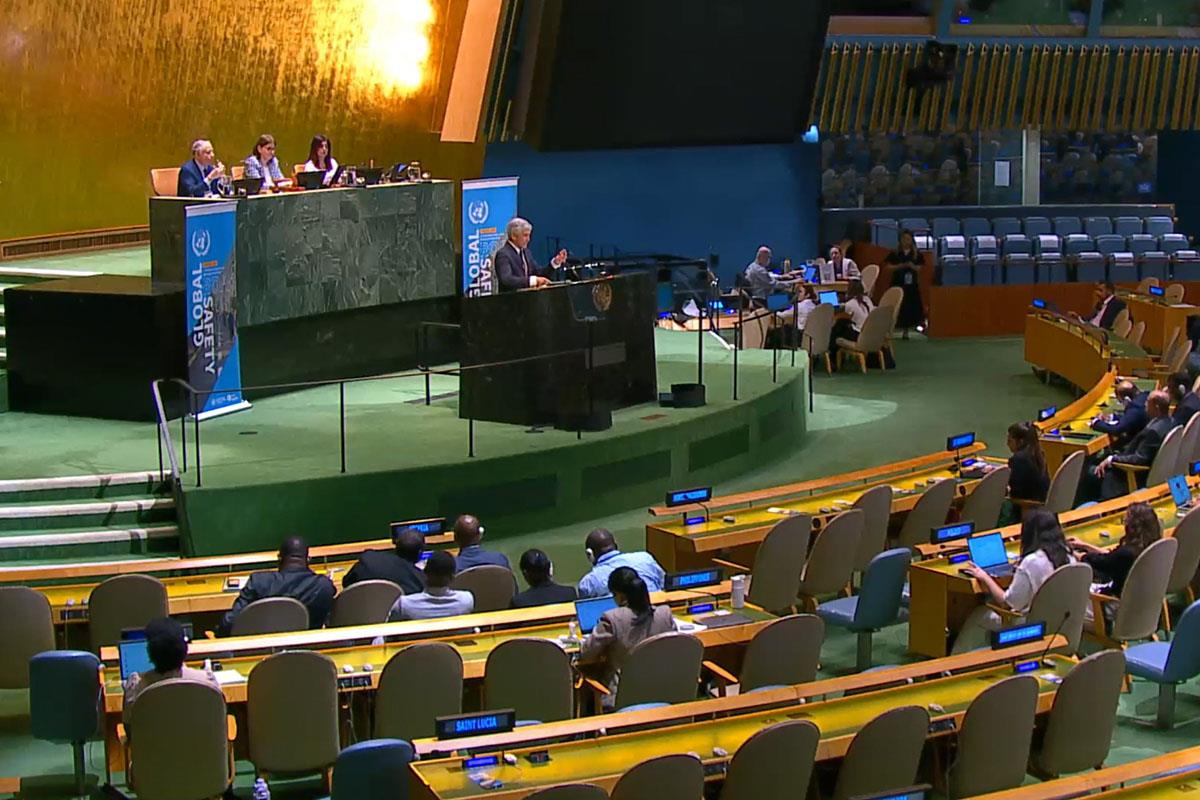 The Minister for Home Affairs, Fernando Grande-Marlaska, during his speech at the High-Level Meeting on Improving Road Safety, held at the United Nations General Assembly in New York






The Minister for Home Affairs, Fernando Grande-Marlaska, has presented in New York, the Spanish road safety model as proof that "road accidents are preventable" if the necessary measures are implemented "with the ambition, determination and urgency" required by "the challenge of saving lives".
The minister highlighted the reduction in road accidents in Spain over the last 20 years. "We have gone from having one of the highest mortality rates in the EU - at 128 deaths per million inhabitants - to being among the best-performing countries, with a rate of 37 deaths per million", he said during his address to the United Nations General Assembly, as part of the High-Level Meeting on Road Safety.
This international forum, convened by the President of the United Nations General Assembly in collaboration with the World Health Organisation, aims to drive a 50% reduction in road accident deaths and injuries by 2030 - an initiative included in the Sustainable Development Goals (SDGs) and the UN Decade of Action for Road Safety 2021-2030, launched in September 2020. In addition to the minister, the Spanish delegation includes the undersecretary of the Ministry of Home Affairs, Susana Crisóstomo, and the Director General of Traffic, Pere Navarro.
During his speech, Grande-Marlaska attributed Spain's progress in road safety to three key areas. Firstly, he emphasised the importance of placing victims and their families at the heart of the process, recognising "their vital role" in fostering a culture of prevention.
He also referred to the need to involve the whole of society in public policy - from public authorities and businesses to third-sector organisations and user associations - "because road safety is a shared responsibility", he emphasised.
In his remarks, the minister emphasised compliance with road traffic legislation as the third key pillar in improving the statistics, through "effective monitoring and enforcement" of the highest-risk factors, such as the use of seatbelts and helmets, alcohol and drug consumption, speeding, distractions and repeat offences.
Measures implemented and proposals for the future
In his address, Grande-Marlaska mentioned the introduction of a 30-kilometre-per-hour speed limit on single-lane urban roads and the replacement of emergency triangles with connected V-16 beacons as two of the recent measures that may help to improve road accident statistics.
Among his proposals for the future, the Minister for Home Affairs stressed the urgent need to lower the maximum blood alcohol limit for drivers to 0.1 milligrams per litre of breath - "a priority proposal for the Government of Spain that we hope to turn into reality soon".
He also highlighted the importance of international cooperation, advocating for the strengthening of the Ibero-American Road Safety Programme and the inclusion of "clear commitments" in this area at the upcoming Ibero-American Summit of Heads of State, scheduled for November in Madrid.
The countries attending the meeting have adopted a joint declaration reaffirming their commitment to implementing the 2030 Agenda for Sustainable Development and its Sustainable Development Goals, with a particular focus on halving the number of deaths and injuries caused by road traffic accidents worldwide by 2030.
The text urges countries to work towards ensuring access to "safe, affordable, accessible and sustainable transport systems for all" and to develop "reliable, sustainable, resilient and high-quality infrastructure" to promote economic development and well-being. "Road safety is an integral part of sustainable development and contributes to progress in its economic, social and environmental dimensions", states the declaration.
World Health Organisation event
During his stay in New York, the minister also spoke at an event organised by the World Health Organisation (WHO) at the United Nations headquarters, entitled 'From Commitment to Delivery: Country Progress and Accountability for Halving Road Traffic Deaths by 2030".
During the panel discussion in which he took part, alongside ministers and deputy ministers from Brazil, the United Kingdom, Morocco and Thailand, Grande-Marlaska stated that improving road safety is not a matter of lacking knowledge - "since the risk factors and most effective actions have already been identified" - but rather a question of implementing the measures.
"The challenge lies in transforming that knowledge into policy decisions; those decisions into regulations; and those regulations into real changes that drastically reduce road accident rates on motorways and in towns and cities", he added during the panel discussion.
The Minister for Home Affairs highlighted Spain's experience and outlined seven lessons that proved crucial to the adoption of effective measures: political will; strong institutions with management capacity, such as the DGT; coordination between the relevant authorities and sectors; policies underpinned by scientific evidence; partnerships with associations and third-sector organisations; appealing to citizens' sense of personal responsibility; and implementing an appropriate public communication policy.
Non official translation