Ibero-America promotes a common framework for road safety and moves towards the harmonisation of driving standards and licences
News - 2026.6.26
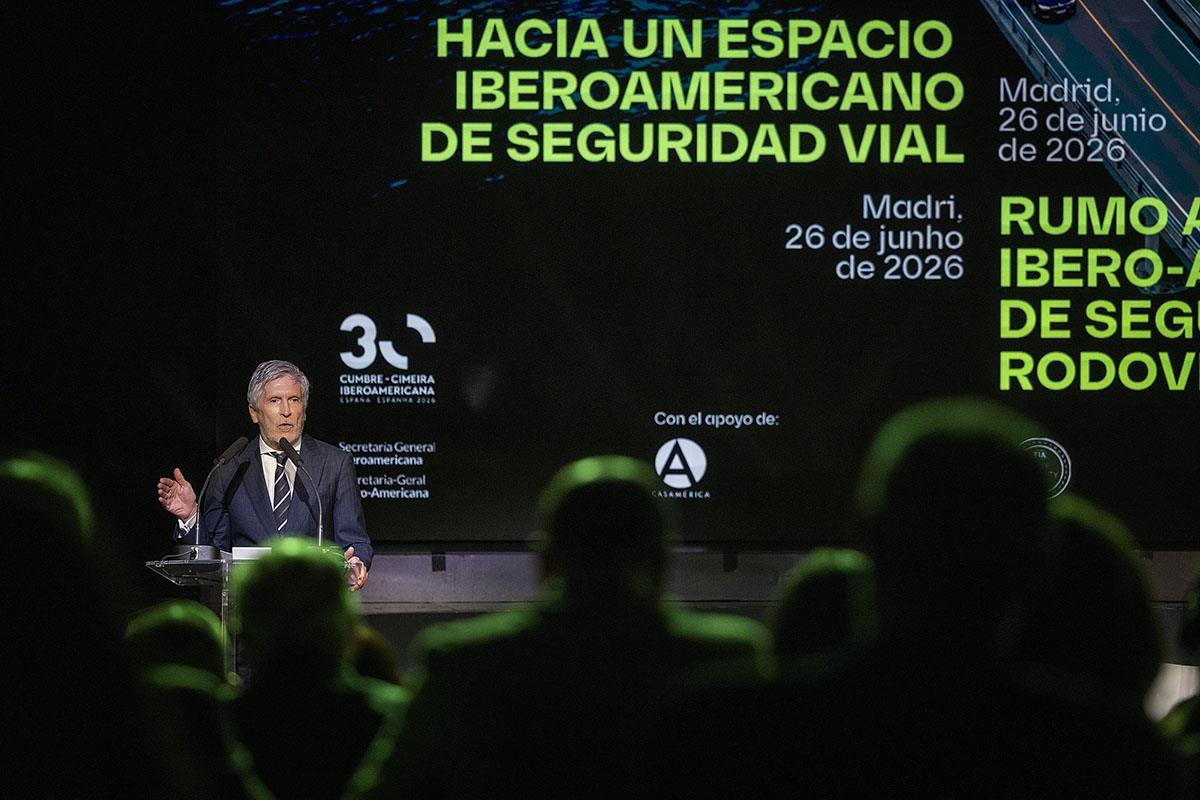 The Minister for Home Affairs, Fernando Grande-Marlaska, during his speech at the event






In his speech, Grande-Marlaska highlighted the adoption of the so-called 'Madrid Declaration' by the heads of the transport and road safety agencies of the Ibero-American countries, an agreement that reaffirms the importance of cooperation in reducing road accidents, which currently claim more than 90,000 lives each year across the 22 countries of the Ibero-American Conference.
The minister emphasised that this document "is an agreement without precedent in the history of regional cooperation on road safety because it reaffirms the value of life as the guiding principle of our public policies, because it recognises road safety as an essential prerequisite for sustainable development, and because it expresses our countries' determination to move forward together over the coming years".
In addition to the "Madrid Declaration", approved during the 12th General Assembly of the Ibero-American Road Safety Observatory (OISEVI) and the Ibero-American Road Safety Programme, the Ibero-American Strategic Framework for Safe Mobility 2030, the Ibero-American Safe Mobility Index, and projects to harmonise driving licenses and traffic regulations were all endorsed.
The Ibero-American Secretary-General, Andrés Allamand, highlighted the significance of the meeting due to the joint participation of governments and civil society - represented by victims' associations - and Ibero-American cooperation itself, as well as the results achieved and the commitments made for the future.
"The fact that the number of road traffic victims in Ibero-America continues to rise, and that they are mainly young people, compels us to act. The number of vehicles in Latin America and the Caribbean continues to rise, and the region's transport infrastructure remains inadequate. "We must take action, because we are talking about preventable deaths," said Allamand.
'Madrid Declaration'
Despite differences in the distribution of powers and the specific challenges facing each country, the adopted declaration maintains that it is possible to agree on a set of common principles. To this end, it is committed to strengthening national traffic and road safety agencies and recognises the key role played by the Ibero-American Road Safety Programme (OISEVI) as the main network for cooperation between the authorities responsible for this area.
The roadmap is defined in the Ibero-American Strategic Framework for Safe Mobility 2030, also recently approved at the OISEVI Assembly, which identifies priorities and establishes a shared vision for the second half of this decade. In this regard, the declaration itself emphasises the benefits that the gradual harmonisation of basic standards and driving licences can bring to people's safety and mobility, and paves the way for convergence.
In fact, one of the most significant points is the request made to the Ibero-American Road Safety Programme/OISEVI to draw up, within two months, a legislative and regulatory framework to harmonise both driving licences and the regulations relating to the main risk factors for road accidents: speed, safety systems, alcohol consumption and distractions caused by mobile phone use. This proposal will be put forward for consideration at the Ibero-American Summit in November.
The progress made on this collaborative project aims to promote a shared framework for road safety and the movement of people and goods. Furthermore, as stated in the Declaration, these efforts should serve to facilitate decisions and promote social acceptance and compliance with the rules.
Ibero-American Safe Mobility Index
The agreement also welcomes the new Ibero-American Safe Mobility Index (IMSS), promoted by the Ibero-American General Secretariat (SEGIB), FICVI, the Mapfre Foundation and around twenty civil society organisations from the region, in collaboration with OISEVI itself.
This initiative seeks to strengthen the role of civil society as an ally in public road safety policies and to encourage greater government commitment to intensifying measures aimed at reducing accidents on roads and in urban areas.
The IMSS has set out a roadmap with eleven priority areas for action over the coming years. Among the most notable proposals is the creation of units and networks providing comprehensive care for victims of road traffic accidents in all Ibero-American countries, including specialised helplines similar to the 018 service recently launched in Spain.
It also advocates moving towards greater harmonisation of traffic regulations and the classification of road traffic offences; strengthening monitoring and enforcement of traffic regulations; promoting public transport as a safer and more sustainable alternative; and implementing safe mobility programmes in both public and private companies and organisations.
Furthermore, the 'Madrid Declaration' proposes improving the quality of data on road accidents and the main factors associated with them. In particular, it focuses on indicators relating to fatalities and serious injuries, basic characteristics of accidents, and indicators relating to road user behaviour, vehicle and infrastructure safety, as well as post-accident care.
It also calls for particular attention to be paid to the protection of vulnerable road users (pedestrians, cyclists and motorcyclists), by improving understanding of their mobility patterns, risk factors and specific protection needs.
Victims of road violence
A particularly noteworthy aspect of the meeting was the presence of victims' organisations. More than 20 representatives from organisations across twelve Ibero-American countries took part on behalf of the Ibero-American Federation of Associations of Victims of Road Violence (FICVI).
"It is difficult to find any precedent for a meeting where government officials from all Ibero-American countries and representatives of victims' associations have been able to engage in a joint dialogue about the present and future of road safety in our region". "Their presence lends legitimacy, humanity and meaning to our work, because behind every public policy, behind every strategy and behind every indicator, there are human lives that we must protect", said Grande-Marlaska.
This Friday's event, opened by Susana Sumelzo, Secretary of State for Ibero-America, the Caribbean and Spanish in the World, and Andrés Allamand, Ibero-American Secretary General, capped off a week of work during which Madrid became the Ibero-American capital of road safety. This event followed the 12th General Assembly of the Ibero-American Road Safety Observatory (OISEVI) held over the previous two days and coincided with the General Assembly of the FICVI.
Over the course of these three days, there have been around twenty sessions, most of them held at the headquarters of the Directorate-General for Traffic, featuring presentations by representatives from the traffic and road safety agencies of OISEVI member countries and guest countries; members of organisations specialising in road safety, transport and sustainable mobility; international bodies such as the World Health Organisation (WHO) and the World Bank; and representatives from police departments and victims' associations.
Grande-Marlaska expressed his gratitude to the Directorate-General for Traffic for making these gatherings a reality. He highlighted that the Director-General, Pere Navarro, "has for over two decades fostered an enduring relationship of collaboration, exchange and mutual learning between Spain and Ibero-American countries - a relationship that, as we see today, is bearing fruit and improving people's lives".
He also extended his thanks to the Ministry of Foreign Affairs, European Union and Cooperation, the Ibero-American General Secretariat (SEGIB); the Ibero-American Road Safety Programme (OISEVI) and other participating countries; the FICVI; the WHO; the Pan American Health Organisation (PAHO); the MAPFRE Foundation; the International Automobile Federation (FIA); and the various civil society organisations, noting that "all have contributed to placing road safety where it belongs among our collective priorities".
Non official translation