The Government promotes a 9.099 billion euro Social Climate Plan to protect vulnerable households and micro-companies from fossil fuel dependence
News - 2026.5.25
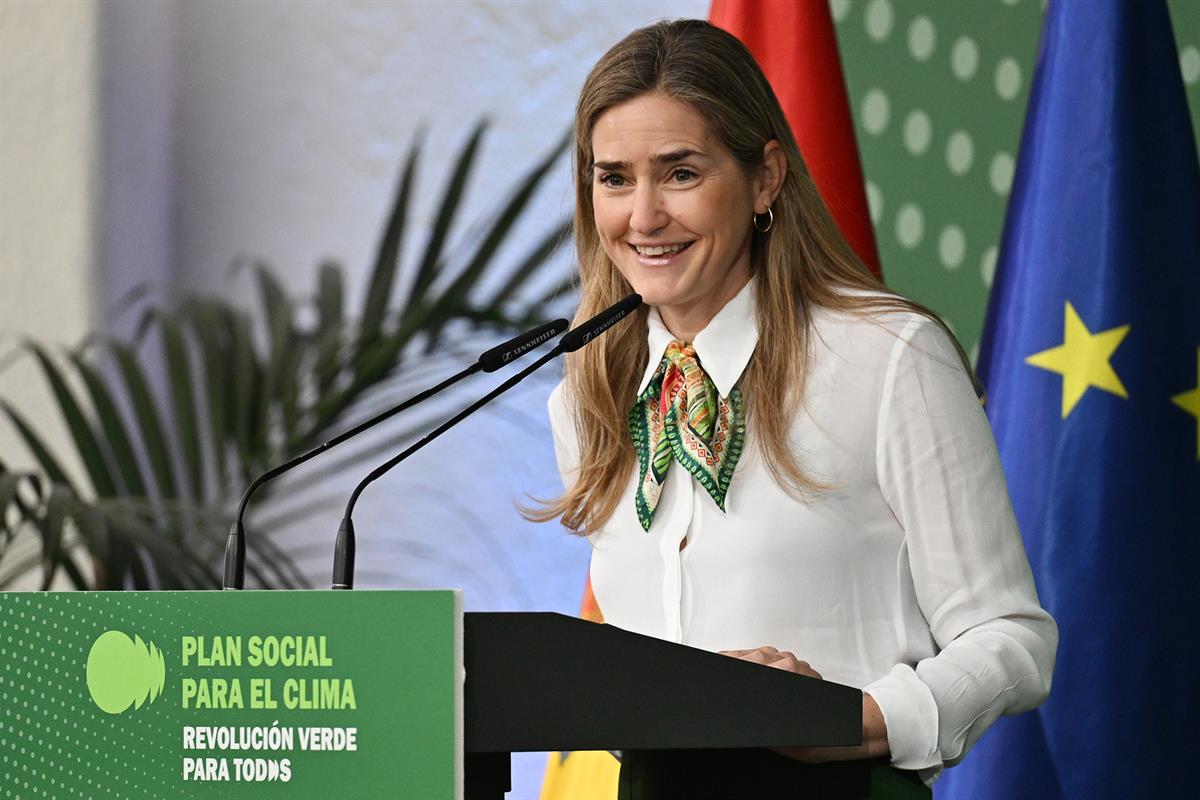 The third Vice-President and minister for Ecological Transition and the Demographic Challenge, Sara Aagesen, speaks at the presentation of the Social Plan for Climate (Pool Moncloa / Borja Puig de la Bellacasa)






The Ministry of Ecological Transition and Demographic Challenge (MITECO), the Ministry of Transport and Sustainable Mobility (MITMS) and the Ministry of Housing and Urban Agenda (MVAU) submit the Draft Social Plan for Climate (PSpC) for public information. It is a strategic instrument with 9.099 billion euros allocated to provide stable protection for the most vulnerable groups in the face of the volatility of fossil fuel prices. It is the Executive's intention to submit it, duly agreed to the European Commission for approval before the end of 2026.
In a context marked by international instability stemming from the crisis in the Middle East and the blockade of the Strait of Hormuz, which has highlighted the risks of dependence on imported fossil fuels, the Government of Spain is moving from temporary protective measures - such as the 5 billion euros social shield - towards permanent and transformative solutions.
The energy transition is an opportunity for businesses and households to reduce their exposure to fossil fuel price volatility, gaining in competitiveness, quality of life and at the same time contributing to the fight against climate change. And the PSpC is a further step in that direction.
The PSpC, which covers the period 2026-2032, will focus its investment capacity on vulnerable groups in two key areas: buildings and road transport, with the aim of facilitating the further decarbonisation of the economy to improve quality of life, habitability and social equity.
As a result, the PSpC is conceived as an accompanying and stable protection instrument that complements and reinforces the goals of the National Integrated Energy and Climate Plan 2023-2030, the National Strategy against Energy Poverty 2026-2030, the State Housing Plan and the Sustainable Mobility Act and the Recovery, Transformation and Resilience Plan. Its design prioritises the permanent reduction of the energy needs of vulnerable households and businesses, as well as access to clean and affordable mobility alternatives for these groups.
A budget of 9.099 billion euros funded by the EU
The PSpC is part of the Social Climate Fund, a European initiative aimed at providing the EU members with resources to finance structural investments in the fields of buildings and road transport. It will have a financial allocation of 9.099 billion euros for 2026-2032, financed through the allocation to Spain of 10.52% of the total resources of the Social Climate Fund, together with a national contribution of 25% of the Plan's total budget.
The distribution of funds responds to the analysis of the country's needs and is structured in two main areas: 52% of the budget (4.723 billion) will go to the buildings sector, while the remaining 48% (4.376 billion) will go to the transport sector.
The beneficiaries have been defined according to criteria of technical rigour and social sensitivity. Only vulnerable households will be eligible, especially those in fuel poverty or with low and lower-middle incomes who do not have the resources to rehabilitate their homes. Also included are vulnerable transport users, affected by the lack of viable alternatives to private vehicles, as well as micro-companies - with fewer than 10 employees and an annual turnover of under 2 million euros - with a high dependence on fossil fuels in their fleets.
Energy transformation and access to affordable housing
The Buildings Component of the PSpC has a budget of 4.723 billion euros and is a key tool for modernising the Spanish residential stock, which still has a high number of homes with low energy efficiency. The planned measures aim to reduce energy consumption, improve thermal comfort inthe face of extreme weather events and significantly reduce CO₂ emissions. They are divided into seven lines of action:
- Affordable housing development (1.813 billion euros): this is the largest measure in the Component. It will enable the construction of new affordable housing and the comprehensive refurbishment of buildings currently without residential use, ensuring high standards of energy efficiency.
- Rehabilitation in vulnerable neighbourhoods and urban environments (1.22 billion euros): will finance comprehensive actions at neighbourhood level to reduce non-renewable primary energy consumption. Priority will be given to areas with higher vulnerability indices, including energy rehabilitation, renewable air conditioning or the development of district heating and cooling networks.
- Rehabilitation of residential buildings (923 million euros): support to improve thermal insulation and replace fossil fuel-based systems in buildings where vulnerable households live. The intensity of the aid will be adjusted according to the level of energy improvement achieved.
- Rehabilitation of individual dwellings (278 million euros): personalised and tailored interventions for those households which, due to their location in multi-family buildings, cannot undergo community rehabilitation.
- Energy communities and active consumers (300 million euros): promotion of collective self-consumption and energy storage systems, with the condition of allocating at least 10% of the energy generated or saved free of charge to vulnerable consumers in the surrounding area.
- RED-ACTÚA (27 million euros): creation and consolidation of one-stop shops and advice offices to facilitate access to aid and reduce the digital divide, with face-to-face and itinerant attention in rural areas.
- Express intervention pilot projects and buildings for social use (162 million euros): fast-track measures for households in thermal emergency situations and actions to improve air-conditioning in public education and care centres.
Sustainable, structured and inclusive mobility
Transport accounts for more than a third of greenhouse gas emissions in Spain and is one of the sectors most exposed to the volatility of oil prices. To respond to this challenge, the Transport Component of the PSpC will mobilise 4.376 billion euros with the aim of facilitating access to clean alternatives, strengthening territorial cohesion and reducing transport poverty, as well as supporting micro-companies and the self-employed whose activity is centred on road transport. The actions are structured in six major strategic blocks:
- Decarbonisation of road transport (2.269 billion euros): 846.2 million euros will be earmarked to support the renewal of heavy vehicle fleets with electric vehicles in vulnerable micro-companies through aid that can cover up to 100% of this extra cost, as well as the scrapping of pre-2020 vehicles (which emit around seven times more NOx than a new one) and 642 million euros for the purchase of light electric vehicles by self-employed workers and vulnerable micro-companies. In addition, 381.4 million euros is included for the electrification of urban public transport fleets and a cross-cutting item of 400 million euros for the roll out of recharging points in companies' own facilities.
- Affordable and accessible public transport (964.8 million euros): reserved bus lanes will be funded to the tune of 224.3 million euros with the aim of developing at least 28 projects totalling more than 80 kilometres of new dedicated bus lanes, and a unified fare system will be promoted through the "Abono Único Social" (740.5 million euros), only available to vulnerable groups - such as Minimum Basic Income recipients - which will allow unlimited and multimodal travel at highly reduced fares.
- On-demand and shared rural mobility (702 million euros): to respond to the dependence on private vehicles in rural areas, where the Motorisation Index is almost 50% higher than in urban areas (698 v 470), with cars absorbing 96.2% of the household transport budget. Zero emission fleets and digital platforms for on-demand transport services (551 million euros) and local shared mobility solutions (151 million euros) will be financed.
- Promotion of active mobility (370.5 million euros): construction of safe cycling infrastructure (357 million euros) and implementation of public cycling systems, both conventional (9.7 million euros) and long-term rental (3.8 million euros), to encourage a shift to active cycling. 58.1% of Spaniards own at least one bicycle, especially in small towns, but only 3.2% use them every day to go to work or school. The new investments aim to remove the safety barriers that cause this mismatch and to triple the potential for cycling as an everyday mode of transport.
- Intermodality (26.2 million euros): adaptation of infrastructure through 263 secure bicycle and personal mobility vehicle parking projects at stations, platforms and stops, as well as accessibility improvements at railway stations and the adaptation of 108 railway units to allow bicycles to be loaded without folding.
- Carpooling exchange points (43 million euros): creation of more than 40 intermodal car parks on the State Road Network to encourage carpooling for everyday journeys.
Social Impact, Governance and Public Participation
The design of the PSpC establishes a governance framework aimed at ensuring that the ecological transition takes place in an equitable and socially protective manner. For its drafting, the Government has promoted an extensive process of consultation and public participation, incorporating more than 1,000 contributions from social agents, third sector entities, regional administrations and local entities.
With the launch of the public consultation, a further step has been taken in the participatory process, with the aim of gathering the allegations, proposals and contributions of society as a whole on the project. Workshops will also be held to improve social participation in the drafting of the plan by civil society associations, companies, trade unions, regional and local administrations, young people, etc.
One of the PSpC's axes is the sex perspective. The analysis shows that women - especially those in single-parent families or with unshared caring responsibilities - are more affected by fuel poverty and transport poverty. Therefore, the socio-economic vulnerability criteria for granting financial support will take into account factors such as family composition, income level, the existence of dependents and the situation of victims of sex-based violence.
Disbursements conditional on meeting milestones
At the operational level, the PSpC will have a monitoring system until 31 July 2032. Disbursements will be conditional on meeting milestones and targets, and measures will be subject to the principle of "do no significant harm" to the environment (DNSH). Institutional coordination will be the responsibility of MITECO, in collaboration with MIVAU, MITMS, the Autonomous Communities and local authorities, which will play a key role in implementing the investments.
With the launch of the PSpC, the Government of Spain reaffirms its commitment to a green transition that, in addition to meeting international environmental objectives, contributes to economic recovery, local job creation and the strengthening of the welfare state. There is no effective climate policy without social justice.
Comments and allegations can be submitted until 29 June using the form available.
Non official translation