Council of Ministers
The Government of Spain is extending protection in cases of temporary incapacity and boosting support for families and victims
Council of Ministers - 2026.10.20
Moncloa Palace, Madrid
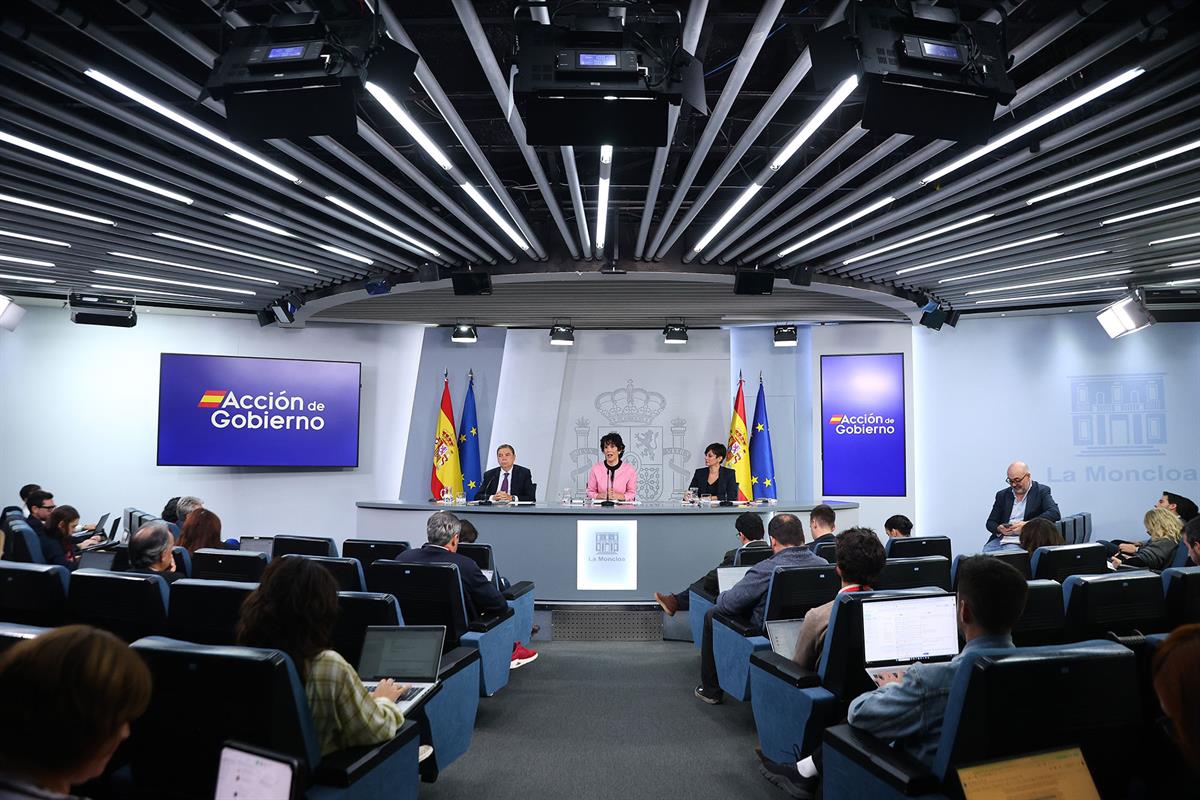 The Minister for Agriculture, Fisheries and Food, Luis Planas, the Minister for Inclusion, Social Security and Migration, Elma Saiz, and the Minister for Housing and Urban Agenda, Isabel Rodríguez, at the press conference after the Council of Ministers (Pool Moncloa / Sandra Armada)



Elma Saiz, Minister for Inclusion, Social Security and Migration and Government Spokesperson, announced that the Council of Ministers has approved a Royal Decree-law to improve the protective role of the social security system. "A piece of legislation that extends rights, strengthens protection for families and addresses situations that required more adequate coverage", summarised Saiz. The government spokesperson highlighted the role of social dialogue and "active listening" to various associations in drafting the text, which must be ratified by the Standing Committee of the Lower House of Parliament.
New special circumstances relating to temporary incapacity
Among the main new features of the legislation, Elma Saiz highlighted the creation of two special categories of temporary incapacity: one for women suffering from incapacitating conditions related to the menopause, and another for female workers who are victims of gender-based violence and whose injuries prevent them from working. From the day following the start of sick leave, both benefits will offer greater protection than standard temporary incapacity cover and will not require a minimum qualifying period.
"In both cases, the financial benefit will be calculated by applying the temporary incapacity rate to 60 per cent of the assessment base, and from the 20th day onwards, this will rise to 75 per cent. This measure protects a very significant proportion of our country's workforce. More than 10.5 million women are national insurance contributors, and we are addressing situations that were previously overlooked, as well as long-standing disparities that women have faced - gaps that will now be met with more adequate protection", stated the Minister for Inclusion, Social Security and Migration.
Greater protection against catastrophic events
The Government Spokesperson also explained that the legislation strengthens the protection afforded to people affected by catastrophic events, by treating their temporary incapacity in the same way as that resulting from an accident at work.
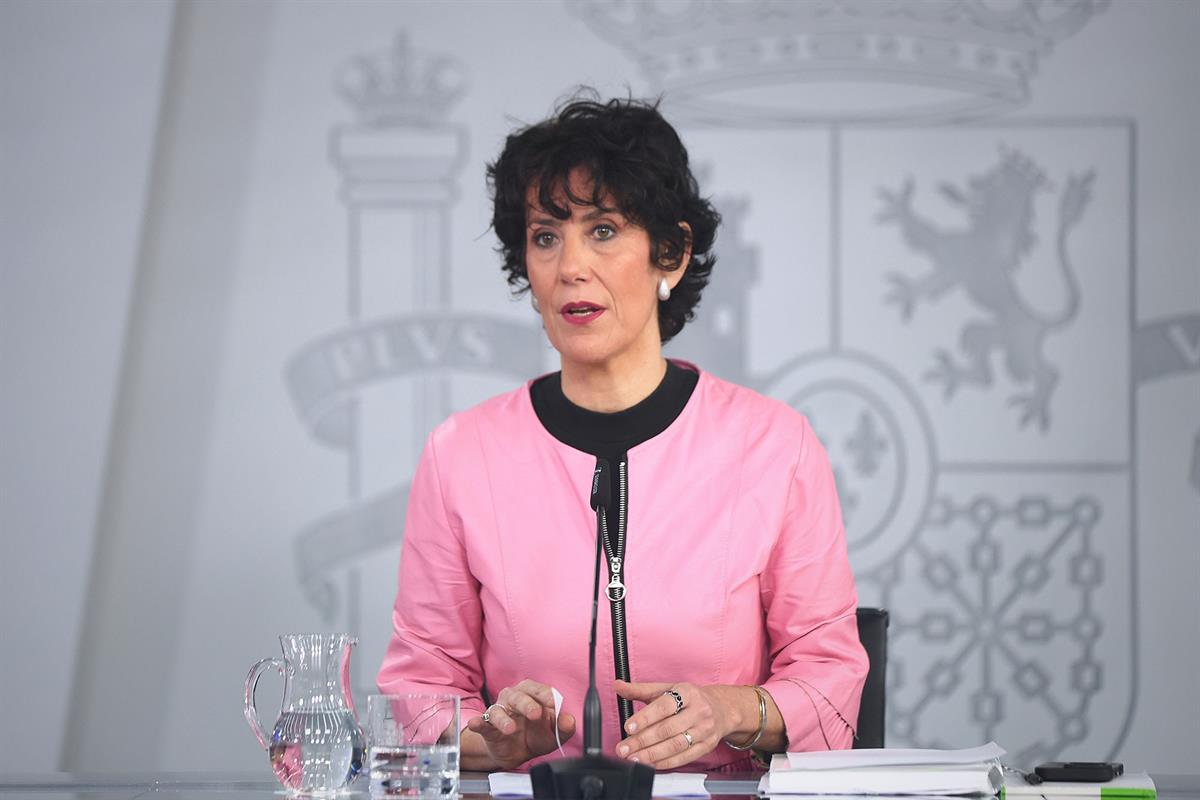 The Minister for Inclusion, Social Security and Migration and Government Spokesperson, Elma Saiz, at the press conference after the Council of Ministers | Pool Moncloa / Sandra Armada
Saiz pointed out that this measure has already been applied on an exceptional basis on previous occasions, but that, under this decree-law, it can be implemented without the need to resort to extraordinary measures, even in the face of "situations such as those currently unfolding in the Valencian Community".
Greater protection for families and victims
Elma Saiz added that the legislation also extends protection to families caring for children with cancer or other serious illnesses, by allowing both parents to receive the benefit either alternately or simultaneously. Furthermore, it extends its coverage beyond the age of 26 where the person concerned has a level III dependency or a disability of 65 per cent or more.
On the subject of pensions, the minister pointed out that access to a widow's pension will be made easier for cohabiting couples with children in common who can prove they have lived together for two years, even if they are not registered in the relevant register. "Furthermore, we are introducing an important provision: a one-year grace period so that potential beneficiaries of this measure, in respect of past deaths, can claim it if they had previously applied for it", emphasised Elma Saiz. The legislation also strengthens financial protection for orphans resulting from violence against women, with a benefit equivalent to twice the National Minimum Wage in force at any given time.
Furthermore, the decree-law places the compensation for victims of terrorism on an equal footing, regardless of whether a criminal conviction has been handed down, both in cases of disabling injuries and in respect of the pensions awarded to their relatives in the event of death.
Finally, the minister stated that the decree-law triples the maximum advance payment from the Maintenance Payments Guarantee Fund, from 100 to 300 euros per month, and extends its duration from the current 18 months until the payment obligation ceases, in order to strengthen the financial protection of children in situations where maintenance payments are not being made.
Funding to increase the supply of affordable housing in high-demand areas
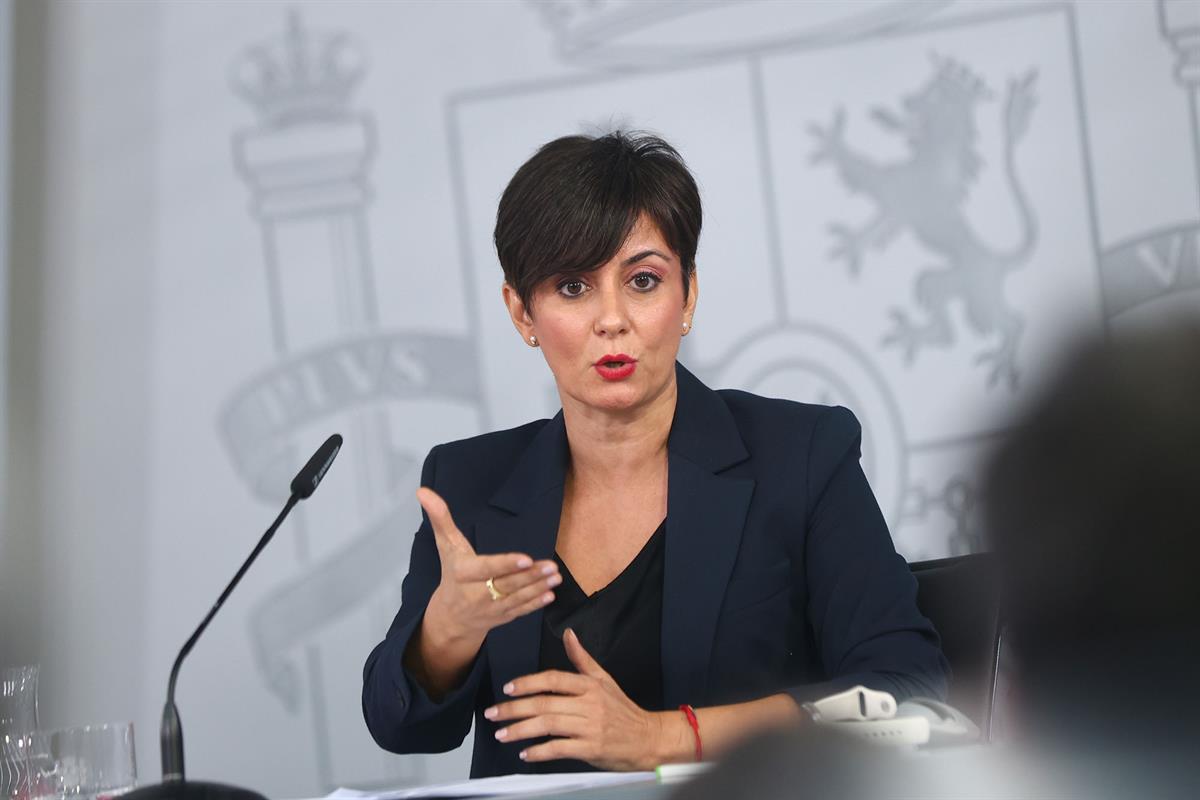 The Minister for Housing and Urban Agenda, Isabel Rodríguez, during her speech at the press conference | Pool Moncloa / Sandra Armada
The Council of Ministers has approved two royal decrees with the common aim of making progress in guaranteeing the right to housing. "They are aimed at promoting housing where it is most needed and also for those who need it most", said the Minister for Housing and Urban Agenda, Isabel Rodríguez.
The first regulation allocates additional resources to areas that have been designated as having a stressed housing market; there are currently 317 towns across five autonomous communities, covering a population of over 9 million people.
As the minister explained, the text complies with the Housing Act, which requires the regional governments - which have jurisdiction in this area - to draw up an Action Plan once areas have been declared to be under pressure, and which calls on the General State Administration to adopt extraordinary measures. The Ministry of Housing has already taken some of these steps, for example, with the approval of the State Housing Plan, which provides extraordinary grants to developers for the construction of social housing and allows public authorities to cover up to 80 per cent of the purchase cost of an existing property to be used for affordable rental accommodation. The decree approved today grants direct subsidies to the regional governments to enable them to implement strategic plans in line with the directive set by the Ministry of Housing.
The funding totals 180 million euros, allocated according to the population affected in each area experiencing housing pressure and the financial burden families face in paying their rent. The largest share goes to the region with the most areas experiencing housing pressure: Catalonia. The funds are earmarked for the development or refurbishment of housing to be made available as social or affordable rental accommodation; the purchase of land by regional governments or local councils for the construction of housing or other emergency solutions; land development and infrastructure; the purchase of properties on the open market to add them to the public housing stock; and the provision of guarantees or insurance for young people.
Promoting affordable accommodation at public universities
 The Minister for Housing and Urban Agenda, Isabel Rodríguez, during her speech at the press conference | Pool Moncloa / Sandra Armada
The second decree allocates 45 million euros to the construction of accommodation for university students and all university staff. These funds will enable the creation of around 2,000 accommodation places, as part of most advanced projects at Spanish public universities - initiatives the government has been working on for several years, according to the Minister for Housing.
Isabel Rodríguez pointed out that there are young people who are having to give up on the university where they want to study because the cost of housing prevents them from doing so. The minister also emphasised that the Government has gone "far beyond" what is required of it and hopes that "this project will serve as an inspiration to the relevant authorities".
Institutions participating in this initiative include the Autonomous University of Madrid, the University of Castilla-La Mancha (Albacete), Pablo de Olavide University (Seville), the University of Burgos, Jaume I University in Castelló, the University of Jaén and the University of Lleida. Minister Rodríguez expressed her gratitude for the collaboration of the Conference of Rectors of Spanish Universities, noting that it helps "to continue advancing not only the excellence of the Spanish university system but also the guarantee of equal access to higher education for all Spaniards".
Aid for farms affected by fires
The Government has introduced two new measures to support farmers and livestock farmers.
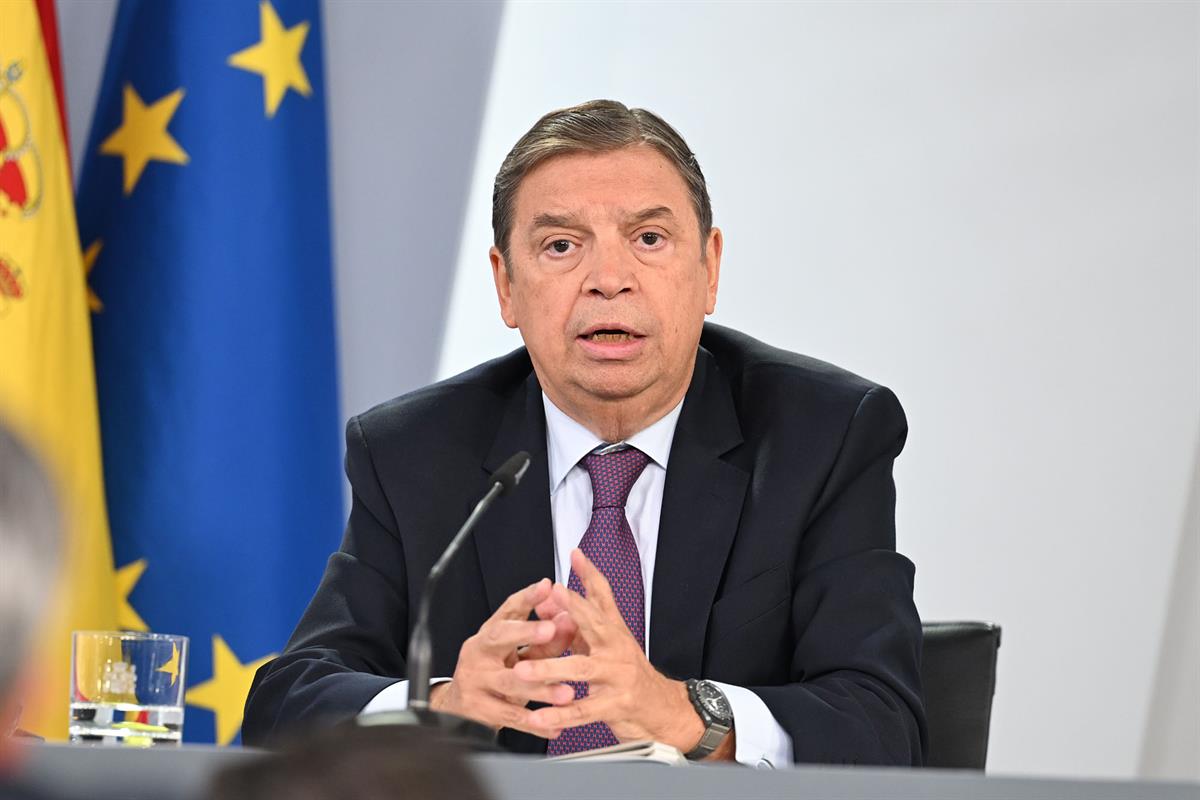 The Minister for Agriculture, Fisheries and Food, Luis Planas, at the press conference after the Council of Ministers | Pool Moncloa / Borja Puig de la Bellacasa
Firstly, it has approved aid totalling up to 9 million euros to supplement agricultural insurance cover against the fires that occurred in 2026. The Minister for Agriculture, Fisheries and Food, Luis Planas, noted that approximately 270,000 hectares have been affected by these fires this year, of which about 60,000 are agricultural lands.
This aid allows, on one hand, for an increase in the Government's subsidy for agricultural insurance premiums - up to 70 per cent of the total cost, which is the legal maximum under European regulations. Luis Planas pointed out that his department has already disbursed 344 million euros this year to support agricultural insurance. On the other hand, the funds provide compensation for damages that were not otherwise covered: 3,500 euros per hectare for fruit orchards, 1,900 euros per hectare for citrus groves, 450 euros per head of cattle, and 120 euros per affected beehive, among other forms of assistance.
"This is a measure that complements the best risk management tool currently available to us in our primary sector, which is under constant pressure", said Planas, who warned of the consequences of "extreme weather events" for agriculture, livestock farming and fisheries.
Combating animal diseases
A second agreement within the Ministry of Agriculture, Fisheries and Food involves the transfer of 19.1 million euros to the regional governments to combat animal diseases.
 The Minister for Agriculture, Fisheries and Food, Luis Planas, at the press conference after the Council of Ministers | Pool Moncloa / Borja Puig de la Bellacasa
Luis Planas emphasised the importance of this issue, which is a recurring one and is heavily influenced by climate change, increased contact through transport, and the globalisation of trade in agri-food products. These are issues, he added, that may seem highly technical but which can affect food prices, as has been the case with outbreaks of avian flu.
Meanwhile, the Minister for Agriculture announced that a Sectoral Conference tomorrow will approve the transfer of 50.1 million euros from the European Union to the regional governments to subsidise the purchase of fertilisers. This sum is in addition to the 635 million that the Government has already allocated for this purpose. "It is a welcome and timely measure that helps to curb the rise in input costs for our farmers and livestock breeders", he said.
Latest developments in Ceuta
The Minister for Inclusion, Social Security and Migration and Government Spokesperson provided an update on the situation in Ceuta, with figures as at 19 October. Elma Saiz explained that a new operation had been carried out to clear various areas, following the actions taken on Trampolín and Guano beaches. The latest clearances took place in the Poblados Regulares neighbourhood, on the Tarajal esplanade and in the Tarajal warehouses, and in the area surrounding the Temporary Immigrant Accommodation Centre (CETI).
According to figures provided by the spokesperson, 12,705 people have returned to Morocco since 10 August, of whom 12,142 returned voluntarily and 536 were deported. Furthermore, the General State Administration has made 7,477 places available in temporary accommodation.
The Minister for Agriculture, Fisheries and Food, Luis Planas, the Minister for Inclusion, Social Security and Migration, Elma Saiz, and the Minister for Housing and Urban Agenda, Isabel Rodríguez, at the press conference after the Council of Ministers | Pool Moncloa / Sandra Armada
As for minors, 3,331 remain in the care of the regional child protection system. A further 107 have been transferred to the mainland through family reunification procedures, and 181 have been relocated to different autonomous communities in accordance with Article 35 of the Immigration Act. In addition, 63 cases have been referred to Morocco.
On the subject of security, the minister pointed out that 11,375 surveillance and intelligence patrols have been carried out and that 5,237 officers are deployed across the city. She also highlighted that school attendance remains at around 90 per cent, which is within normal parameters.
Finally, with regard to healthcare, Saiz stated that 83 per cent of migrants housed in the designated facilities have been vaccinated and that, of the 211 hospital beds available in Ceuta, 100 are currently occupied, 20 of which are occupied by migrants.
Current affairs: Storm Adam
The spokesperson conveyed the Government's solidarity with those affected by Storm Adam in the Valencian Community, as well as its condolences for those who lost their lives as a result of the storm. Saiz also expressed her support for the families and loved ones of the victims and acknowledged the work of the emergency services and all the professionals who have stepped in to assist those affected and protect the public.
Non official translation