The Government confirms that resources have been mobilised in Ceuta, enabling more than 12,700 people to return to Morocco since 10 August
News - 2026.10.20
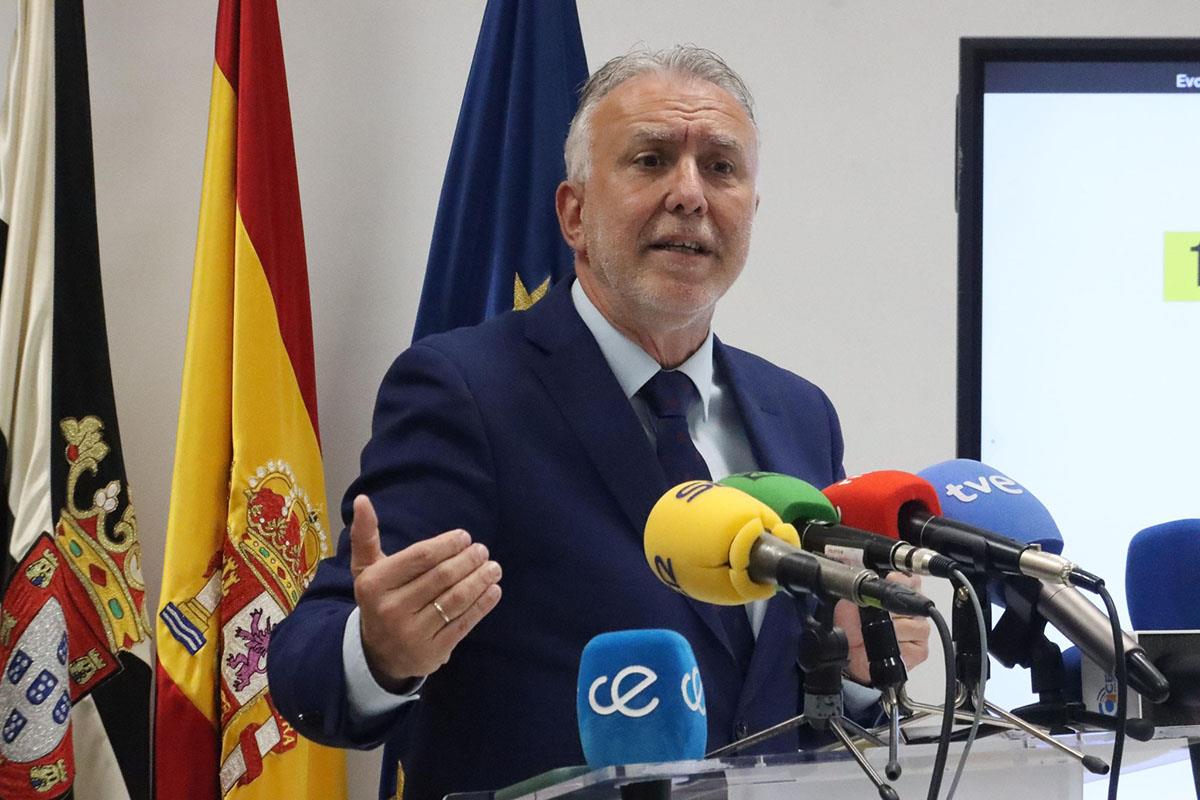 The Minister for Territorial Policy and Democratic Memory, Ángel Víctor Torres, during his appearance before the media






The Ministry of Territorial Policy and Democratic Memory has responded to the preliminary request submitted in September by the President of Ceuta, Juan Jesús Vivas, regarding the actions taken by the General State Administration following the events of 30 and 31 July.
Although the Government of Spain's failure to respond would in itself be considered a rejection, a decision has been sent to the autonomous city. This decision concludes that there is no inaction, as alleged by the head of the city government, given that the requested actions "are already underway". Furthermore, the response to the request explains that these measures "have made it possible to drastically reduce the initial pressure and maintain public order in the city".
Furthermore, it highlights that the declaration of a 'Situation of National Security Interest' in Ceuta, approved by the Government, facilitated the establishment of a strengthened coordination structure to address the crisis and organise a comprehensive response from the General State Administration, which "is already clear evidence that there has been no inaction" on the part of the services under the authority of the Government of Spain.
The Ministry therefore rejects the request, whilst informing the city government of the measures taken by the various ministerial departments and state bodies. Actions taken by the Government of Spain have enabled more than 12,700 people to return to Morocco between 10 August and 20 October, and ensured that the majority of adult migrants remaining in the city are housed in facilities provided by the General State Administration. Furthermore, the large settlements along the coast (Trampolín, Benítez and Guano) have now been completely cleared, whilst work continues on clearing scattered settlements in urban areas.
A section of the Functional Authority's resolution explains that, since early August, the General State Administration sought to secure designated spaces, agreed upon in consultation with the autonomous city. These included plots of land within the port area; although initially offered by the city, they later faced complications raised by the Port Authority, which delayed their implementation.
The Government of Spain's statement emphasises that the provision of these spaces (which currently offer over 7,400 places) and the dismantling of large migrant encampments were "swift, effective and necessary" measures that have resulted in a higher number of returns of adult individuals.
The document details further measures to strengthen security, establish regulated areas, increase resources for identification and triage processes, and expedite the processing of case files as much as possible.
Migrants cannot be 'deported' without due process
In its response, the Government reiterates the obligation to respect legal safeguards in this migration crisis. With regard to the request to resolve, within one month, all cases concerning expulsion, refoulement or return, as well as applications for international protection, the Ministry points out that their processing must comply with the time limits, procedures and safeguards laid down in Spanish and European legislation.
The resolution states that these procedures "require an individual assessment" and that "it is not appropriate to impose a general time limit that takes precedence over that laid down by the applicable legislation".
Support for the city within its areas of responsibility: Children and young people
The response to the request explains that the individuals who have so far returned to Morocco are adults, falling within the remit of the General State Administration, and that ordinary jurisdiction over unaccompanied minors lies with the autonomous city, noting that "none of them has, as of today, been reunited with their families in Morocco".
The Ministry's document also takes stock of the actions undertaken by the relevant ministerial departments in caring for unaccompanied migrant children and adolescents and in supporting the autonomous city in this area.
In this area, there has also been ongoing collaboration with the authorities in Ceuta, as well as the provision of additional support amounting to 88 million euros for the care of minors.
Specifically, during the plenary session of the Sectoral Conference on Childhood held on 27 August, an allocation of 25 million euros was approved to fund the care of unaccompanied migrant children and adolescents in Ceuta for the year 2026.
Furthermore, a Royal Decree-Law on Urgent Social and Economic Measures - approved on 1 September - includes 63 million euros in direct support for the autonomous city to assist with the care of minors. This Royal Decree-Law also provides 2 million euros to enable the autonomous city to appoint representatives for minors - a role that is essential under new European regulations for procedures involving minors.
Non official translation