Council of Ministers
The Government of Spain is stepping up social protection and support for Spanish athletes
Council of Ministers - 2026.6.16
Moncloa Palace, Madrid
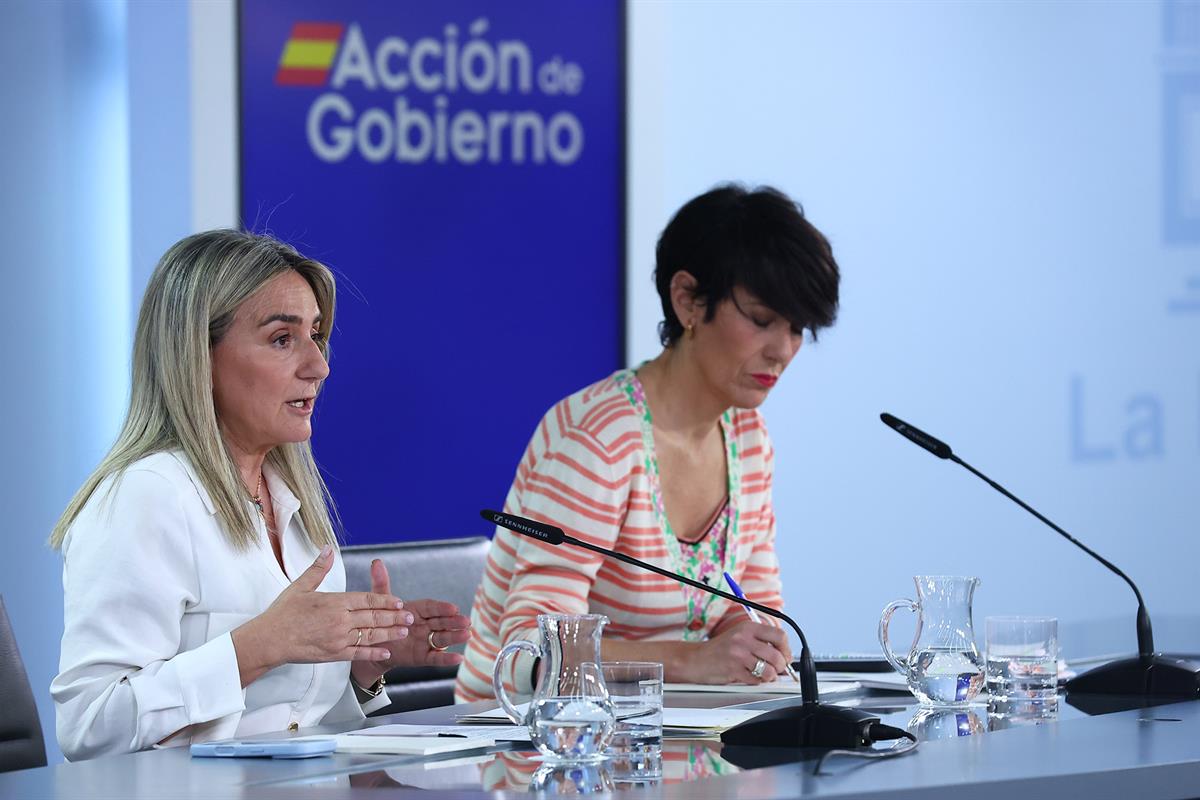 The Minister for Education and Vocational Training and Sports, Milagros Tolón, and the Minister for Inclusion, Social Security and Migration and Government Spokesperson, Elma Saiz, during the press conference after the Council of Ministers (Pool Moncloa / Fernando Calvo)






The Council of Ministers has authorised the allocation of grants totalling 29.4 million euros to strengthen social protection for top-level Spanish athletes and to support the preparation of those representing Spain in major international competitions.
"When an athlete competes in the Spanish team's kit, there are years of hard work, sacrifice and dedication behind them, and it is the duty of the institutions to support that effort and provide the best possible conditions," said Milagros Tolón, Minister for Education, Vocational Training and Sport.
Support for athletes, coaches and sports federations
The investment of 29.4 million is divided across three funding streams.
The first, amounting to 3 million euros, is earmarked for the social protection of elite sportspersons, specifically for the payment of social security contributions. In recent years, the Government has invested more than 7.5 million euros in this type of call for proposals.
A second programme is aimed at athletes who represent Spain in international competitions. The grants, totalling 13.9 million, are aimed at preparing athletes and coaches for the 2028 Olympic and Paralympic Games in Los Angeles.
Finally, a third funding stream provides 12.5 million euros to support the work of sports federations through two programmes: Team España Élite, which aims to improve the preparation of athletes with the best prospects of success in major international competitions, and Team España Estratégico, which promotes sports with high potential for competitive development and internationalisation. The minister pointed out that this funding will also be used to support those who took part in the recent Winter Olympic and Paralympic Games, "at which Spain put in a truly outstanding performance".
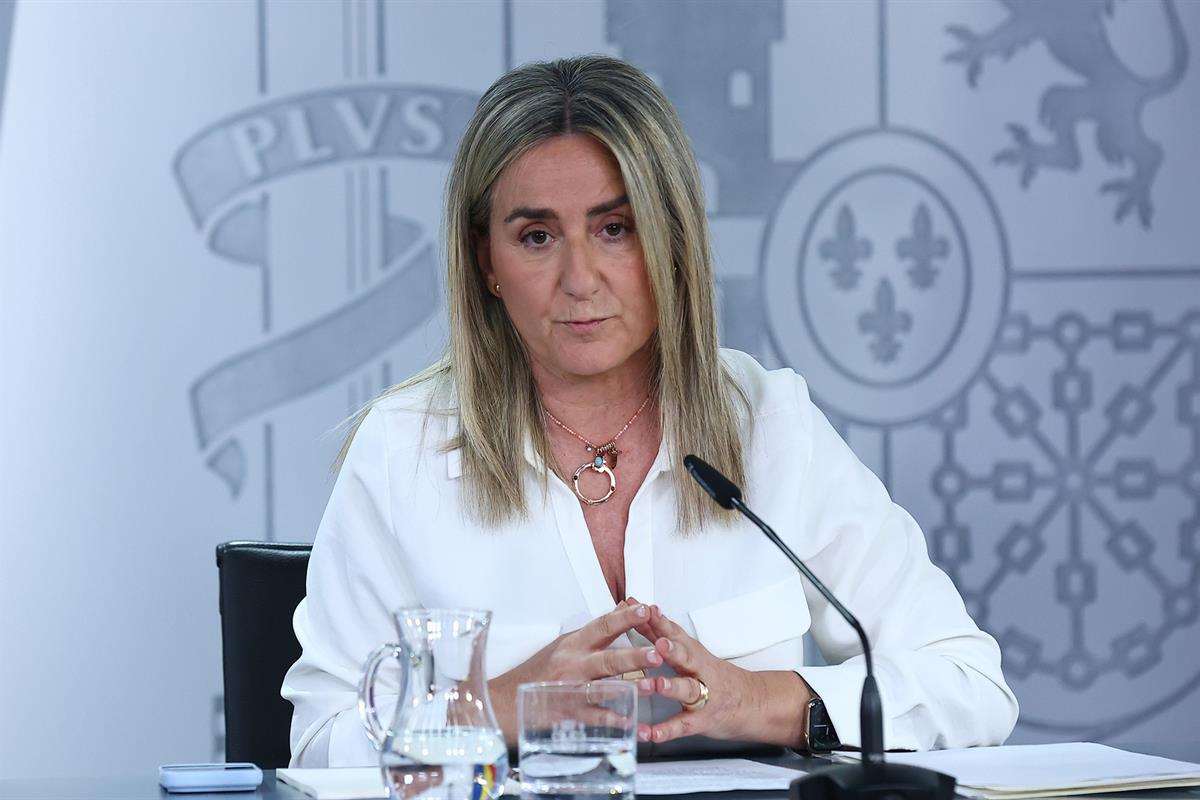 The Minister for Education, Vocational Training and Sports, Milagros Tolón, during the press conference after the Council of Ministers | Pool Moncloa / Fernando Calvo
Tolón emphasised that "sporting success cannot be improvised" and "requires planning, stability and public support". The funding allocated today, he added, forms part of the "ambitious sports policy" that the Government has been implementing since 2018. "We have made the largest public investment in sport in our recent history, with more than 2,300 million euros earmarked for modernising the Spanish sports system," he said. The minister emphasised that, during this period, the Government has also stepped up its support for elite sport and women's sport, made progress towards equality between Olympic and Paralympic athletes, and consolidated strategic programmes such as Team España.
Annual Plan for the Promotion of Decent Work
Elma Saiz, Minister for Inclusion, Social Security and Migration and Government Spokesperson, has announced the approval of the 2026 Annual Plan for the Promotion of Decent Work, drawn up by the Ministry of Work and Social Economy. Saiz has described it as "a key tool for ensuring that everyone, regardless of where they live, has access to quality job opportunities and effective public employment services".
The spokesperson explained that the initiative "includes a total of 92 services and programmes aimed at improving employability, strengthening training, facilitating entry into the labour market and supporting both workers and businesses".
Elma Saiz also highlighted that the plan includes measures to reduce inequalities in the labour market, with the aim of moving towards more inclusive, stable and high-quality employment. In this regard, specific measures are being introduced to target groups requiring priority support, such as young people, the long-term unemployed and the Roma community.
The plan has been drawn up in collaboration with the autonomous communities. In fact, the Sectoral Conference on Employment and Labour Affairs agreed on the allocation of 2,571.9 million euros to fund active labour market policies.
A Spanish-run artificial intelligence "gigafactory"
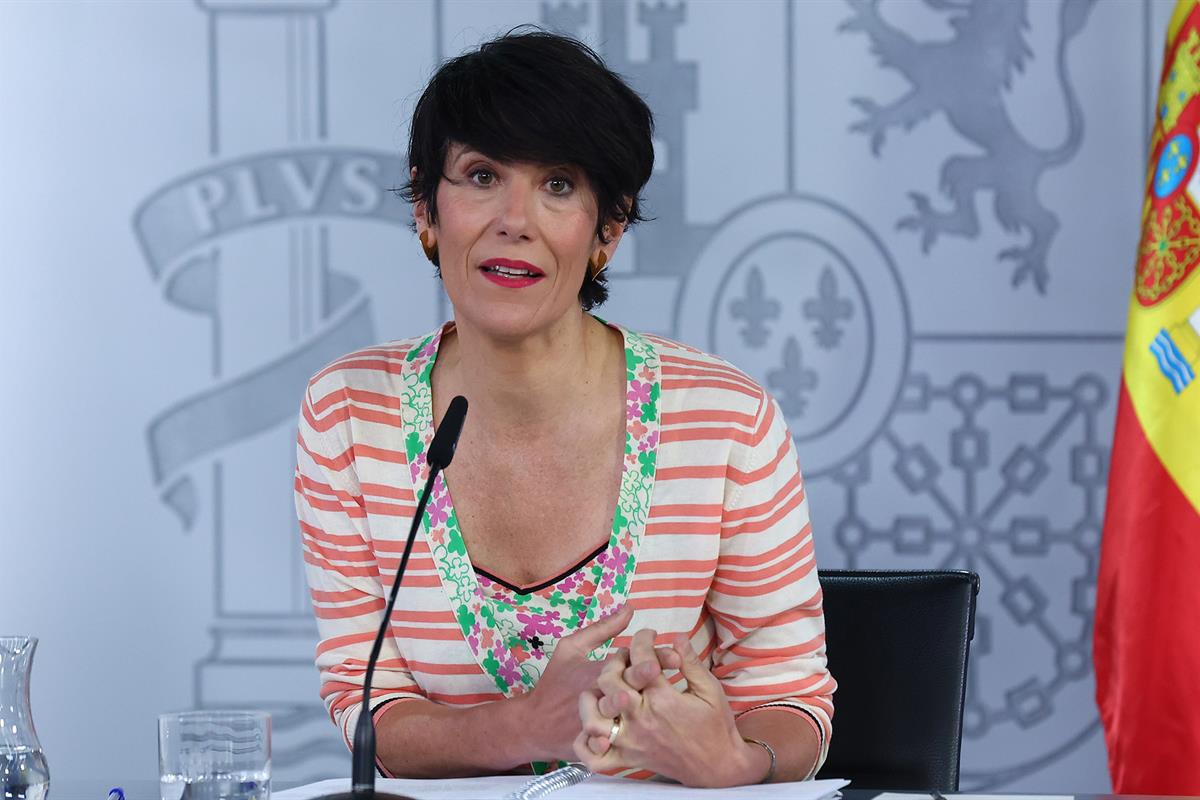 The Minister for Inclusion, Social Security and Migration and Government Spokesperson, Elma Saiz, during her speech at the press conference after the Council of Ministers | Pool Moncloa / Fernando Calvo
Elma Saiz also explained that the Government has authorised an investment of 719 million euros from the Ministry for Digital Transformation and the Civil Service, via the Spanish Society for Technological Transformation (SETT), in the public-private consortium that will develop an advanced artificial intelligence (AI) gigafactory.
AI gigafactories are enormous data centres designed to house hundreds of thousands of GPUs (Graphics Processing Units), which are essential for training and performing inference on large artificial intelligence models, such as language models and computer vision models. They form a technological and industrial infrastructure within which the most advanced artificial intelligence systems are trained and operated.
The government spokesperson has emphasised that this is "a multi-site bid" which includes locations for the gigafactory in Móra la Nova (Tarragona) and San Fernando de Henares (Madrid). Through this transaction, SETT will be able to become a shareholder in the company that plans to submit Spain's bid in response to the call for proposals that the European Commission is due to launch shortly in this sector.
"This investment reflects the Government of Spain's commitment to technological sovereignty, reindustrialisation and leadership in developing reliable and sustainable artificial intelligence. Having European access to advanced computing capabilities will enable our SMEs, as well as large companies, to innovate more quickly and strengthen their competitiveness. "It also means that our scientific community has access to new, state-of-the-art infrastructure, or that public authorities develop more advanced, secure and efficient public services," said Saiz.
Amendment to the Law on VAT
The Council of Ministers has approved the amendment to the Law on Value Added Tax (VAT), a reform which marks progress towards the partial transposition of European VAT legislation in the digital age.
As explained by the Government spokesperson, the bill aims to adapt the tax to new economic and technological realities through three main lines of action: strengthening the fight against tax fraud in intra-Community transactions; simplifying the administrative and registration obligations faced by businesses and professionals to promote the development of e-commerce and the digital economy; and strengthening the role of digital platforms in the management and collection of tax in sectors where market distortions have been identified, such as short-term accommodation rentals or passenger transport.
Current affairs: the Middle East peace agreement and a review of the Pope's visit
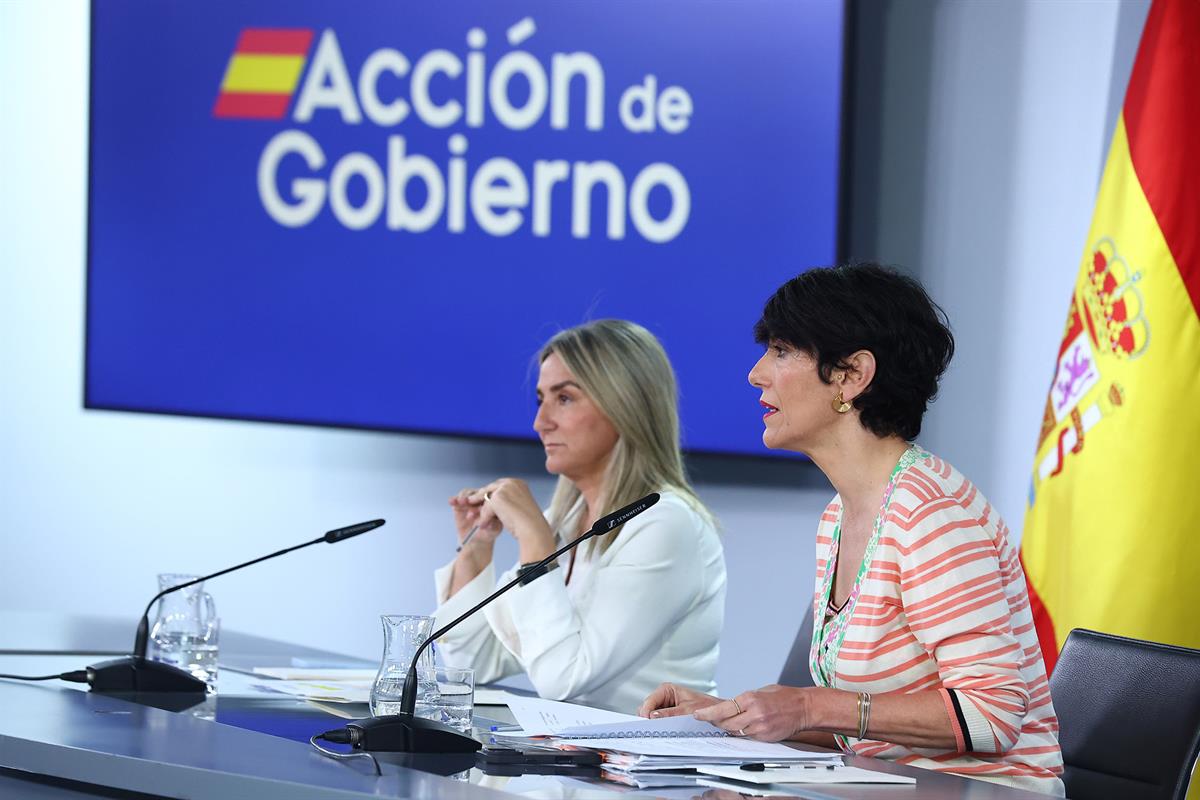 The Minister for Education and Vocational Training and Sports, Milagros Tolón, and the Minister for Inclusion, Social Security and Migration and Government Spokesperson, Elma Saiz, during the press conference after the Council of Ministers | Pool Moncloa / Fernando Calvo
Elma Saiz began her speech by describing the agreement reached between the United States and Iran to secure a ceasefire "that would ease tensions" in the Middle East as "very positive".
The spokesperson pointed out that the Government has always maintained "that dialogue, diplomacy and negotiation are essential tools for addressing international conflicts and moving towards lasting solutions" and, for this reason, they are confident that this agreement represents a firm step towards stability and security in the region. Saiz wished to acknowledge the work of the countries and parties that had acted as mediators to ensure the agreement went ahead. In particular, he mentioned Pakistan, as "its commitment and its ability to facilitate opportunities for understanding have proved crucial".
Similarly, the minister gave a positive assessment of Pope Leo XIV's visit to Spain, which took place between 6 and 12 June. Saiz highlighted both the "excellent coordination" between the authorities and institutions involved and the warm reception from the public, which, in his view, "reflect the best of our country and our society".
According to the spokesperson, this trip projected an image of Spain as "open, diverse and committed" and confirmed that the Government's migration policy "has been backed by Pope Leo XIV". The Minister for Inclusion, Social Security and Migration has highlighted the fact that the Pope has conveyed the message that the phenomenon of migration must be addressed through values such as solidarity, international cooperation and respect for human rights. "These are principles which, I can assure you, will continue to guide this Government's actions," he said.
Non official translation