Extraordinary Council of Ministers
The Government of Spain allocates €5 billion to mitigate the effects of the war in the Middle East
Council of Ministers - 2026.3.20
Moncloa Palace, Madrid
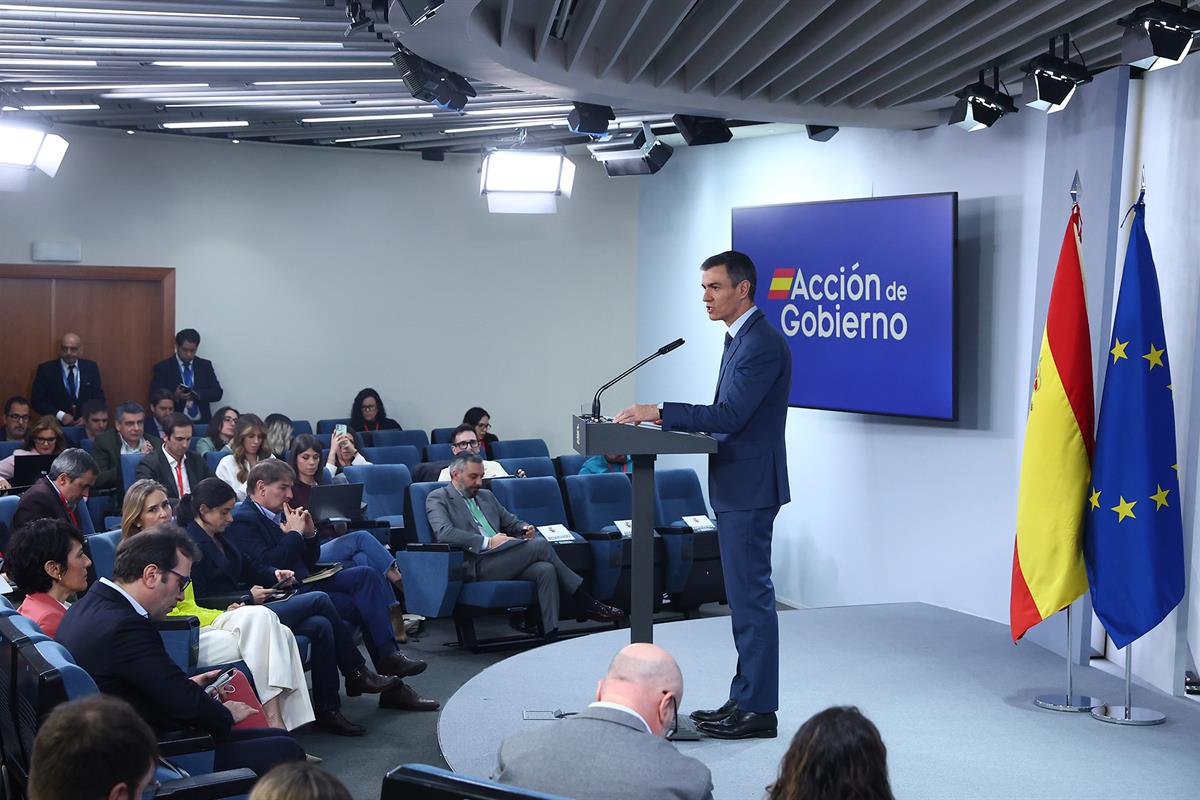 The President of the Government of Spain, Pedro Sánchez, appears before the media after the extraordinary Council of Ministers (Pool Moncloa / Fernando Calvo)






The Council of Ministers has approved two royal decree-laws with urgent measures to mitigate the impact that the war in the Middle East is having on citizens and the economy. The first contains 80 measures that will mobilise €5 billion to benefit 20 million households and 3 million businesses. The second establishes a temporary freeze on housing rental prices. Both will come into effect after their publication in the Official State Gazette.
During his appearance at the press conference following the Council of Ministers meeting, the President of the Government of Spain, Pedro Sánchez, reiterated that Spain does not endorse this war: "The no to war is a resounding no to an illegal war in Iran". However, the president assured that the government will mobilise all necessary resources to protect citizens, help small and medium-sized enterprises, the primary sector, and Spanish industry, just as it has done in previous crises, such as the one caused by the pandemic or Russia's invasion of Ukraine, by adopting "bold and pioneering reforms."
Pedro Sánchez stressed that war costs innocent lives and has an economic impact on Spaniards: "It will cost us 5 billion euros, which we could be allocating to scholarships, healthcare, and social services."
Protection for households and the most vulnerable sectors and a boost to energy sovereignty
 The President of the Government of Spain, Pedro Sánchez, appears before the media after the extraordinary Council of Ministers | Pool Moncloa / Fernando Calvo
The first royal decree approved today includes two main pillars: the first, of a temporary nature, to establish a social safety net to protect households and the most vulnerable economic sectors, and the second, of a structural and strategic nature, with initiatives aimed at boosting energy sovereignty.
Temporary measures: tax cuts
The president announced a "drastic reduction" in energy taxes. Thus, taxes on electricity will be reduced by 60%, the Tax on the Value of Electricity Production will be suspended, and the Special Tax on Electricity will be lowered to the minimum rate of 0.5%. VAT on electricity will be reduced from 21% to 10%. In addition, the VAT applicable to natural gas, briquettes, and pellets will decrease to 10%, and the maximum sale price of butane and propane will be frozen.
Pedro Sánchez also announced that taxes affecting the price of petrol and diesel will be reduced to the minimum allowed by the European Union, which translates into "an effective reduction of up to 30 euro cents per litre depending on the fuel, about 20 euros in savings per tank for an average car."
Furthermore, the president announced that all extraordinary discounts on the social electricity tariff (bono social eléctrico) will be extended until the end of the year, as well as the ban on cutting off basic utilities to the most vulnerable households.
In addition, electricity transmission and distribution tolls will be reduced by 80% for all energy-intensive industries. "We are going to help these industries save around 200 million euros and preserve their competitiveness, their activity, and hundreds of thousands of jobs in very important regions that depend precisely on these industries."
The royal decree-law also includes specific support measures for the agricultural and fishing sectors. Pedro Sánchez highlighted the establishment of a subsidy of 20 cents per litre of fuel for all hauliers, farmers, and livestock breeders, as well as additional aid for the purchase of fertilisers.
Furthermore, greater flexibility in energy supply contracts is being established by law so that companies and the self-employed can adapt their terms to the current situation without additional costs.
The National Commission for Markets and Competition will be given new supervisory and sanctioning powers to ensure that aid reaches its intended recipients and to prevent abuses. The president stressed that any company that takes advantage of this crisis or state aid to enrich itself will be severely punished: "Every euro of this plan comes from the taxpayers' efforts and must be returned to them in full. A responsible government and the competent authorities cannot tolerate some people trying to profit from this crisis out of pure greed."
Structural measures to boost energy sovereignty
The second pillar of the measures is structural in nature. "We are focused on what is urgent, but also on what is important, and in fact, thanks to the fact that we never forget what is important, we are better prepared today," the President of the Government of Spain stated.
The objective, as Pedro Sánchez explained, is to continue with the energy policy of decarbonising and electrifying the Spanish economy, "which has proven to be very positive in addressing the effects of the climate emergency" and has also benefited consumers. The head of the Executive highlighted that installed renewable energy capacity has increased by 150% in the last 7 years, making Spain more resilient to energy crises like the current one.
The measures in this pillar are aimed at further promoting energy sovereignty. Among these measures, the president cited a "massive package of deductions" in personal income tax for the installation of solar panels, charging points, and heat pumps, new subsidies for building climate control, and streamlined procedures for the installation of renewable energy sources. The legislation also increases electrical storage capacity through, for example, batteries and the declaration of public utility for pumped hydroelectric power.
Temporary freeze on rental prices
 The President of the Government of Spain, Pedro Sánchez, appears before the media after the extraordinary Council of Ministers | Pool Moncloa / Fernando Calvo
The Council of Ministers has approved another royal decree-law, the result of an agreement between the two political groups that make up the coalition government, to establish a temporary freeze on rental prices, similar to those applied in previous crises.
The head of the Executive acknowledged that there is not yet a parliamentary majority to ratify this second measure, "but this does not mean that the progressive coalition government will forgo providing a response to the housing emergency affecting a large part of the Spanish population." Pedro Sánchez added that negotiations with parliamentary groups will continue in the coming weeks with the aim of passing this royal decree-law.
Largest social and economic safety net in the entire European Union
The sum of the agreements approved by the Council of Ministers will make Spain "the country with the largest social and economic safety net in the entire European Union in response to this illegal war, which we do not condone," Pedro Sánchez emphasised. The measures, he added, will remain in effect for as long as necessary. "And if circumstances require it because the severity of the crisis worsens, we will extend them," he assured.
The president stated that this is a plan consistent with the policies that have allowed Spain to recover and even surpass, "in record time," the economic growth and job creation levels prior to the pandemic and the war in Ukraine. No plan, however ambitious, "will be able to neutralise all the miseries of this illegal war," so all political parties must demand "the immediate cessation of this conflict" and respect for international law, as Pedro Sánchez has argued.
Non official translation