Council of Ministers
The Government of Spain approves the draft Statute for non-work-based practical training
Council of Ministers - 2026.3.3
Moncloa Palace, Madrid
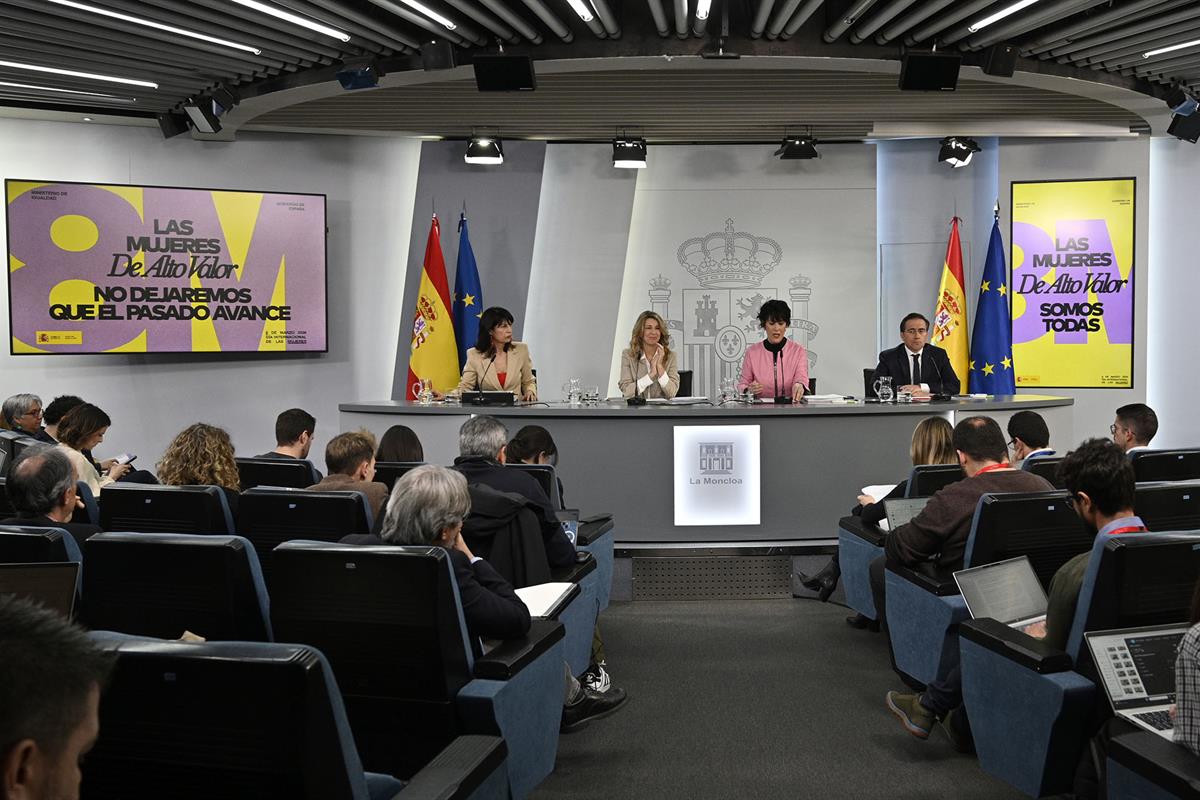 The Minister for Equality, Ana Redondo, together with the Ministers for Labor and Social Economy, Yolanda Díaz, for Inclusion, Social Security and Migration, Elma Saiz, and for Foreign Affairs, European Union and Cooperation, José Manuel Albares (Pool Moncloa/Carlos Herrero)






The Council of Ministers has approved sending to Parliament the draft bill on the Statute for non-work-based practical training, a regulation that responds to the objectives of the 2021 labour reform. The regulation defines the boundary between employment relationships and training activities and will allow for the eradication of fraudulent practices that disguise an employment relationship, which will lead to an increase in youth employment.
The Minister for Inclusion, Social Security and Migration and Government Spokesperson, Elma Saiz, highlighted that the approval of the regulation is very timely because yesterday the number of young people who have contributed to social security during their unpaid training placements since 1 January, 2024, surpassed two million, of whom 56% are women. "The so-called Internship Statute that we have approved today addresses this issue, guaranteeing rights and preventing the exploitation of young students who are taking their first steps in the labour market", she emphasised.
Similarly, the Second Vice-President of the Government of Spain and Minister for Labour and Social Economy, Yolanda Díaz, who presented the draft bill in November 2025, highlighted that the objective of the legislation is "to define what constitutes quality training in Spain, preserve it, and make it a hallmark of excellence".
Guarantees and rights of individuals in non-work placements
Non-work placements must be linked to official university studies, Vocational Training, or courses determined by public employment services. Otherwise, an employment relationship will be considered to exist. An employment relationship will also exist if the intern replaces the work of an employee.
Yolanda Díaz explained that, from now on, non-work placements in companies must be documented in writing. Companies will be required to sign a cooperation agreement with the training centre outlining the training each individual must receive and the maximum duration of their internship. Furthermore, each individual will have dual supervision: one person from the company or government agency and another from the training centre.
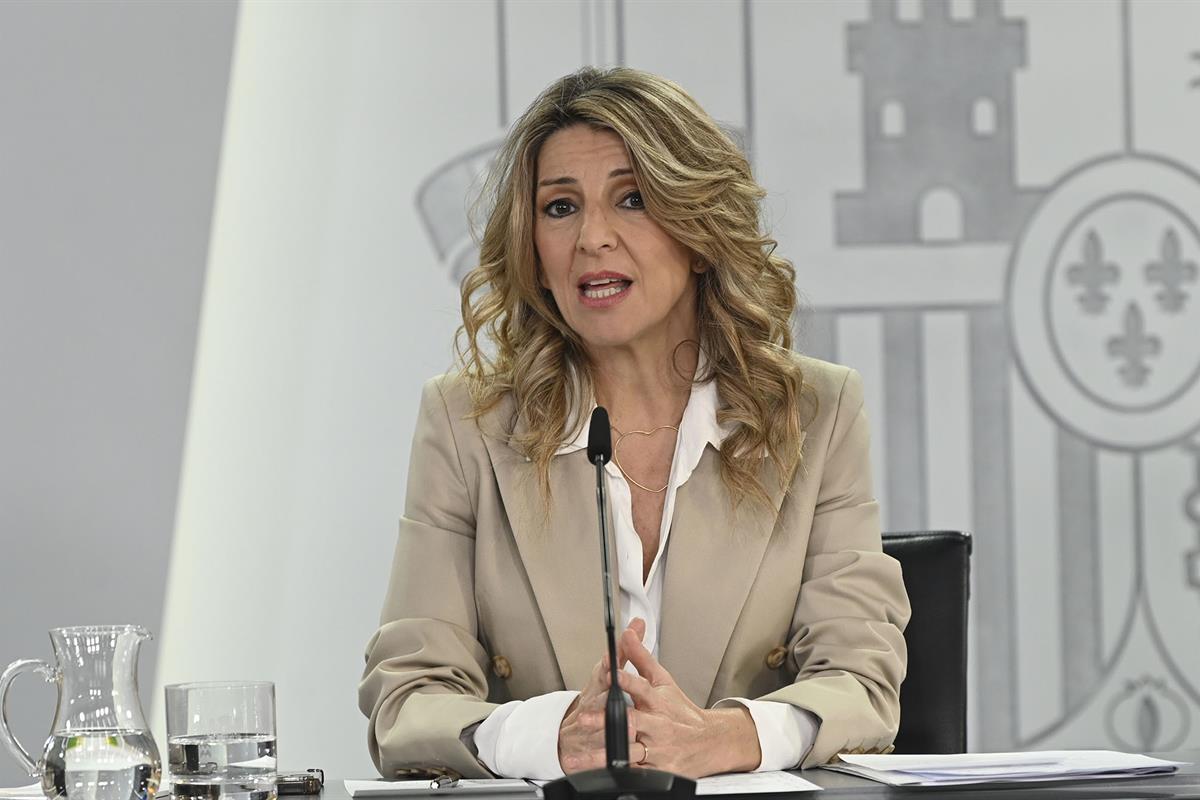 The Minister for Labor and Social Economy, Yolanda Díaz, at the press conference after the Council of Ministers | Pool Moncloa/Carlos Herrero
Access to practical training through payment is prohibited, and trainees will be entitled to reimbursement for expenses incurred during their non-work placement. The minister announced that the Labour Inspectorate will increase the fines and penalties for violations, which could exceed €250,000.
The Minister for Labour reiterated the Government's commitment to combating precarious employment and youth unemployment, stating that the measure approved today is what young people have been waiting for. Díaz also expressed her gratitude for the dialogue with social partners and urged the main opposition party to support the legislation in Parliament.
Commitment to real and effective equality between women and men
The Government has approved an institutional declaration on the occasion of International Women's Day, celebrated on 8 March, in which it reaffirms its commitment to the fight for real and effective equality between women and men. The Minister for Equality, Ana Redondo, stressed that no country has achieved this goal set by the United Nations almost fifty years ago and that this 8 March arrives within a context of "growing violence" against women internationally.
The digital violence suffered by women is precisely the subject of a report that the Minister for Equality presented to the Council of Ministers. 70% of complaints against digital platforms are for violence against women, and 83% of women under 35 have experienced harassment or stalking on social media at some point. Furthermore, 57% of women in politics or institutional positions are the target of smear campaigns and dehumanisation, and 72% of female journalists, influencers, and activists receive this type of attack constantly, according to the study.
Strengthening controls against digital violence
This violence has repercussions in the personal sphere, but it also harms pluralism and public debate. "This, logically, is what the algorithm intends, seeks out, and amplifies", said Ana Redondo, who criticised the anonymity and lack of controls in the "digital Wild West".
The report identified four forms of attack: disinformation campaigns; cultural violence through the terminology used to refer to women; explicit sexual violence through pornography and the use of artificial intelligence to dehumanise women; and the reproduction of traditional stereotypes of women. This year's 8 March campaign encourages reflection on the resurgence of traditional gender roles and its implications for limiting women's freedom.
The study also addresses how to respond to these attacks. "We must defend ourselves and, moreover, be a beacon for other countries", stated Redondo, who noted that Spain ranks fourth in the European gender equality index thanks to the progress achieved during fifty years of democracy.
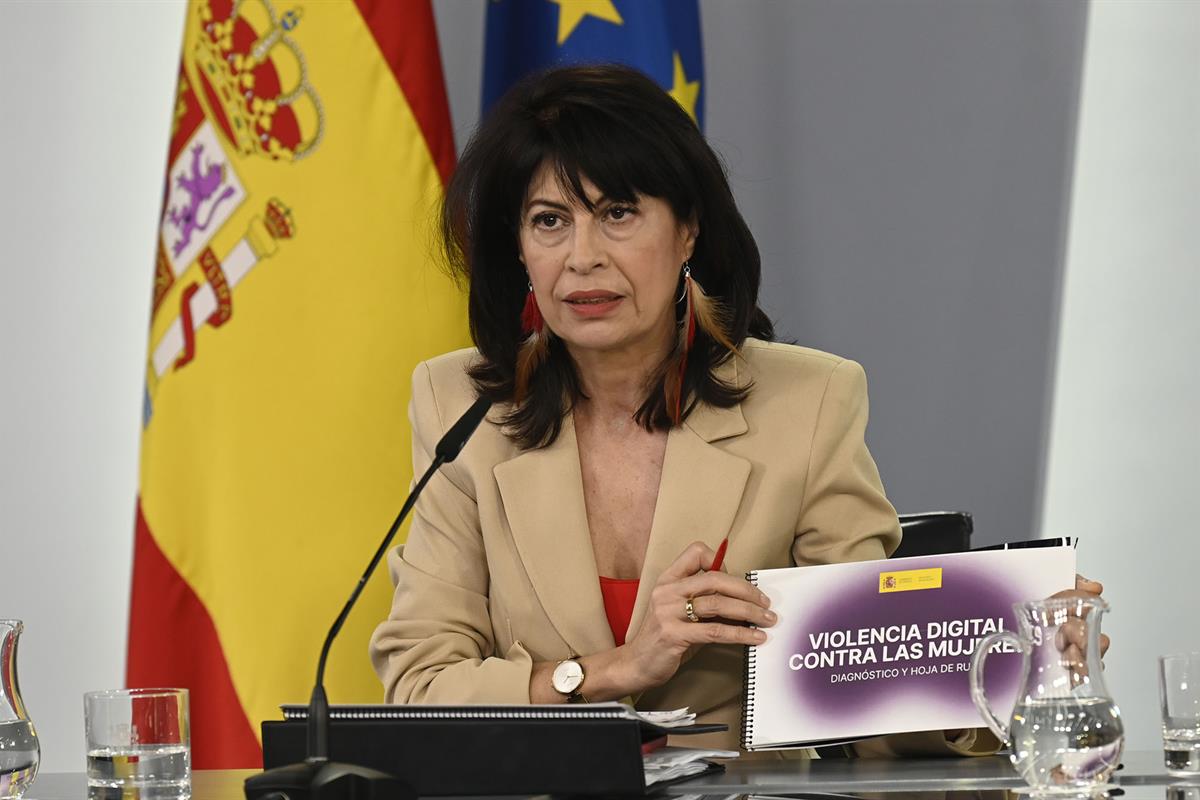 The Minister for Equality, Ana Redondo, during the press conference after the Council of Ministers | Pool Moncloa/Carlos Herrero
The report proposes strengthening controls on networks and platforms within the framework of European digital sovereignty, developing the Charter of Digital Rights, prohibiting access to social media for minors under 16, and requiring age verification on platforms and websites featuring pornography of any kind. The Minister for Equality also emphasised the need to promote the measures related to digital violence included in the State Pact against Gender Violence.
"We are going to do everything possible to ensure that this past, a past of violence and denial of women's rights, an anti-democratic past, does not prevail", Ana Redondo concluded.
Defence of negotiation and international law
The Minister for Foreign Affairs, European Union and Cooperation, José Manuel Albares, outlined the Government's response to the "new cycle of violence, conflict, and instability" unleashed by the US and Israeli attack on Iran and Iran's response. Albares stressed that the military actions of the United States and Israel are not part of a collective action nor are they in accordance with the Charter of the United Nations. He condemned Iran's attacks on many countries in the region and on Cyprus, "a partner of the European Union to whom we extend our full solidarity".
Faced with this "qualitative and quantitative leap in violence, with unforeseeable consequences not only for the region", the Minister for Foreign Affairs affirmed that "Spain defends de-escalation, negotiation, and international law". José Manuel Albares added that this balancing role is the one that the European Union must play.
Assistance to Spanish citizens
The government's absolute priority, as the minister emphasised, is the safety of the more than 30,000 Spaniards in the region, as well as that of embassy staff and their families, whom he thanked for their "extraordinary work" carried out under difficult circumstances, especially in the case of the embassy in the Iranian capital. So far, no deaths or injuries have been reported among the Spanish community.
Albares explained that Spanish embassies and consulates are providing ongoing assistance to Spanish citizens in the region and are available through the established emergency phone lines. Furthermore, the Ministry's Consular Emergency Division remains operational at all times, with additional diplomatic staff in the crisis room, and supplementary phone lines have been set up to bolster consular services. Since Saturday, the Ministry's crisis room alone has received nearly 2,000 calls.
The Minister for Foreign Affairs has asked all Spaniards temporarily displaced in the region to register in the Traveller Registry to improve monitoring and assistance capacity. They also have access to timely and updated information from the Ministry and embassies through social media, websites, and emergency phone lines.
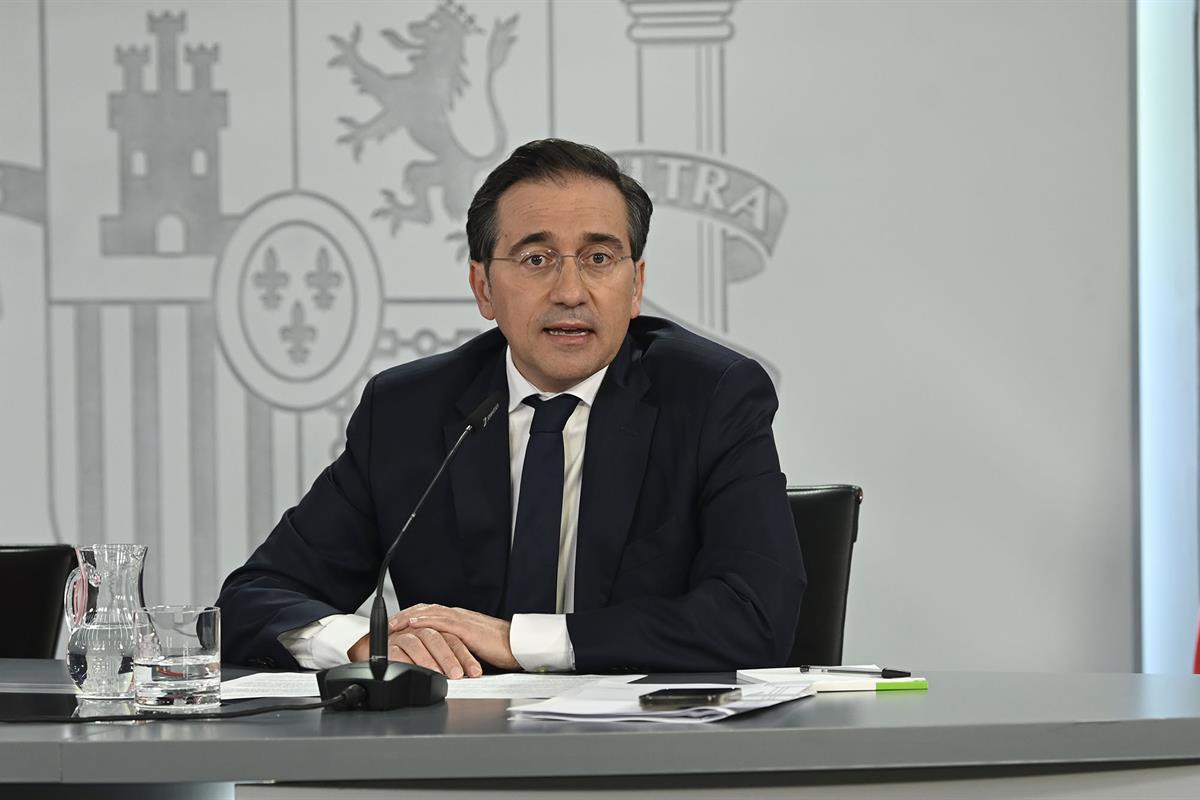 The Minister for Foreign Affairs, European Union and Cooperation, José Manuel Albares, during the press conference after the Council of Ministers | Pool Moncloa/Carlos Herrero
Furthermore, the Minister announced that evacuation operations for Spaniards in various countries in the region are now underway. "The resources used, the level of difficulty, and the duration of each operation vary considerably from country to country, but we are already using all available means, both land and air, that each circumstance allows to repatriate as many Spaniards as possible as soon as possible", he assured. Just over 175 Spaniards are already flying to Madrid from Abu Dhabi, and more flights are scheduled to depart from the United Arab Emirates throughout the day.
José Manuel Albares also announced that he will hold another virtual meeting today with the ambassadors and chargés d'affaires of all the countries in the region to coordinate a comprehensive response tailored to each country. "We are going to immediately reinforce the material and human resources of the embassies, as well as position other resources to prepare for possible evacuations as soon as opportunities arise", he explained.
The Government Spokesperson reiterated the call for a de-escalation of the violence and conveyed a message of "caution" regarding the economic situation. According to Saiz, the government is assessing the effect of the conflict on price increases and its consequences for consumers, industries, and businesses. "Spain's direct exposure is low, both due to the diversification of our energy mix and our sources of supply in terms of crude oil and gas", explained the minister, who clarified that, in any case, the impact of the conflict will depend on its duration.
Recognition of defenders of democracy
In the area of Democratic Memory, the Government Spokesperson referred to the approval of a Royal Decree-Law that modifies the Democratic Memory Law regarding recognition for individuals who died or suffered disabling injuries due to their activities in defence and advocacy of democracy. This text, Saiz explained, extends the initially established timeframe: the law recognised these compensations in situations that occurred between 1 January 1968, and 31 December 1977, which is now extended to the entry into force of the Constitution on 29 December 1978. The deadline for submitting applications will be one year, extendable for another year.
Furthermore, the Council of Ministers has approved an institutional declaration recognising the victims of the events of 3 March 1976 in Vitoria-Gasteiz, which resulted in five workers dead and a hundred injured as a consequence of the disproportionate use of force by the Police in the dispersal of a workers' assembly. According to Saiz, the text condemns those events and "reaffirms the commitment to democratic memory, truth, justice, and reparations".
The declaration, the minister continued, underscores the importance of the labour movement of that era, which, despite the absence of trade union freedoms, fostered spaces for collective participation that contributed to democratic progress and the recognition of social and labour rights. These victims have recently been recognised and provided with reparations by state institutions; on 23 February, the Church of San Francisco de Asís, where the events took place, was declared a "Site of Democratic Memory".
More agreements from the Council of Ministers
With the aim of continuing agreements to protect the productive sector, the Council of Ministers has approved the first package of ICO-backed loans for companies and self-employed workers in the areas affected by the storms that have battered the Iberian Peninsula so far this year. This support measure is intended to help the affected agricultural and fishing operations recover their productive potential.
The financing lines will have a total of €100 million, which is part of the €2.8741 billion extraordinary aid plan approved by the Government on 17 February in the Council of Ministers to help the agricultural, fishing, aquaculture, and agri-food sectors affected by the series of storms.
Furthermore, in the areas of Defence and Home Affairs, the Executive has approved the allocation of positions in the Armed Forces and the Civil Guard for 2026, thus formalising the calls for applications to fill almost 4,500 positions in these forces.
Other topical issues: Recovery Plan and affiliation data
The Minister for Inclusion, Social Security and Migration highlighted in her address the Government of Spain's request for the sixth payment of the Recovery, Transformation, and Resilience Plan, amounting to €7.256 billion. With this request, corresponding to the penultimate disbursement, Spain will reach 75% of the total funds allocated, which, according to Saiz, "reinforces its European leadership".
Saiz also celebrated the Social Security affiliation data recorded in February, which shows that the Spanish labour market has over 21.9 million registered workers, once seasonal factors are taken into account. "We have created 100,000 jobs in one month; it's one of the best Februaries in history", she declared, adding that these figures contribute to the message of "certainty" conveyed by the Government regarding the economic impact of the conflict in the Middle East.
On the eve of 8 March, International Women's Day, the Government Spokesperson highlighted the progress made in closing the gender gap in the workplace: "February ends with 10.3 million women registered with Social Security. This marks 13 consecutive months with over 10 million women, representing more than 47% of the total workforce in our country. In the last year alone, we have added almost 233,000 more women to the workforce, 1,750,000 more than in 2018", she concluded.
Non official translation