Council of Ministers
The Government of Spain agrees to limit price increases for goods and services in emergency situations to prevent abuses
Council of Ministers - 2026.2.10
Moncloa Palace, Madrid
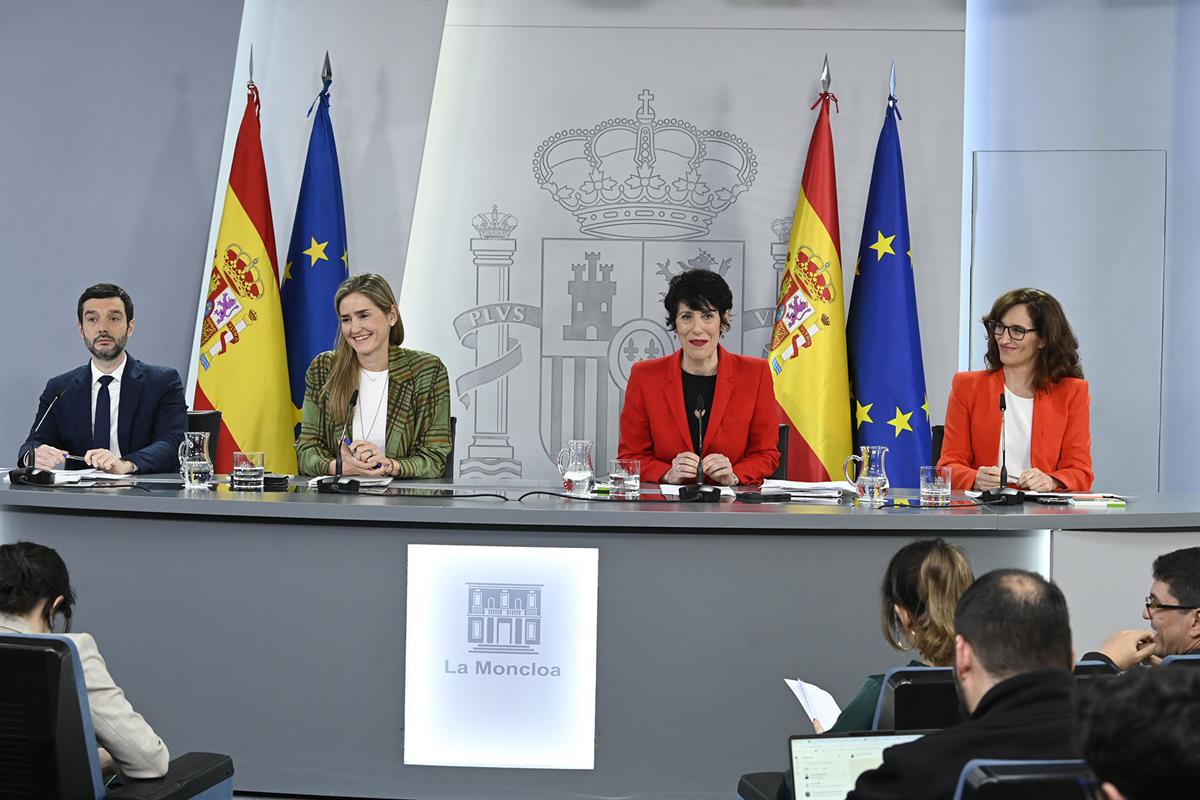 Pablo Bustinduy with Sara Aagesen, Elma Saiz, and Mónica García at the press conference after the Council of Ministers (Pool Moncloa/José Manuel Álvarez)






The Council of Ministers has approved a Royal Decree-Law guaranteeing equitable access to goods and services in emergency situations.
The Minister for Social Rights, Consumer Affairs and 2030 Agenda, Pablo Bustinduy, explained that the aim of the regulation is to prevent disproportionate or abusive price increases in emergency situations, such as those reported after the train accident in Adamuz (Córdoba). "We are introducing a mechanism to prevent profiteering in situations that exploit the vulnerability of citizens", he said.
The regulation stipulates that when a state of emergency is declared, the price of goods and services cannot exceed the maximum price they have had in the 30 days prior to the emergency.
 The Minister for Social Rights, Consumer Affairs and 2030 Agenda, Pablo Bustinduy, during the press conference after the Council of Ministers | Pool Moncloa/José Manuel Álvarez
Bustinduy specified that this mechanism will be activated by a Council of Ministers agreement, which will establish which services or products are affected and the duration of the price limitation. Furthermore, the Government may require retailers to inform consumers about the average and maximum price offered in at least the 30 days prior to the declaration. Consumers will have the right to an automatic refund of any amounts charged in excess of the established price limits.
The minister reiterated that the regulation establishes "the minimum conditions of equality and respect for consumer rights so that their potentially vulnerable situation does not become an added source of profit for a few economic agents". Bustinduy also reflected on the impact of the climate crisis on "the cohesion of our societies and on citizens' rights".
Electricity supply, marketing and aggregation
The Council of Ministers has approved the Royal Decree approving the general regulation for the supply, marketing and aggregation of electricity.
The Third Vice-President of the Government of Spain and Minister for Ecological Transition and Demographic Challenge, Sara Aagesen, highlighted that this regulation modernises the electricity system and drives its transformation toward a more efficient and sustainable model. The measure strengthens consumer protection, especially for the most vulnerable; promotes and advances the democratisation of energy; and continues to support the energy transition.
The regulation, the minister added, aims to guarantee fair and transparent access to energy and rebalance the scales between consumers and electricity retailers, as well as prevent abusive practices and opaque offers.
End to unsolicited calls
 The Minister for Ecological Transition and the Demographic Challenge, Sara Aagesen, at the press conference after the Council of Ministers | Pool Moncloa/José Manuel Álvarez
Sara Aagesen pointed out that the Royal Decree prohibits unsolicited telephone calls from retailers to households for advertising or to offer contracts, except with the consumer's express consent and request. In addition, calls will be recorded and made available to the customer.
In the event of a contract, energy suppliers will have to send the customer the contractual terms clearly and simply, with sufficient time for them to assess the alternatives and choose the contract type that best suits their needs.
Moreover, abusive penalties and minimum contract periods for households will be removed and limited to specific cases.
The minister explained that the regulation also protects consumers with regard to billing discrepancies. If the discrepancy is in favour of the consumer, the amounts must be refunded with interest on the next bill. If the discrepancy is in favour of the energy supplier, a pro-rata calculation will be made based on the months in which the billing was delayed, with a maximum rebilling limit of one year.
Complaints can be submitted in writing through all available channels. And service interruptions will not be permitted on the eve of public holidays, public holidays, or days when customer service is unavailable.
Protection for the most vulnerable consumers
The minister stressed that protection for the most vulnerable consumers, which the government has been implementing from the outset (Bono Social discount for electricity and heating), is being strengthened. A new category of essential supply is being declared, which cannot be interrupted under any circumstances: households with people dependent on electricity for medical reasons. Furthermore, the autonomous communities and local authorities will be able to prohibit the interruption of supply to households receiving the Bono Social who default on payments, by declaring them essential.
Aagesen stated that penalties or minimum contract periods that hinder vulnerable consumers' access to the Bono Social are expressly prohibited. Beneficiaries of the Bono Social are also being protected from being deceived by supposedly advantageous contracts: "The supplier will have to expressly inform the vulnerable consumer that the new contract will entail waiving the Bono Social".
Increasing transparency and democratisation of the system
The Minister for Ecological Transition explained that consumers are being empowered by increasing transparency through a data hub, a single point where all information about the electricity system is centralised. Managed by the system operator, Red Eléctrica, this will allow any user to access both consumption and generation data.
To further democratise the system, the rights, obligations, and requirements for demand aggregators are being established. Consumers will be able to contract the services of an aggregator to manage their electricity demand and achieve savings on their bill or some other form of compensation, regardless of whether they have a contract with a retailer for their supply.
Healthcare: public management, the role of patients and the financing of healthcare products
 The Minister for Health, Mónica García, during the press conference after the Council of Ministers | Pool Moncloa/José Manuel Álvarez
The Council of Ministers addressed three "core" initiatives for the healthcare system, according to Minister for Health Mónica García: the Draft Bill on Public Management and Integrity of the National Health System, the Draft Bill on Patient Organisations, and a royal decree on healthcare products.
Priority of direct public management
The minister described the Draft Bill on Public Management as "a victory for civil society" against the privatisation of public healthcare, manifested in practices that are not "isolated cases" but rather "a structural problem". The regulatory framework has allowed the management of public healthcare to be oriented toward economic profit instead of toward healthcare, García argued, reiterating the scientific evidence that privatisation diminishes the quality of patient care.
"This is what this law aims to put a stop to. It is the first law that unequivocally establishes that direct public management is the preferred form of management for our National Health System", the minister stated. The law expressly prohibits concessions through which an administration commissions a company to build a hospital and pays it a fee for 20, 30, or 35 years, a fee that impacts public budgets, with "cost overruns that are absolutely unacceptable", Mónica García emphasised.
The minister pointed to the fact that indirect management is limited to exceptional cases-when it is demonstrated that a service cannot be provided directly by public services, that it is financially viable, and that it does not harm either the public interest or the public system itself-as a "major step forward". García clarified that the law does not oppose non-profit models or "healthy" public-private partnerships. What is excluded, she clarified, are models that combine public works contracts with for-profit healthcare provision. Furthermore, any initiative in this direction will have to undergo rigorous evaluation, and outsourcing any service will require demonstrating that it cannot be provided internally.
The regulation also seeks to strengthen transparency, accountability, and democratic control of healthcare management. All healthcare facilities will be subject to the same public disclosure requirements, regardless of their management model. "Every public euro must be accounted for in terms of health," the Minister of Health emphasised. Another key aspect of the law is that it facilitates the reversion to public management after the termination of a contract, as it establishes clear procedures and provides technical support to ensure legal certainty.
In short, Mónica García summarised, the law "puts an end to the concessionary models for public works and services that turn healthcare into a business and establishes, once and for all, that public healthcare is managed to provide better care, not to make money".
Recognition of the role of patients
The objective of the second draft bill presented to the Council of Ministers, the Law on Patient Organisations, is based on the premise that the healthcare system cannot make decisions without considering the voice of patients, as Mónica García explained.
With the new law, this voice goes from being an informal, voluntary, or occasional element to being integrated into a legal framework that recognises the duties and rights of patient organisations. These organisations must therefore explain their funding sources. and their potential conflicts of interest in order to participate in decision-making, from the establishment of strategies to the evaluation of health technologies or clinical research.
The minister highlighted that the regulation also gives space to small patient organisations, for example, those of people suffering from rare diseases.
Equitable and sustainable financing of healthcare products
Finally, the government has updated the regulations on the financing and evaluation of healthcare products. The Minister for Health pointed out that the lack of this royal decree has sometimes led to shortages of these products, which are sold in pharmacies and range from urine bags and catheters to wound care supplies and nappies.
The text, which replaces the regulations in force since 1996, "focuses on the value of health and not on market logic and guarantees that healthcare products financed by the National Health System improve people's lives and do so in an equitable and sustainable way", according to Mónica García.
Declaration of areas affected by emergencies for territories battered by storms
 The Minister for Inclusion, Social Security and Migration and Government Spokesperson, Elma Saiz, during her speech at the press conference after the Council of Ministers | Pool Moncloa/José Manuel Álvarez
The Minister for Inclusion, Social Security and Migration and Government Spokesperson, Elma Saiz, has confirmed that the Council of Ministers has declared the territories affected by the storms that have struck various autonomous communities between 10 November and 10 February as "areas affected by a civil protection emergency." Saiz announced that the next Council meeting is scheduled to approve a new decree with specific measures to "counteract this new environmental disaster that our country is suffering".
In this context, the spokesperson emphasised the importance of combating climate change "as this Government is doing". "In these eight years, we have faced droughts, floods, DANA storms, and very aggressive storms that are jeopardising our priorities". "This is not the time to look the other way, much less to deny the climate consequences that so many people are experiencing first-hand".
Both the spokesperson and the Minister for Ecological Transition and Demographic Challenge highlighted the government's work to address the climate emergency and the challenges it presents, with initiatives such as the Declaration on the Climate and Environmental Emergency, approved in January 2020, and the State Pact to tackle the Climate Emergency, presented in December 2025.
Both ministers stressed that unity and joint work between administrations are essential to anticipate and respond to the effects of extreme weather events, which are becoming increasingly frequent. As an example, they noted the deployment of 10,000 personnel, day and night, in perfect coordination with the Regional Government of Andalusia, the provincial councils, and the municipalities to address the effects of storms and ensure the safety of citizens.
Aagesen and Saiz conveyed a message of support to the families of the deceased, the residents of the affected municipalities, and the public servants who are working tirelessly to protect the public, and called for extreme caution and adherence to the instructions of the emergency services in anticipation of the upcoming storm, Nils.
Elma Saiz also made specific mention of the two workers who died as a result of the storm in Cádiz and Ávila.
Renewed commitment to sustainable development
 The Minister for Social Rights, Consumer Affairs and 2030 Agenda, Pablo Bustinduy, during the press conference after the Council of Ministers | Pool Moncloa/José Manuel Álvarez
The Council of Ministers has approved the revised Sustainable Development Strategy, an initiative defined by Pablo Bustinduy as "our country's response to a world marked by emergencies, restrictions on rights and freedoms, and setbacks in the ecological transition".
The minister noted that Spain has moved from 30th place in 2016 to 14th in 2025 in terms of compliance with the Sustainable Development Goals (SDGs), according to the Sustainable Development Solutions Network. Bustinduy explained that progress has been made on 11 of the 17 goals, which "reflects objective realities" in the reduction of poverty, inequality, and social exclusion; the improvement of the social protection system; higher employment rates and better job quality; the deployment of renewable energies; the decrease in greenhouse gas emissions; and the transformation of production structures.
The strategy review aims to reinforce Spain's commitment to achieving the SDGs and focuses on four major challenges: strengthening the welfare state, developing a circular economy, ensuring territorial cohesion that fosters social cohesion, and combating all forms of inequality and discrimination. To advance this roadmap, specific targets have been set for 2030: the adoption of a benefit to eradicate child poverty, investment in public housing, reducing the gender pay gap and school dropout rates, and increasing labour force and education participation rates for people with disabilities.
The Minister for Social Rights, Consumer Affairs and 2030 Agenda contrasted the model of those who attack international law and multilateralism with that of the Government, summarised in the strategy and embodied in measures such as raising the minimum wage and pensions and regularising the status of hundreds of thousands of workers "who live in this country and, therefore, must have rights".
International Day of Women and Girls in Science
 The Minister for Inclusion, Social Security and Migration and Government Spokesperson, Elma Saiz, at the press conference after the Council of Ministers | Pool Moncloa/José Manuel Álvarez
Elma Saiz reported on the Council of Ministers' approval of a declaration commemorating the International Day of Women and Girls in Science, celebrated every 11 February. "Spain is changing, but there is still a long way to go to fully recognise the contributions of women in science and technology", the spokesperson stated, citing the latest report, "Women in Science 2025", which indicates that, for the first time, there is real parity in the Public Administration.
"However, we must be realistic: in the private sector, female representation falls to 31%, and in universities, the gap persists, with only 28% of engineering students and 17% of computer science students being women", she warned. " Thus, the text of the declaration reflects the Government's commitment to "continue contributing to accelerating social, cultural, and organisational changes capable of guaranteeing equal, diverse, and inclusive work environments, and thereby ensuring that women and men have the same opportunities to build a career around R&D&I".
News: Report on Social Security consultations
The Minister for Inclusion, Social Security, and Migration celebrated during her speech the 2025 report on Social Security consultations, which exceeded 290 million, including 223 million automated consultations. This figure shows, according to Saiz, that the modernisation required of the administration "has borne fruit very quickly".
As examples, the minister cited the employment history report, which received over 110 million consultations, and the pension simulations for future retirement benefits, which reached almost 29 million. In addition, 3 million European Health Insurance Cards have been issued. "The total volume of services and procedures has increased by more than 35% compared to 2024 and by nearly 65% compared to 2023", Saiz explained, describing these tasks as "essential work" by Social Security employees, "which often goes unnoticed".
Non official translation