Pedro Sánchez: "China and Europe have prospered together in the past and there is no reason why they should not do so again"
President's News - 2026.4.13
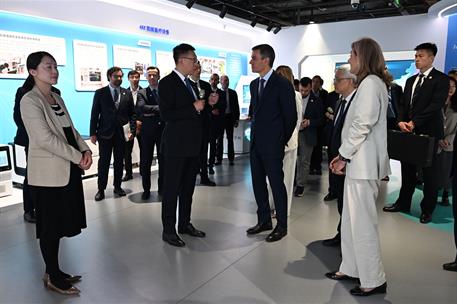
Images from a visit to an exhibition at the Chinese Academy of Sciences | Pool Moncloa/Carlos Herrero - 13.04.2026







Tsinghua University, Beijing (China)
The President of the Government, Pedro Sánchez, defended the need to move towards building balanced and reciprocal trade relations with China in his speech at Tsinghua University in Beijing. During his official visit to the Chinese capital, he reaffirmed Spain's vocation for understanding in a context of great global tensions.
Speaking to an audience composed mainly of students from one of China's most prestigious and influential academic institutions, Pedro Sánchez recalled how in 1583 the Jesuit Matteo Ricci redrew his map when he realised that China was not located at the edge of the Earth, as was believed in the West at the time. This was a reality with which Spain was familiar, given that it was already trading with the Ming dynasty. "Spain at that time knew the greatness of China. It knew that Beijing was not the periphery of the world, but one of its centres. And today's Spain also knows this. It knows that China is rebuilding its greatness. It is already the world's leading exporter of goods and the fourth largest exporter of services," he said.
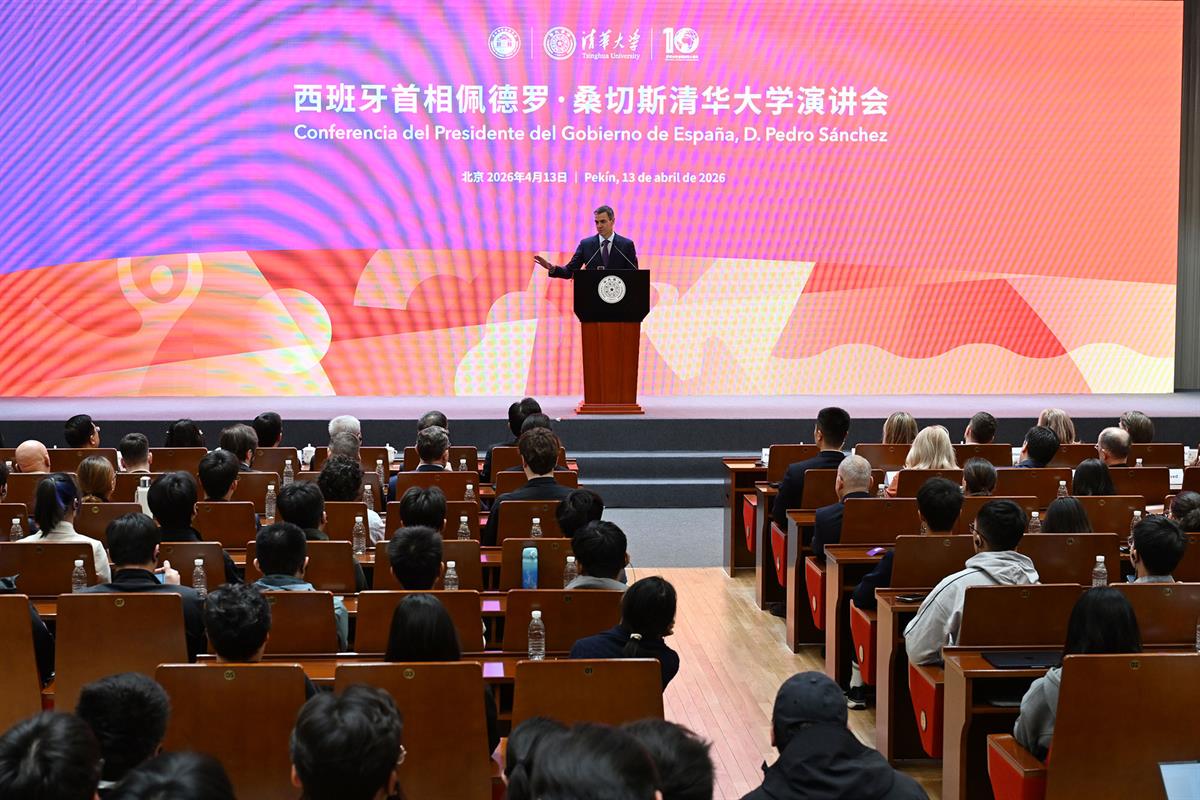 The President of the Government of Spain, Pedro Sánchez, gives a lecture at Tsinghua University | Pool Moncloa/Borja Puig de la Bellacasa
In this regard, President Sánchez pointed out that what is happening today is not a "shift in hegemony" but a "proliferation of centres" of power and prosperity. "For the first time in modern history, progress is taking root simultaneously in various parts of the world," he said. In this context, the Government of Spain has chosen to embrace this reality "with realism, pragmatism and, without a doubt, a sense of responsibility", and, whilst acknowledging the existing differences with China, it has advocated building on what unites both countries, which have cooperated in the past.
"Spain's proposal is clear: to build a relationship based on mutual respect. A respect that enables us to cooperate as much as possible, compete where necessary, and manage our differences when they are unavoidable. Spain defends this vision. It does so in Madrid. It does so in Brussels. And it will do so wherever it is required," he added.
To achieve this understanding and for the world to prosper under the new multipolar order, the president set out three priorities, the foremost among which is the defence of a renewed multilateralism that reflects "the balances of power and the sensitivities of today's world". Along these lines, he advocated transforming the UN with a more representative Security Council in which all regions have a voice and a vote in order to move towards a more democratic decision-making system. Furthermore, he expressed the hope that the next Secretary General will be a Latin American woman for the first time in history.
Second, he emphasised the need for China to move towards more balanced relations with its trading partners, recalling that in the last decade alone, the EU has signed agreements with 25 countries and has increased imports from the Global South by 80%. "We need China to do the same. Let China open up, so that Europe does not have to close itself off," he said, calling for the trade deficit to be addressed.
President Sánchez also stressed the need for greater involvement of the major powers in the management and provision of public goods for challenges such as the fight against climate change, the development of responsible artificial intelligence, the control of nuclear arsenals and the eradication of poverty. In this vein, he called on China to play a greater role, demanding that international law be upheld and that the conflicts in Ukraine, Lebanon and Iran be brought to an end.
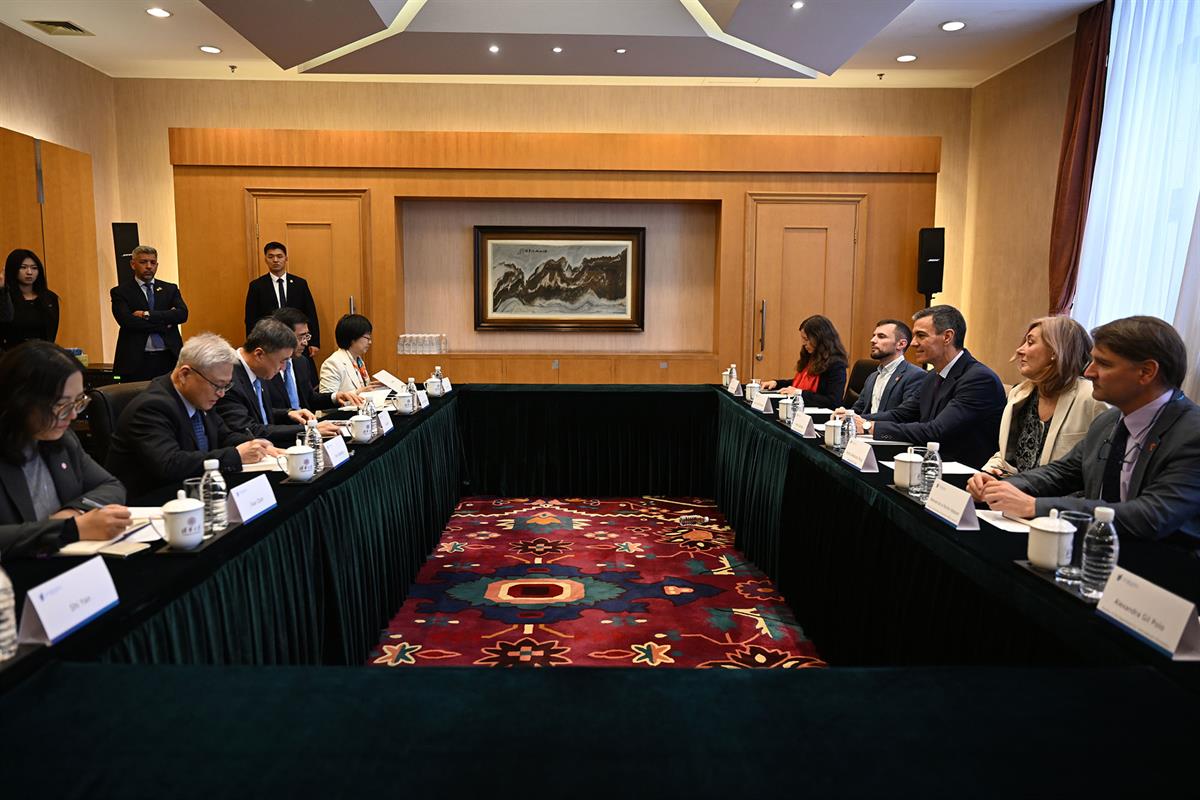 The President of the Government of Spain, Pedro Sánchez, holds a meeting with experts in international relations | Pool Moncloa/Borja Puig de la Bellacasa
At the end of the speech, Pedro Sánchez met with a group of six experts in international relations, most of them specialised in relations between China and the EU.
The President of the Government then visited an exhibition of scientific and technological projects at the Chinese Academy of Sciences. There he was awarded the honorary professorship of the University of the Chinese Academy of Sciences (UCAS), the same distinction with which three Nobel laureates were conferred: Paul Nurse, David Gross and Samuel C.C. Ting. In his speech of thanks, he said that "cooperation does not weaken science. It strengthens it. It improves its quality, broadens its impact and creates lasting links between scientific communities. I therefore accept this distinction as a compromise. A commitment to go further. To deepen collaboration, to promote new joint research and to support the exchange of talent".
Non official translation