Pedro Sánchez: "We cannot let 20 million Spanish households foot the bill for the war"
President's News - 2026.3.26
College of Architects, Madrid
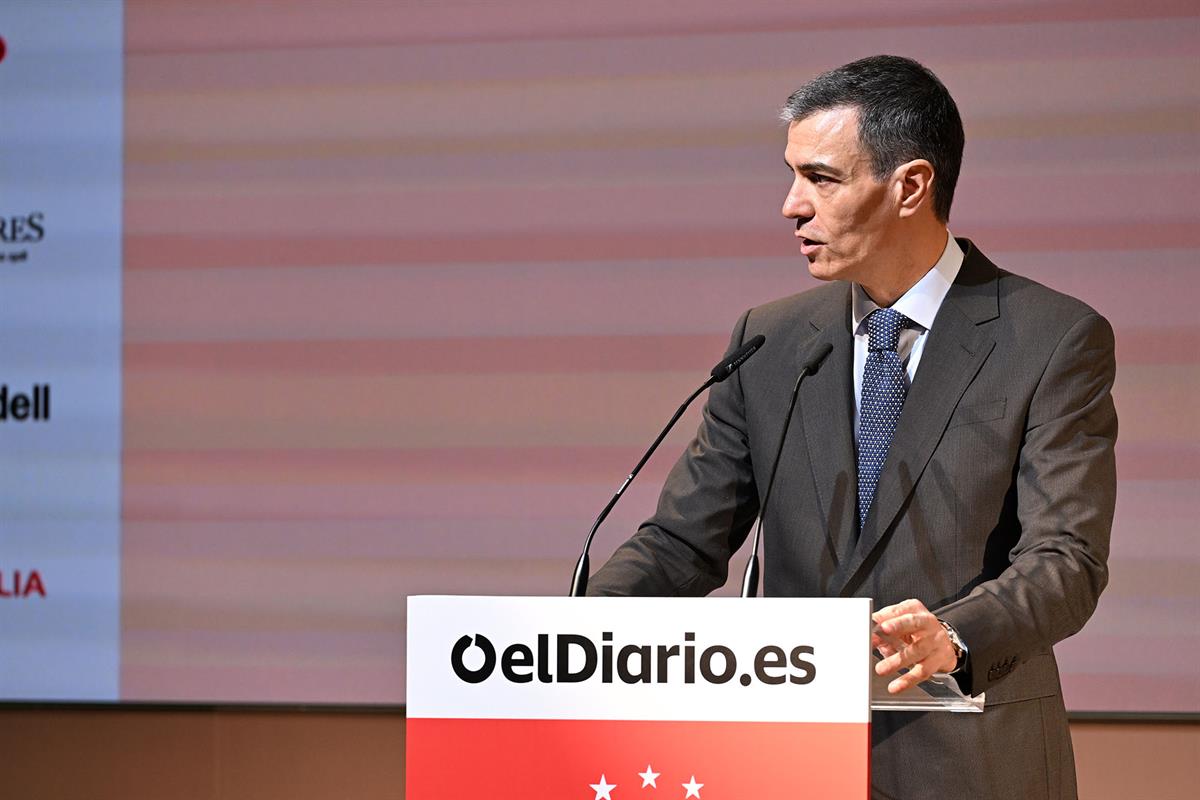 Pool Moncloa / Borja Puig de la Bellacasa






The President of the Government of Spain, Pedro Sánchez, argued that "we cannot let 20 million Spanish households foot the bill for the war in the Middle East" and warned that the conflict "is a catastrophe and threatens to trigger a global economic earthquake." He made these remarks during his speech at the Sixth edition of the elDiario.es Economic Forum, organised under the slogan 'Spain's leadership in European strategy'. The event, held at the Madrid College of Architects, was attended by the Second Vice-President and Minister for Work and Social Economy, Yolanda Díaz; the Minister for Health, Mónica García; and the Minister for Equality, Ana Redondo.
Pedro Sánchez noted that, compared to the challenge of tariffs a year ago, "today the threat to global prosperity has a far crueller and more worrying face: that of war," and emphasised that the response will once again be "to protect the people." Ahead of the vote in the Lower House to ratify the Royal Decree-Law containing the first measures to mitigate the consequences of the war in the Middle East, he expressed his confidence that "all parliamentary groups will rise to the occasion of this historic moment." In this regard, he argued that "it is here, and now, that a sense of statesmanship and true patriotism are demonstrated", as "there is no greater demonstration of patriotism than contributing, through one's vote, to easing the electricity bill for millions of households or to safeguarding the future of thousands of SMEs, the viability of many agricultural and livestock farms, or the self-employed and the social economy, who are suffering from a surge in prices for which they bear no blame," he noted.
"The war was started by leaders of foreign countries; but we cannot let 20 million Spanish households foot the bill," he added. The war in the Middle East "is a catastrophe and a major mistake politically, geopolitically and economically, not just in humanitarian terms", but it also "destabilises a vital artery of international trade (the Strait of Hormuz) and threatens to trigger a global economic earthquake, and is already hitting our fellow citizens' pockets." He therefore stressed the importance of "being aware of the significance of this historic moment", just as the Government of Spain did in calling for peace "almost alone at the outset; although many have now joined in."
"Solid" economic foundations: GDP grew 2.8% in 2025
He also noted that the Executive has thrown itself into helping the public, thanks to the fact that "we have solid foundations for our economy and the necessary strength and fiscal capacity to weather these storms." Specifically, he noted that Spain leads growth among the major EU economies and grew 2.8% in 2025, double the EU average, according to data from the National Accounts review published today by the INE. "Not only are we growing faster, we are growing better, and that makes us better prepared to face scenarios such as the one the world is suffering with this new war," he asserted.
"Unprecedented structural change" thanks to the Recovery Plan
In this regard, he referred to Spain's "unprecedented structural change", which he attributed "largely" to the Recovery Plan. After Spain requested the sixth instalment of the NextGenerationEU Fund, amounting to over 7.2 billion euros, it will have reached 75% of the allocated funds, with 343 milestones of "reforms that have transformed the Spanish economy forever". "In contrast to those who resort to failed formulas of the past: without funds, there can be no reforms, because stimulating national economies is essential to boosting European competitiveness," he argued, citing the three main pillars of the funds.
The first is the commitment to human capital, with a "historic boost to vocational training, which has over a million students and has brought youth unemployment and the school dropout rate down to record lows", reducing temporary employment by more than ten percentage points and boosting productivity whilst inequality falls to historic lows. "Spain has shown that to be competitive, there is no need to cut wages or work twelve hours a day. On the contrary: investing in workers is the best investment in the future for any company", to which is added the migration policy to attract talent. And this is helping families to regain purchasing power for the third consecutive year. "In today's Spain, there are one and a half million more households than in 2018 that are able to save. This is progress," he added. Secondly, he cited the acceleration of the energy transition, which will receive a "new boost" if the Royal Decree-Law is approved, having already achieved a situation where almost 60% of electricity generation comes from renewable energy, being "better prepared" for shocks and lower electricity prices - last week it was 25% cheaper than in France, three times cheaper than in Germany and four times cheaper than in Italy. "The current context gives us a certain authority and legitimacy to tell Europe that abandoning the Green Deal - as the far right and a large part of the conservative forces wish - is a very bad idea for tackling the climate emergency and a terrible idea for protecting household budgets and the productive fabric."
Atlantic Constellation: 325 million euros for three new satellites
Finally, he highlighted the boost to science, innovation and digitalisation, with R&D investment having risen 60% over the last eight years and already at an all-time high. He also cited other milestones: Spain ranks sixth globally in greenfield foreign investment projects, first in the EU for AI competitiveness, boasts the largest fibre-optic network in Europe, has a regulatory framework that "attracts innovation and entrepreneurship" and is "taking off in sectors we could not have dreamed of a few years ago, such as aerospace." In this regard, he announced that a call for proposals for the development of the Expanded Atlantic Satellite Constellation, ESCA+, will soon be launched through the European Space Agency, with 325 million euros to build three new satellites that will transmit data in real time and strengthen Spain's response capacity to extreme weather events. He stated that this "legacy" of the Recovery Plan will be continued through the Spain Grows Fund, mobilising 120 billion euros in public and private funding in strategic sectors such as digitalisation, AI, the climate emergency and housing.
Unity and a European roadmap to "not let ourselves be broken"
The president of the Government of Spain argued that Spain "has its roadmap, but today, more than ever, Europe needs its own", for which he has set out four priorities. These include completing the internal market by opting, in the face of deregulation, for greater simplification and harmonisation of regulations. He also called for the strengthening of European public assets, such as European security, the climate emergency, science and technology. Similarly, he called for "investing more and strengthening our financial sovereignty", by bringing in private investment from banks and others. "Only in this way can we prevent 300 billion euros of European savings from seeking out across the Atlantic every year what they cannot find here," he explained.
The head of the Executive emphasised the need to "shoulder the European social pillar", as "there can be no competitiveness without cohesion." In response to calls within NATO to allocate 5% of GDP to military spending, he argued that capabilities to address threats must be defined and that, based on national sovereignty, each country should decide the level of resources to allocate to those capabilities. In his view, allocating up to 350 billion euros over the next decade to military spending would not be a wise commitment for Europe; rather, it would be better to "invest resources in European industry, and cooperate and collaborate with nations possessing more advanced technology", as set out in the Industrial and Technological Plan for Security and Defence, launched by the Government a year ago.
Coinciding with the 40th anniversary of Spain's accession to the EU, Pedro Sánchez said that the Government of Spain has a "pro-European outlook to tackle the challenges facing Europe, and we must do so through unity; it is vital that we do not allow ourselves to be broken." "It is time to take bold decisions based on responsibility, ambition and vision", because "we are staking our chance of becoming a much more autonomous, stronger, freer and more resilient Europe. A Europe that is aware of its own strengths and uses them not to impose, but to inspire. Not to dominate, but to cooperate in an increasingly multipolar world. That is the leadership that the European Union can and must offer the world, which needs a strong Europe that inspires and cooperates more than ever," he concluded.
Non official translation