The President of the Government of Spain analyses the final phase to complete the implementation of the Recovery Plan
President's News - 2026.1.7
Meeting of the Interministerial Commission for Recovery, Transformation and Resilience | Pool Moncloa - 07.01.2026
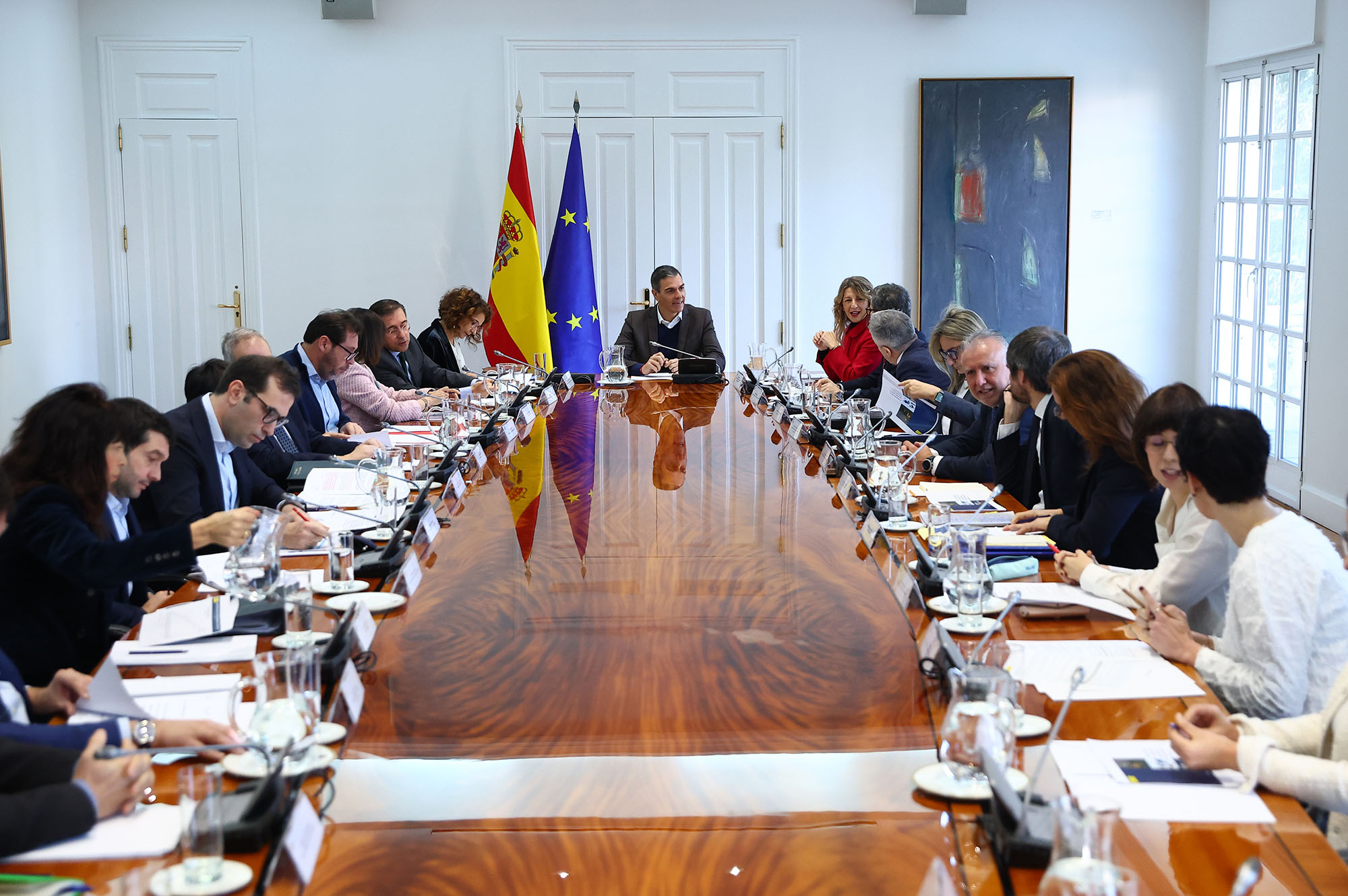





Moncloa Palace, Madrid
The head of the Executive chaired the 9th meeting of the Interministerial Commission for Recovery, Transformation and Resilience at the Moncloa Palace, where progress in implementing the Plan was analysed, along with the recently agreed-upon DANA and simplification addenda from the European Commission and the final steps to complete the plan's implementation this year.
Pedro Sánchez highlighted the government's efforts and the progress achieved in the last year with the Recovery, Transformation and Resilience Plan, which has positioned Spain as the country receiving the most Next Generation EU non-repayable funds, with more than €55 billion. Pedro Sánchez also highlighted the level of implementation, with more than €62.975 billion disbursed since the start of the Recovery Plan and a total of 1.36 million beneficiaries across the country.
Spain received more than €23 billion in August from the fifth disbursement of the Plan, including €7.1 billion in grants and €16 billion in loans. In total, Spain has already met 264 milestones and objectives of the Recovery and Resilience Mechanism, placing the country at the forefront of compliance and reflecting its commitment to structural reforms and the effective implementation of the Plan's investments, such as labour reform, the Create and Grow Law, the Startup Law, the 5G Cybersecurity Law, and Vocational Training. During the Interministerial Commission meeting, the two latest addenda were analysed. These addenda have already received the approval of the European Commission and will allow for the full implementation of the Recovery Plan this year. The Simplification Addendum adapts the milestones and objectives to maximise implementation.
Also attending the meeting were the First Vice-President of the Government of Spain and Minister for Treasury, María Jesús Montero; the Second Vice-President of the Government of Spain and Minister for Labour and Social Economy, Yolanda Díaz; the Minister for Foreign Affairs, European Union and Cooperation, José Manuel Albares; the Minister for the Presidency, Justice and Parliamentary Relations, Félix Bolaños; the Minister for Defense, Margarita Robles; the Minister for Home Affairs, Fernando Grande-Marlaska; the Minister for Transport and Sustainable Mobility, Óscar Puente; the Minister for Education, Vocational Training and Sports, Milagros Tolón; the Minister for Industry and Tourism, Jordi Hereu; the Minister for Territorial Policy and Democratic Memory, Ángel Víctor Torres; the Minister for Housing and Urban Agenda, Isabel Rodríguez; the Minister for Culture, Ernest Urtasun; the Minister for Economy, Trade and Business, Carlos Cuerpo; the Minister for Health, Mónica García; the Minister for Social Rights, Consumer Affairs and 2030 Agenda, Pablo Bustinduy; the Minister for Science, Innovation and Universities, Diana Morant; the Minister for Equality, Ana Redondo; the Minister for Inclusion, Social Security and Migration and Government Spokesperson, Elma Saiz; the Minister for Digital Transformation and Civil Service, Óscar López, and the Minister for Youth and Children, Sira Rego.
Non official translation