Mariano Rajoy says that EU immigration policy must "comply with international law"
President's News - 2016.3.18
1. Images of the meeting of the European Council | European Council - 17.03.2016 11:55:00
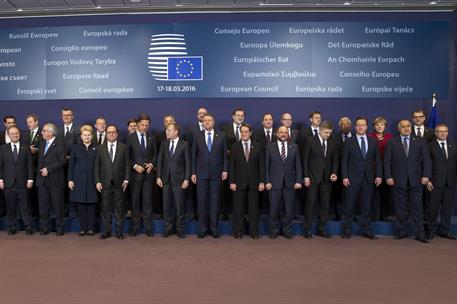





Justus Lipsius Building, Brussels (Belgium)
Regarding the migrant crisis, Mariano Rajoy said that the EU has agreed in its conclusions to support Greece. He added that, following a request from FRONTEX, Spain will dispatch civil servants to Greece in order to provide assistance in the refugee crisis because "we have people who are highly specialised in these issues".
Furthermore, the President of the Government said that "great importance" was given at the meeting to the readmission agreements because "they are essential to an ordered, sensible and reasonable immigration policy".
Defending the right to asylum
As regards the agreement with Turkey, Mariano Rajoy said that as yet "no deal has been finalised". However, he explained that the position he defended while talking with the European leaders is that which was unanimously approved by the Spanish Parliament and requires "any decision that may be reached to comply with international law". If this is not the case, "it is clear that we cannot support the conclusions", he said.
Furthermore, the President of the Government highlighted "the importance of defending the right to asylum, that this right should not be weakened in any way and that there should be no mass expulsions of people from the Greek islands to any other country".
In this regard, Mariano Rajoy believes it is "essential" that "all asylum applications" are processed individually because "that is the only way to provide guarantees and that is what international law requires". He went on to add that "meeting requirements and following procedures" is a must so that the final decision can be "challenged".
Fiscal consolidation, reforms and investment
As regards the agreements on economic affairs, Mariano Rajoy recalled that "the most important agreement we have to reach relates to the presentation - by 30 April - of the Stability Plan for the next year and the National Reform Plan".
The President of the Government also stressed that the EU economic policy is based on three pillars: progress in terms of fiscal consolidation; ongoing reform efforts; and maintaining investment. The Juncker Plan was discussed at the meeting with regard to the latter, which already has various projects "under way in various EU countries".
Mariano Rajoy said that besides talking about an energy union and a single digital market, the European leaders also agreed "to maintain efforts aimed at building an economic and monetary union" - a topic on which the European Council in June will focus on exclusively.