Control session in Upper House
Mariano Rajoy condemns cases of corruption and asserts that action will be taken to prevent further cases
President's News - 2014.10.28





Upper House of Parliament, Madrid
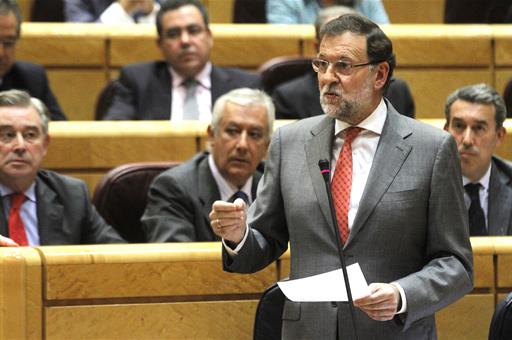
At the start of his speech in the government control session held in the Upper House of Parliament, Mariano Rajoy referred to the cases of corruption uncovered in the last few days. The President of the Government stressed that he fully shares the indignation of the people of Spain, their anger and their growing weariness at the accumulation of these scandals.
The latest scandal uncovered, he said, "seems to respond to the personal greed of those holding the public offices affected and not the political organisations to which they belong or belonged".
The President of the Government stressed that the people who are members of his party have had their membership suspended, and if they are charged they will be expelled from the party. "On behalf of the PP, I would like to apologise to the Spanish people for having placed in office those who have abused such positions of which they were not worthy".
Mariano Rajoy regretted that certain conduct casts a shadow of generalised suspicion over the conduct of all politicians because "this unjustly sullies the image and reputation of the majority of people who are in politics to serve others and not to serve their own ends".
"As President of the Government, it does not only fall to me to condemn these acts but also to take action to prevent their repetition", he asserted. In this regard, he recalled the obligation on those holding high public office to declare their assets at the start and end of their term of office. He also mentioned the proposals to ban companies from making donations to political parties and for banks to write off their debts, harsher penalties for misconduct and increasing the number of new criminal offences for influence peddling.
He also stressed that the government will continue to increase the range of anti-corruption measures "until such time as we ensure that any public office holder in this country thinks twice before falling into the temptation of becoming corrupt".
Mariano Rajoy added that "a democracy cannot allow anyone to play with the trust placed by our citizens in those who run the country", and pointed out that he is in talks with the opposition to agree on two legislative draft bills to combat corruption: the Statute on senior public office and the Law to control the economic and financial activity of political parties.
"We are not going to wait a minute longer to approve this raft of reforms. I announce to you that if we have the support of the opposition so much the better but that, if not, we will approve these measures with the votes of our party MPs", he underlined.
Furthermore, Mariano Rajoy asked the people of Spain to trust in the rule of law "because it works" and stressed the government's full commitment "to cleaning up public life".
Policies are starting to bear fruit
 Pool MoncloaIn response to a question from the Member of the Upper House for the Socialist Parliamentary Group (Spanish acronym: GPS) Victoria Chivite, who enquired after the government's measures to reduce inequality among the citizens of Spain, the President of the Government stated that the policies that have been implemented during this legislature are starting to bear fruit.
In this regard, he pointed out that Spain has now been growing for the last five quarters in a row, following many years of negative growth, and that it is the country in the European Union to enjoy the most growth. Net employment is being created and the indicators used by international bodies to measure inequality and poverty are starting to register a decline, thus pointing to the start of a change of trend, he added.
Border control and legal certainty
The President of the Government argued that the situation at the borders of Ceuta and Melilla is an issue of "great sensitivity" and must thus be handled "with maximum responsibility" and as a "State policy".
In response to a question from the Member of the Upper House for the United Left (Spanish acronym: IU), Jesús Enrique Iglesias, Mariano Rajoy maintained that in relation to this issue, "we must add weight to an undeniable obligation, which is the control of our borders, and the stark reality and drama of illegal immigration, which is unfortunately the result of the activity of criminal gangs that traffic in human beings".
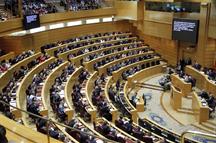 Pool MoncloaThe President of the Government highlighted that the borders at Ceuta and Melilla are subject to enormous migratory pressure, "with continuous episodes of mass attempts to storm the border", and are the only European Union borders with Africa.
He added that these border controls "suffer situations prior to the laws on immigration", and hence "this raises the need to provide greater legal certainty to the surveillance and border entry rejection actions", carried on by the State law enforcement agencies.
Mariano Rajoy announced that this legal reform to improve the coverage of actions taken against "attempts to illegally enter the country that frequently take place in a violent or clandestine manner" will be completed by the Ministry of Home Affairs with a protocol on comprehensive action. The President of the Government stressed that the modification proposed by the government is fully adapted to international legislation, in the same way as the State law enforcement agencies currently act in line with the law.
He also stated that the medium- and long-term solution lies in a European policy of collaboration with the countries of origin to help them eliminate poverty and strengthen their democratic institutions. "It is clear that if people cannot conduct a dignified life in their own country, they will seek out a new life in any other country", he said.
Collaboration and dialogue with Catalonia
As regards the government's initiatives to tackle relations between Catalonia and the rest of Spain, in response to a question from the Member of the Upper House for the Catalan-Spanish joint Socialist party (Spanish acronym: PSC-PSOE), Jesús Montilla, Mariano Rajoy mentioned the examples of "loyal and effective collaboration" between public authorities that have taken place during this legislature, such as the Regional Liquidity Fund and the Supplier Payment Plan. He also underlined that the Regional Government of Catalonia has helped contribute to fiscal consolidation and has supported various structural reforms.
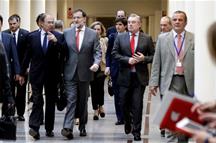 Pool MoncloaPresident of the Government reiterated his position on the referendum on 9 November. "In a democratic State with the rule of law such as ours, all those in government must be subject to the law, and the Constitutional Court handed down its ruling on what was legal and what was not". Mariano Rajoy added that he is prepared to "speak about any issue unless this is against the law" and recalled that the law can be changed by following the established procedures.
The President of the Government pointed out that he will continue to defend national sovereignty, equality between all Spaniards and individual liberties and rights. He will also continue to speak of Spain as a country that has been "united for many centuries by all sorts of ties", with the greatest degree of decentralisation in the world, it participates in the European integration process and has managed to overcome a serious economic crisis. "In the globalisation process we are undergoing, what we are seeing are union and integration processes, and what is not being seen, because it is ridiculous and directly leads to poverty, is division", he pointed out.
Pool Moncloa