Agreement between Spain and NATO on Rota Naval Base to create 1,000 new jobs
President's News - 2011.10.5





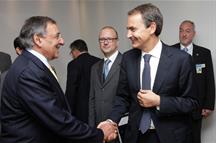
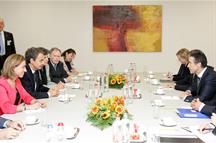
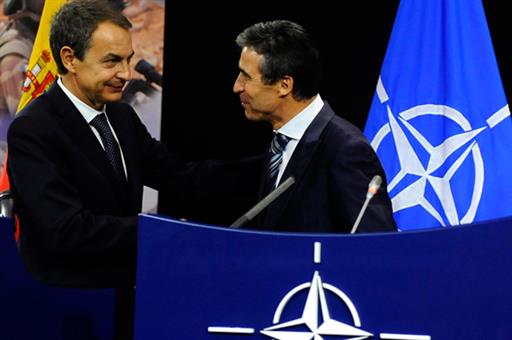
On Wednesday, 5 September, the President of the Government, José Luis Rodríguez Zapatero, spoke at the NATO central headquarters in Brussels alongside the Secretary-General of NATO, Anders Fogh Rasmussen, and the US Secretary of Defence, Leon Panetta. The President of the Government had previously attended the NATO meeting held earlier in the day, as well as a bilateral meeting with Anders Fogh Rasmussen.
José Luis Rodríguez Zapatero began his speech by recalling the fact that decisions "of enormous significance to NATO, including the New Strategic Concept," were taken at the Lisbon Summit in order to tackle the challenges we face in the 21st Century.
The President of the Government said these decisions resulted in NATO taking the decision to develop a Missile Defence System. "This is a dissuasive initiative and one for defence purposes that is not aimed at any specific party", stressed José Luis Rodríguez Zapatero. By taking this initiative, NATO seeks to guarantee protection for all of Europe and its citizens against the growing threat of missile proliferation in States that do not respect international law.
He added that the new organisational structure of NATO that was defined in Lisbon provided Spain with an installation of great importance within the Command and Control Structure of NATO: the Combined Air Operations Centre (CAOC) in Torrejón de Ardoz.
This centre, together with the centre located in the German town of Uedem, will form part of the air command and control system that will, in turn, form part of the missile defence system that NATO plans to implement.
Socio-economic impact of the agreements in the Bay of Cadiz
 Pool Moncloa
Together with this ground-based component of the new air defence system, Spain will also provide support to an important naval component from 2013 onwards. As its contribution to the NATO missile defence system, the United States will deploy a total of four ships fitted with the AEGIS system to operate out of the Rota Naval Base in Cadiz.
Rota will thus become a support base for the deployment of these ships so they can go on to form part of multinational forces or carry out NATO missions in international waters, particularly in the Mediterranean.
In socio-economic terms, the initiative will have a highly important impact on employment, investment and industry throughout Spain, but especially in the Bay of Cadiz region.
The socio-economic impact of this deployment can be summarised as follows:
• The creation of 1,000 new direct and indirect jobs;
• 1,300 families will move to Rota, with an economic impact on the region valued at 51 million euros per year;
• An investment of three to six million euros will be made at the Rota Naval Base;
• It will generate contracts with Spanish industry valued at 8.4 million euros per year.
Four ships being permanently based in Rota will require an investment in infrastructures at the base and contracts with service companies. The foreseeable impact on the shipyards and the Spanish defence industry is also highly positive as the United States is considering the San Fernando (Cadiz) shipyards for the maintenance and development of these ships.
In addition, there will also be a significant transfer of cutting-edge technology that could benefit Spain.
Committed to the defence of Europe
 Pool Moncloa
"As a Member State dedicated and fully committed to the joint defence of Europe, Spain is going to participate in and support an initiative that is aimed at improving the defence and security of our citizens", said José Luis Rodríguez Zapatero. "And we do so with the conviction that this commitment to joint defence is a guarantee for the defence of Spain and the Spanish people", he added.
The President of the Government stressed that the main opposition party was informed of the content of the agreements with NATO and the US last week.
Meeting with the Secretary-General of NATO
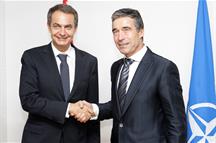
The President of the Government held a bilateral meeting with the Secretary-General of NATO, Anders Fogh Rasmussen, during which they discussed the transition in Afghanistan once the withdrawal of international troops has begun. They also spoke about the NATO mission in Libya, for which Spain is carrying out surveillance mission over the no-fly zone and is involved in the naval embargo in the Mediterranean.
They also reviewed the objectives for the next NATO summit, to be held in Chicago in May 2012. NATO is committed to increasing cooperation between its allied members in order to maintain and increase defence capabilities in an economic environment that is forcing military budgets to be reduced. José Luis Rodríguez Zapatero and Anders Fogh Rasmussen also discussed the Spanish involvement in the new cooperation project on defence capabilities.
EFE