Pedro Sánchez presents the National Plan for Cultural Action Abroad 2026-2028
President's News - 2026.5.29
Presentation of the National Plan for Cultural Action Abroad | Pool Moncloa / Jorge Villar - 2026.5.29
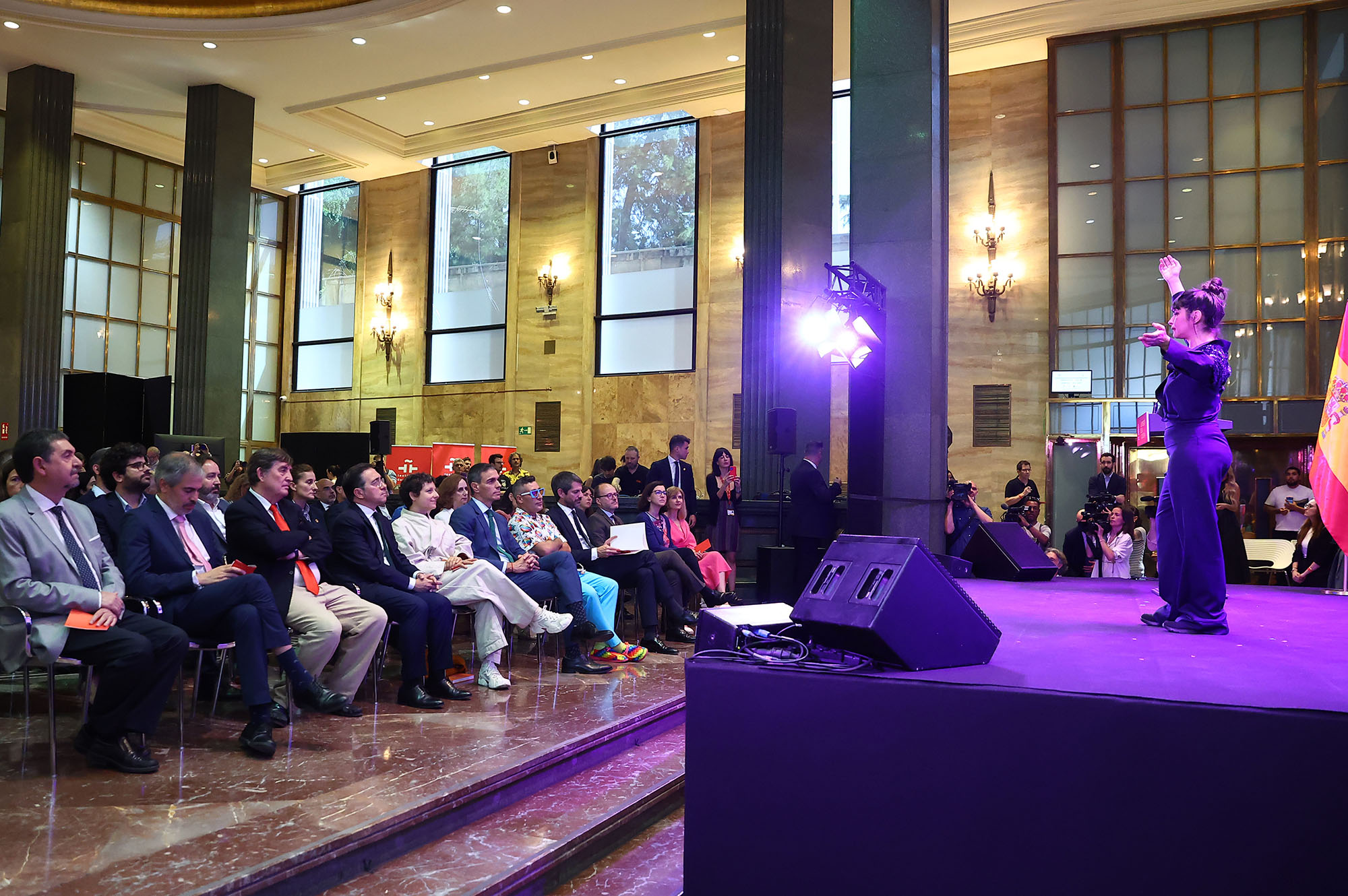






Cervantes Institute, Madrid
The President of the Government of Spain, Pedro Sánchez, has presented the National Plan for Cultural Action Abroad 2026-2028. A plan with which, he explained, "we are going to better help our cultural industries to open up markets and gain a greater international presence".
The initiative also seeks to 'concentrate efforts in strategic regions where Spain has a great deal of scope for cultural and economic growth, such as Asia, Latin America and the United States', and 'to strengthen Spanish as a global language of culture, knowledge and influence, together with our co-official languages'. But, "above all, it means something very important: to better coordinate all the enormous cultural scaffolding that our country already has".
The challenge is to export our talent through an ecosystem capable of projecting it with all its strength and building a true "organised cultural power". Because "countries that believe in their culture don't improvise their presence in the world; they plan it, promote it and make it a matter of national policy". In short, "we have to better capitalise on our assets" and do so "in a strategic, coordinated, and intelligent way", he stressed.
During his speech, Pedro Sánchez pointed out that "being Spanish today is a way of being in the world" and that "our culture not only transmits these values; it embodies them". Our country - he recalled - is currently the fourth largest cultural and heritage power in the world according to the Global Soft Power Index 2026. We are the second most popular tourist destination on the planet, and one in four visitors is drawn here precisely by our culture.
Moreover, culture "is an industry that generates employment, projects international reputation and builds collective self-esteem". In fact, today the cultural and creative sectors employ almost 800,000 people in Spain, and for every euro invested in culture, our economy generates €1.75 of added value.
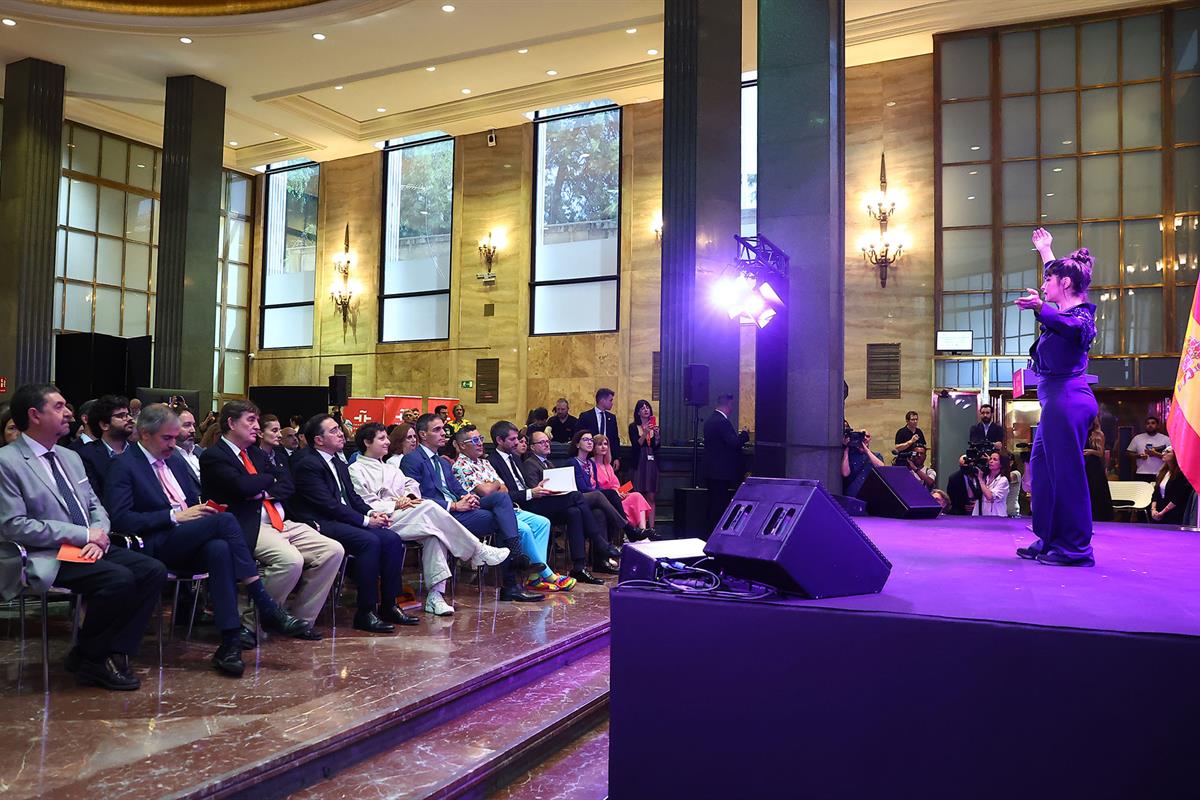 The President of the Government of Spain, Pedro Sánchez, during the presentation of the National Plan for Cultural Action Abroad 2026-2028 | Pool Moncloa/Fernando Calvo
On this point, the President of the Government of Spain wanted to differentiate between "countries that leave their mark through the power they accumulate" and "those that achieve something much more difficult: becoming part of the world's emotional imagination". That is why, "at a time when some are advocating the culture of force, of war, we choose the opposite: the force of culture", he added. And indeed, "Spain, when it has given its best, has never tried to impose itself through force; it has always done so through culture".
For this reason, he continued, "to talk about culture is also to talk about democracy, values, principles, rights, coexistence", and "the greatest success of foreign policy is not that they fear Spain, it is that they want to be like us".
Objectives and milestones of the National Action Plan for Cultural Action Abroad
The specific objectives pursued by the Plan are:
- To promote the international projection of all creative and cultural sectors: equal visibility and sectoral diversity.
- To increase the export of cultural goods and services and the projection of our creators, cultural managers, companies and industries.
- To consolidate the level of influence of our 'soft power'.
- To strengthen cultural links and exchanges with other countries.
- To promote multilateralism through culture: Spanish cultural diplomacy as a tool for peace, understanding and cooperation.
- To promote cultural rights and access to culture as a global public good.
- To design and position the "Spanish culture" brand on the international stage as a mark of excellence.
- To increase the international standing, awareness and interest in cultural creation in Spanish by leveraging the language's impact.
- To include and develop Spanish and its co-official languages in leading fields: international organisations, academic institutions, universities, science, technology, AI and professional groups.
- To strengthen cultural cooperation for sustainable development, with emphasis on the concept of culture as a human right.
The Plan relies on the coordination of strategies and resources and maximises the effectiveness of the various stakeholders involved in cultural action abroad: the Ministry of Foreign Affairs, European Union and Cooperation through its affiliated agencies: AECID, Instituto Cervantes and the Directorate General for Spanish Language in the World (DGEM); the Ministry of Culture and its affiliated public bodies; the Cabinet of the Presidency of the Government (Department of Cultural Affairs); the Ministry of Economy, Trade and Business through ICEX; the Ministry of Education, Vocational Training and Sports through its unit for foreign educational action; the Ministry of Finance through Acción Cultural Española (AC/E), and the Ministry of Industry and Tourism through Turespaña, and Rrtve.
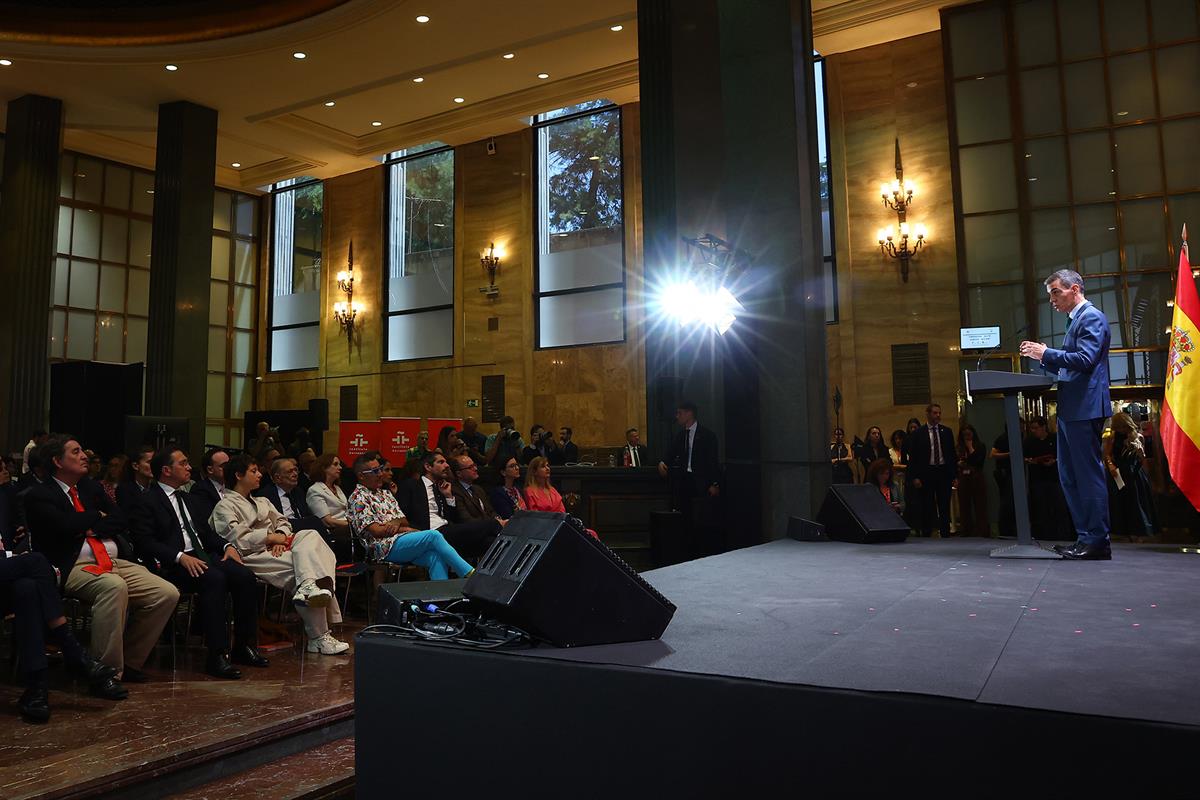 The President of the Government of Spain, Pedro Sánchez, during his speech at the presentation of the National Plan for Cultural Action Abroad 2026-2028 | Pool Moncloa/Fernando Calvo
As for the key cultural milestones in the Plan, the following stand out in 2026: the Spain-India Dual Year, the 250th anniversary of the founding of the United States, the 30th Ibero-American Summit, the São Paulo Book Fair Biennial, and a busy schedule at the new headquarters of the Cervantes Institute in Seoul. In 2027 there will be the International Exhibition in Belgrade, the Centenary of the Generation of '27 and the Prague Quadrennial, while in 2028 we will celebrate the Year of Goya.
Identity of Spanish culture abroad: SPAIN. LIVING CULTURE
During the event, the identity ESPAÑA. CULTURA VIVA (SPAIN. LIVING CULTURE) was presented to the public, winner of the ideas competition held within the framework of the National Plan to design the graphic image for the dissemination of Spanish culture abroad.
ESPAÑA. CULTURA VIVA is an idea from the Barcelona-based studio CLASE and defines a common identity for Spanish culture abroad: recognisable, usable and capable of providing coherence in a diverse ecosystem. The aim is to project a strong, contemporary, shared presence that works on an international scale without erasing nuances. Spanish culture is a constantly evolving constellation, where heritage and experimentation, tradition and innovation coexist. This new brand-inspired by the richness of Spanish culture, the brilliance of the sun, and the radiating and expanding energy of cultures in Spain-will be a hallmark of quality and excellence, a globally recognisable emblem.
Speeches by Ministers Albares and Urtasun
The meeting was also attended by the Minister for Foreign Affairs, European Union and Cooperation, José Manuel Albares, and the Minister for Culture, Ernest Urtasun.
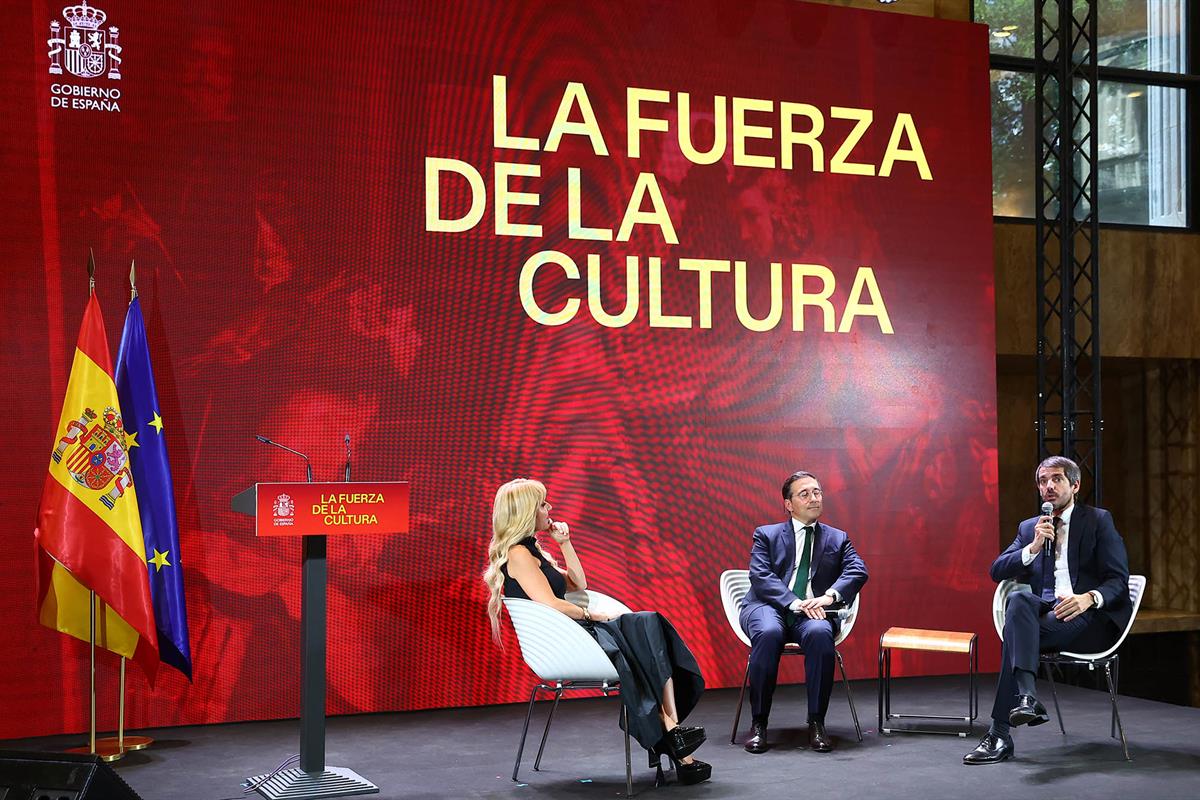 The Minister for Foreign Affairs, European Union and Cooperation, José Manuel Albares, and the Minister for Culture, Ernest Urtasun, during the presentation of the National Plan for Cultural Action Abroad 2026-2028 | Pool Moncloa/Fernando Calvo
Albares stressed that our culture is what most defines our identity, and therefore, it is important to have a Plan that allows us to reflect, that projects us forward, and that supports cultural agents, since Spain's greatest ambassadors are those who create culture: Rosalía, 'los Javis', Almodóvar.... In his opinion, Spain is one of the few countries with a global language and culture that allows us to pursue a global and humanist foreign policy, and these humanist values are clearly rooted in and nourished by our culture.
For his part, the Minister for Culture stressed that the great debate of our time is also a democratic debate. We are seeing the advance of authoritarian models that challenge multilateralism, human rights and democratic coexistence itself. And in the face of this, culture is what allows diverse societies to coexist, engage in dialogue and recognise one another. Therefore, this Plan is not only an external promotion strategy, it is also a commitment to strengthening the international presence of a democratic, diverse, open Spain, committed to culture as a tool for coexistence and dialogue.
Non official translation