Pedro Sánchez highlights that the 2026 minimum wage increase represents "a very significant step towards improving the lives of 2.5 million workers"
President's News - 2026.2.16
Headquarters of the Ministry of Labour and Social Economy, Madrid
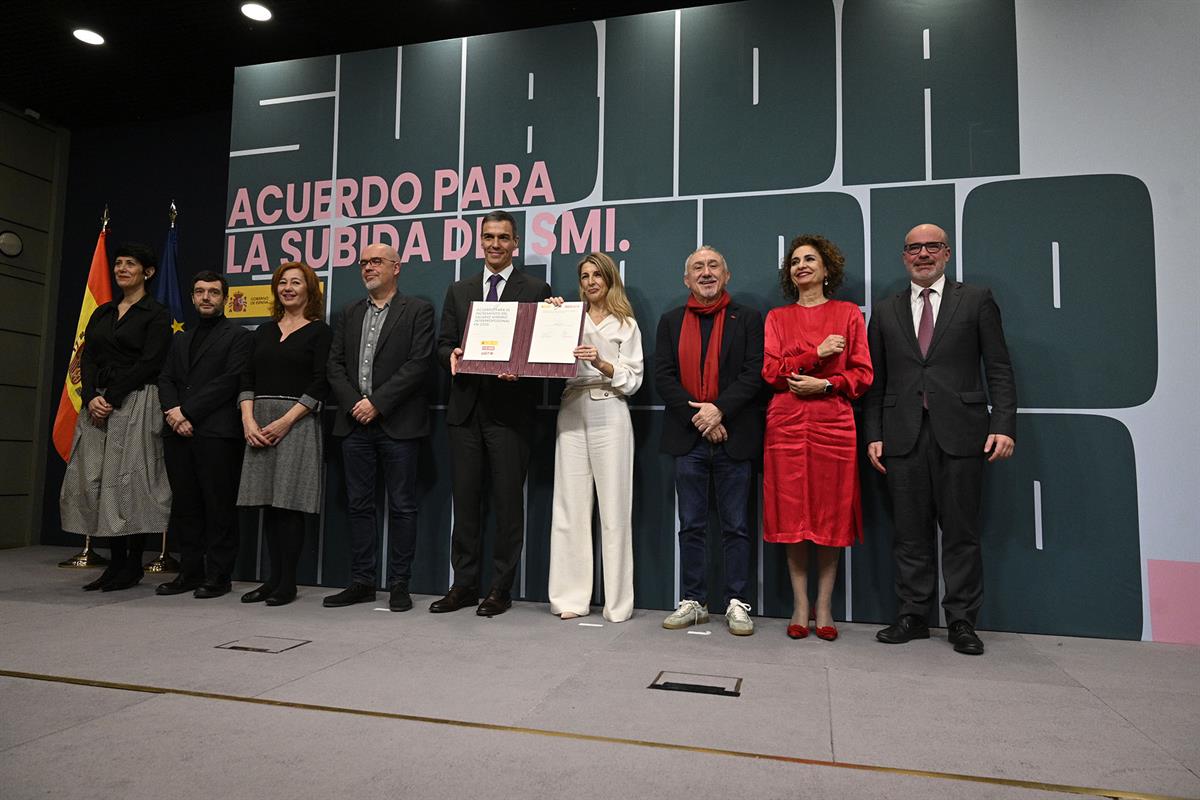 The President of the Government of Spain, Pedro Sánchez, and the Second Vice-President and Minister for Labour and Social Economy, Yolanda Díaz, display the agreement accompanied by other members of the Executive (Pool Moncloa/José Manuel Álvarez)






The President of the Government of Spain, Pedro Sánchez, has signed the agreement to raise the minimum interprofessional wage (SMI) in 2026, which he highlighted as "a very significant step towards improving the lives of 2.5 million workers", especially women and young people. This was stated during his speech at the signing ceremony for the minimum wage increase agreement with the labour unions, held at the Ministry of Labour and Social Economy. Also participating in the event were the Second Vice-President of the Government of Spain and Minister for Labour and Social Economy, Yolanda Díaz, and the general secretaries of the CCOO and UGT unions, Unai Sordo and Pepe Álvarez, respectively.
The event was also attended by the First Vice-President of the Government of Spain and Minister for Finance, María Jesús Montero; the Minister for Social Rights, Consumer Affairs and 2030 Agenda, Pablo Bustinduy, and the Minister for Inclusion, Social Security and Migration and Government Spokesperson, Elma Saiz.
Pedro Sánchez emphasised that those benefiting from the new minimum wage increase "don't make headlines, but they sustain the real economy every morning" when they "open a shop, care for an elderly person, serve coffee, drive a vehicle, or spend hours in front of a machine or a screen". And he has emphasised the Government's commitment to ensuring that "work allows people to live with dignity," which is why the eighth increase in the minimum wage since 2018 has been approved, representing a cumulative increase of over 66% in just eight years, rising from €735 per month to €1,221 gross per month (paid in 14 instalments) this year, following the approval of a further 3.1% increase in 2026.
He thanked the Second Vice-President of the Government of Spain and Minister for Labour and Social Economy for "her unwavering commitment and her capacity for work and dialogue", and the UGT and CC.OO. trade unions for "proudly representing millions of workers and for reminding us every day that labour rights are not given freely, but rather won and defended".
He also expressed his regret at the absence of the employers' association. "Where is the employers' association when the IBEX is reaching all-time highs? Where is the employers' association when the Spanish economy is growing at 2.8%, well above the European average? Where is the employers' organisation when corporate profits are breaking records year after year?", he asked.
The President of the Government of Spain stressed that "good numbers don't fall from the sky", but rather "are made possible by the daily work of millions of people, those who get up early, produce, serve, care for, and keep companies going".
He then praised the fact that many Spanish companies "understand that their workers are their greatest asset and that they therefore deserve a decent wage. "What is unacceptable is that, in a context of economic prosperity, the wages of those earning the minimum wage are scrutinised while turning a blind eye to multimillion-euro profits. That is not economic prudence. "Raising the minimum wage is not a whim, nor a symbolic gesture; just ask those who earned 735 euros in 2018 and will earn 1,221 this year", he emphasised.
"Raising the minimum wage is a matter of social justice"
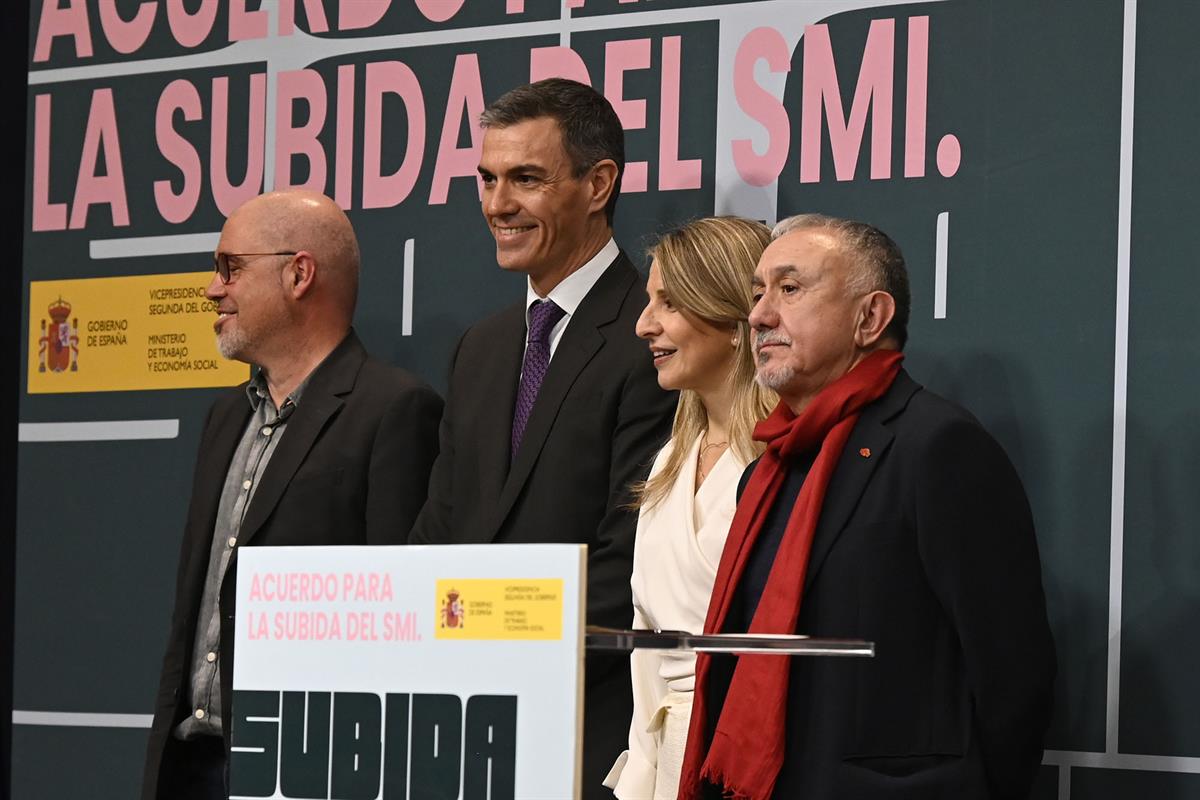 The general secretary of CCOO, Unai Sordo, the President of the Government of Spain, Pedro Sánchez, the second Vice-President and Minister for Labour and Social Economy, Yolanda Díaz, and the general secretary of UGT, Pepe Álvarez, during the signing | Pool Moncloa/José Manuel Álvarez
The President of the Government of Spain argued that raising the minimum wage is "a matter of social justice and economic intelligence, which refutes those who predicted the disaster of any economy in the face of a minimum wage increase", since "the facts prove otherwise", with more employment, consumption, and job stability. "This government has chosen the path of ensuring that growth reaches people's paychecks, of guaranteeing shared prosperity, of strengthening our economy not at the expense of weakening wages, but precisely by increasing them. This increase in the minimum wage sends a very clear and powerful message to millions of people: their work matters, their effort matters, and their dignity matters", he added.
Similarly, he stressed that Spain will not return to the "work more and earn less" mentality, nor to the era of sacrifices while the same people always profit. When it's time to tighten our belts, we all tighten them. And when it's time to share the benefits, we share them among everyone". In this regard, he indicated that "the Government is doing what it can: with the minimum wage and with civil servants' salaries", and therefore asked employers "to do their part and pay more, to sit down with the unions at the collective bargaining tables, and for us to move towards a general increase in salaries where, unfortunately, there are no increases in real terms".
"Today we are signing an increase in the minimum wage, but above all, we are reaffirming a political and social commitment: to continue dignifying work, to continue expanding rights, and to continue governing for the social majority, because Spain progresses when its workers progress, and we are not going to ask for permission to continue doing so", he added.
Yolanda Díaz: "The minimum wage does not destroy jobs, it destroys poverty"
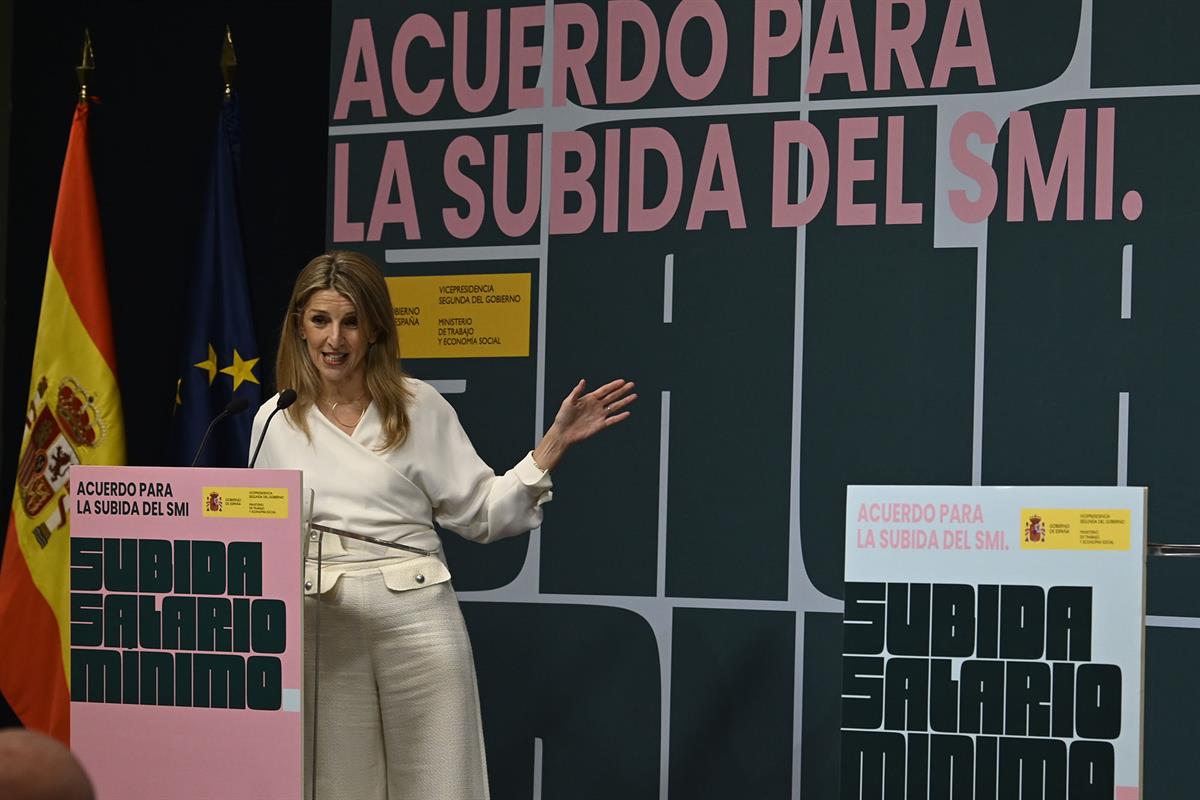 The Second Vice-President and Minister for Labour and Social Economy, Yolanda Díaz, during her speech at the event | Pool Moncloa/José Manuel Álvarez
The Second Vice-President of the Government of Spain and Minister for Labour and Social Economy, Yolanda Díaz, celebrated that the lives of the working class are once again being "improved" with a new increase in the minimum wage, while at the same time achieving record employment and a larger active population, and reducing inequality and in-work poverty. "The minimum wage does not destroy jobs, it destroys poverty. This government will continue to move forward and deliver good news," she stated, adding that "this will be a legislature for working people, improving well-being, time tracking, reducing working hours, improving work in the cultural sector, preventing unpaid overtime, protecting against unfair dismissal, and regulating platforms, algorithms, and generative artificial intelligence".
Non official translation