Control session in the Lower House of Parliament
Pedro Sánchez defends his support for the welfare state through state investment in public services
President's News - 2025.12.10
Lower House of Parliament, Madrid
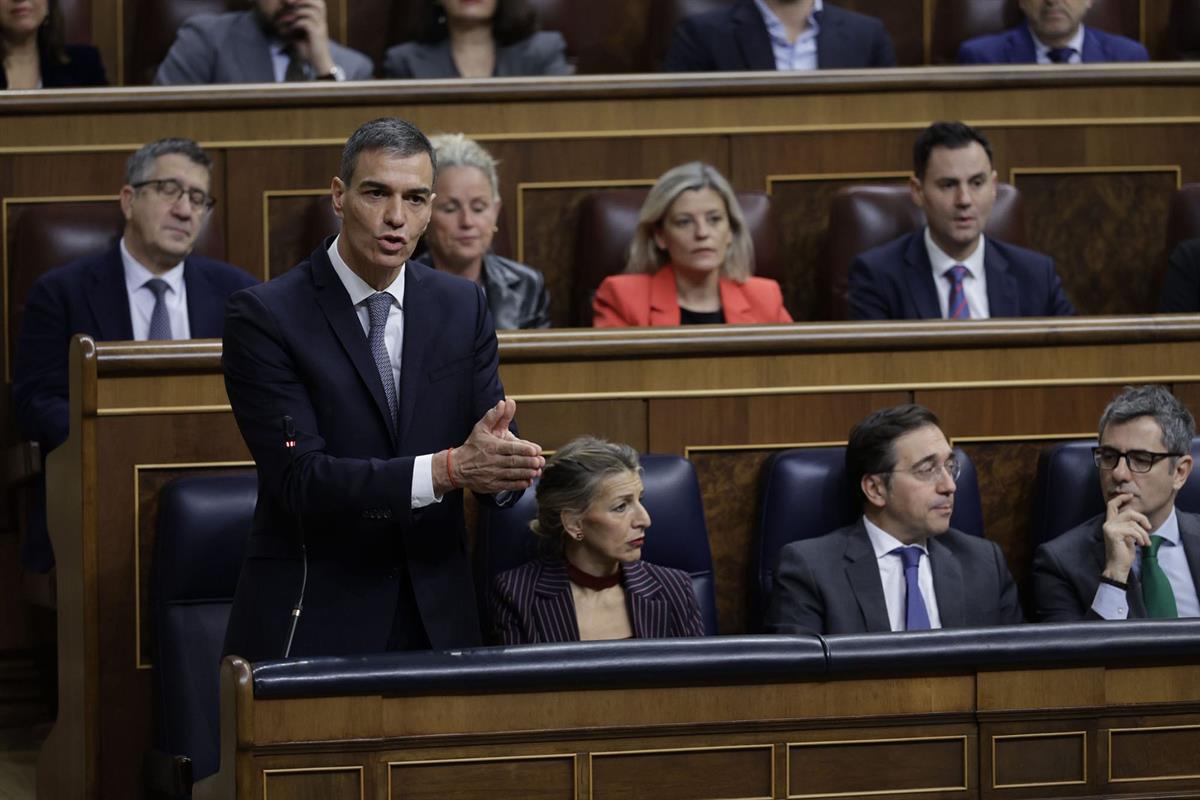 The President of the Government of Spain, Pedro Sánchez, speaks during the question period for the Executive (Pool Congreso)





The President of the Government of Spain, Pedro Sánchez, during the control session in the Lower House of Parliament, defended the financial support provided by the state to the autonomous communities over the past seven years with the aim of "strengthening public healthcare, public education, long-term care, and all policies related to social services."
In his response to MP Gabriel Rufián of the Republican Parliamentary Group, the president reminded the regional governments that in recent years the central government has transferred €300 billion more than the previous administration. He added that this is in addition to the 61% increase in the Minimum Interprofessional Wage and the adjustment of pensions in line with inflation.
"But we are aware that it is not enough," stated President Sánchez, who appealed to the regional governments to translate this investment into a real improvement in public services: "We can transfer economic resources, increase the Minimum Interprofessional Wage, and adjust pensions. The problem lies at the heart of those governments that do not believe in this welfare model".
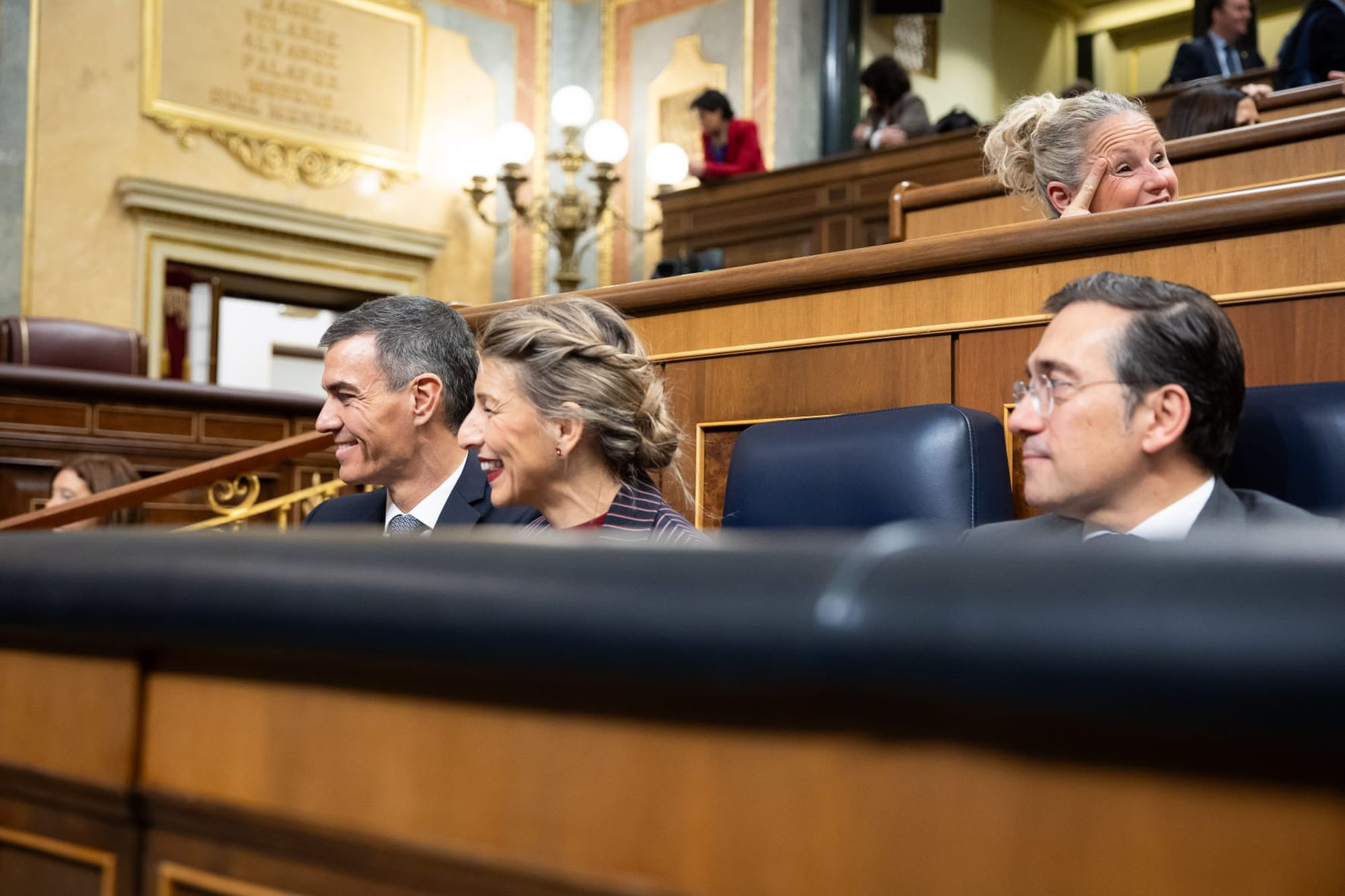 The President of the Government of Spain, Pedro Sánchez, together with the Minister for Labor and Social Economy, Yolanda Díaz, and the Minister for Foreign Affairs, European Union and Cooperation, José Manuel Albares | Pool Congreso
Measures on ecological transition and migration policy
The president once again celebrated the national economic data within the European context, in which Spain stands out as the country with the highest job creation and the third in reducing inequality. "That doesn't mean this is a self-congratulatory message," noted Pedro Sánchez, who cited housing, the privatisation of public healthcare, and the National Security Strategy recently approved by the US government as among the government's main concerns.
In his response to MP Santiago Abascal, of the Vox Parliamentary Group, the president added another achievement in the area of the ecological transition to these economic figures. "Thanks to the boost we have given to renewable energy-which now represents 60% of total electricity-we have reduced the price of electricity by 50%: today in Spain, the price of electricity is on average 20% cheaper than in the EU," he celebrated.
With regard to migration policies, the leader of the Executive highlighted that over 95% of migration arrives through legal channels and reiterated the contribution of migrant workers to economic growth: "We have received 2 million migrants in recent years, but at the same time, we have reduced the unemployment rate in our country by 40%," he argued.
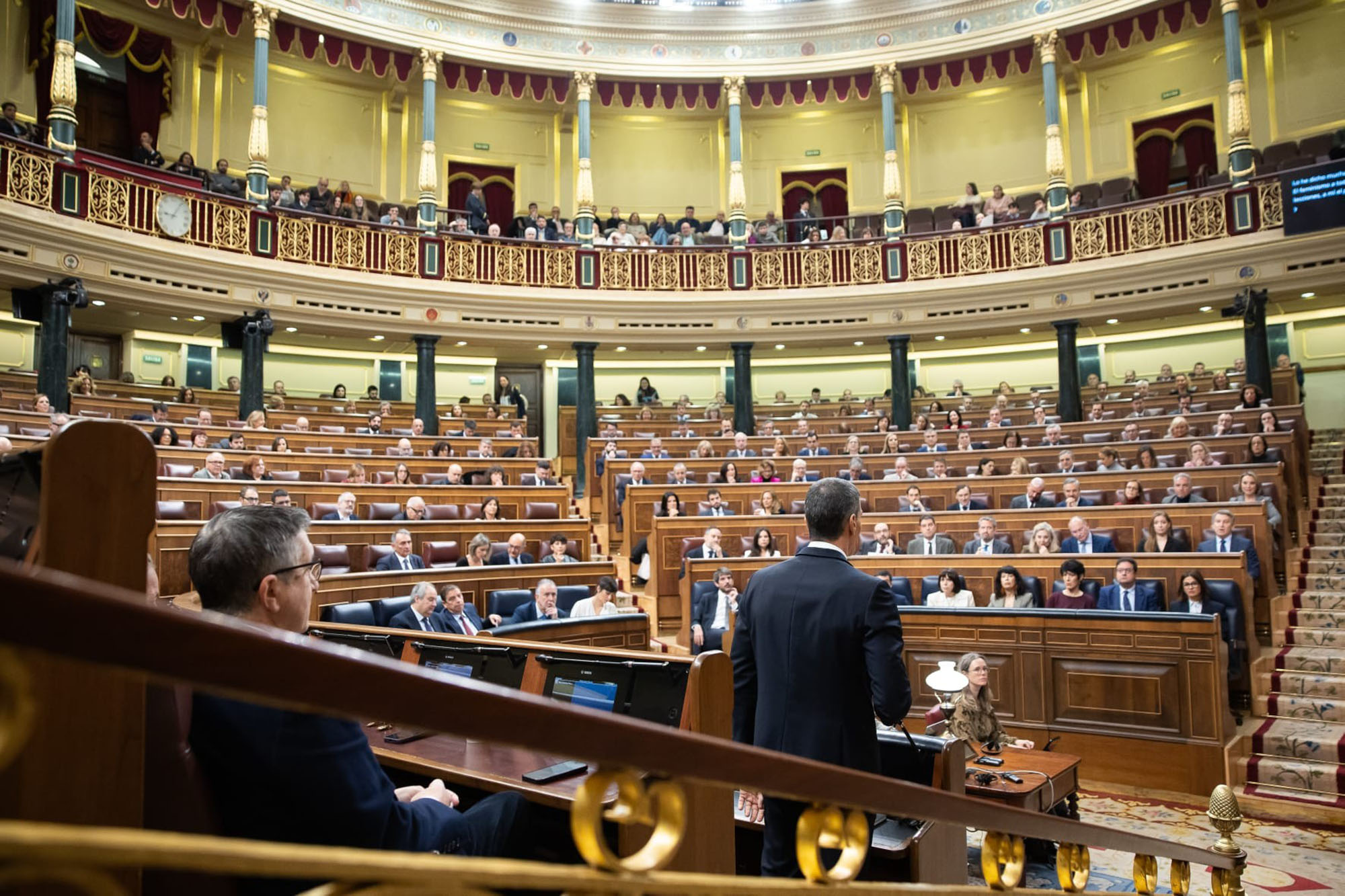 The President of the Government of Spain, Pedro Sánchez, answers questions from members of parliament | Pool Congreso
"The Government that most supports women"
In response to a question from MP Alberto Núñez Feijóo, of the People's Parliamentary Group, about the reported cases of harassment at the Moncloa Palace, the president asserted that the government "acknowledges its mistakes when they are made" and "acts accordingly": "Feminism teaches us all lessons," added Pedro Sánchez, who affirmed that the data from the latest Equality Survey reflects that workplace harassment is a "structural problem," as one in three women report having experienced it.
In this context, President Sánchez highlighted the measures adopted by the government to achieve equality in different areas: "This government is the one that most supports women," he asserted. Among these, the president reiterated previously mentioned economic measures that particularly benefit the female population.
"When we raise the minimum wage, who are we benefiting, if not the 65% who are women workers? When we increase pensions in line with inflation, we are benefiting more than 2,600,000 women pensioners. When we approve the Gender Parity Law or the State Pact against Gender Violence, or when we reinstate Social Security contributions for caregivers of dependent family members-who are mostly women-this government is supporting women," he concluded.
Non official translation