Plan of 130 measures to face the Demographic Challenge
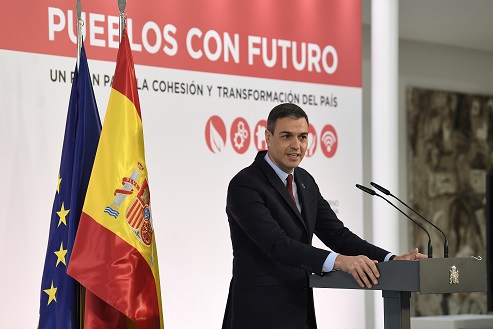
Pedro Sánchez: "Our villages must be territories of hope"
President's News - 2021.5.22





Moncloa Palace, Madrid
"We will work tirelessly to unite our territories and to offer the same economic opportunities to all. Our villages and hamlets must be shared villages and hamlets and, above all, territories of hope," the president pledged.
The plan will have 10 billion euros invested in it and will enable small towns to roll out their future strategies in line with the Recovery, Transformation and Resilience Plan.
In an event at the Moncloa Palace, Sánchez was accompanied by the vice-president for Ecological Transition and Demographic Challenge, Teresa Ribera, the secretary general for Demographic Challenge, Francisco Boya, and a broad representation of towns both in person and online. With them, the president reviewed the plan's measures and presented its first steps forwards, thanks to the rapid implementation of several of the proposed initiatives, among which he highlighted the creation of the Just Transition Institute, the allocation of 400 million euros for the MOVES III Plan, the 100 million euros for the Energy Rehabilitation of Buildings Programme, another 100 million euros for the sanitation and purification plan in towns with fewer than 5,000 inhabitants, and the 100 million euros for unique energy transition projects.
He also pointed out that the Ministry of Transport, Mobility and Urban Agenda's Resource Relocation Plan is already underway, with different centres in Teruel, Alcázar de San Juan (Ciudad Real), Mérida (Badajoz), Miranda de Ebro (Burgos), León, Soria and Castellón.
The president stressed that Spain's 8,131 villages are 8,131 opportunities for hope. "We are not going to squander any of them, not a single one. Because each of them represents what we want Spain to be. Our identity, our strength and our possibility for the future.
"We wanted the Recovery, Transformation and Resilience plan to begin to be deployed in rural areas first, in the territory, because we want this territorial cohesion perspective to be fundamental in the roll out of this plan that is going to modernise our country," he said.
Agenda for the future throughout the territory
The Action Plan - accessible through this link - marks the beginning of a future agenda to rethink small towns in technological terms and turn them into key players in the ecological transition. The integration of renewable energies in production processes and rural buildings is essential in bringing the economy closer to the territories.
At the same time, the Plan identifies entrepreneurship and innovation as a priority in attracting talent and determining the population. The revitalisation of economic activities in rural environments is essential to establish a new cultural relationship between cities and towns, as well as to guarantee citizens the possibility of developing their personal or work projects in any territory. To this end, it is essential to complete connectivity and eliminate the urban-rural digital divide, as has been done in the last two years, with ultrafast broadband coverage - 100 Mbps - growing by more than 25 points and now reaching 63% of the rural population.
These 130 measures call for ensuring dialogue between urban and rural areas, eliminating gender gaps and giving women and young people a greater role as the main actors in securing the future of the towns most affected by the urgent demographic challenge.
130 measures and 10 lines of action
The Action Plan is the result of the government's coordinated and cross-cutting action on the demographic challenge and establishes an effective agenda for equality and territorial cohesion to incorporate small towns into a green, digital, inclusive and gender-sensitive recovery.
Along these lines, the Plan focuses its 130 actions on achieving two fundamental objectives for social and territorial cohesion. On one hand, to guarantee equal rights, the adequate provision of services, gender equality and the elimination of social gaps; on the other hand, to generate opportunities for entrepreneurship and boost economic activity in the territories with the greatest difficulties in competing in globalised markets.
The main lines the Action Plan revolves around are ecological and digital transition, territorial innovation, sustainable tourism, equal rights, the promotion of entrepreneurship, public services, social welfare and the promotion of culture. At the same time, the document points to the application of the demographic perspective in the decision-making process at all levels of government as a priority.
Active social participation
The Action Plan underlines the necessary involvement of local actors to bring investments to small towns. The recent creation of the Forum for Territorial Cohesion and the Sectoral Conference on Demographic Challenge are some of the government's instruments for guaranteeing municipal participation in the design and configuration of lines of investment.
The Plan also seeks this social participation through open governance mechanisms that promote public-private alliances with the third and private sectors, as well as with universities, research centres and citizens.
The expression of interest launched by the general secretariat for Demographic Challenge at the end of 2020 has provided a clearer picture of the needs and opportunities in small towns, as well as the characteristics of the projects that come from the rural associative fabric.
Of the more than 4,000 initiatives received, over 60% came from small towns, which has allowed the Action Plan to be brought closer to the local administration and to effectively focus its actions on small towns.
Non official translation
Pool Moncloa/Borja Puig de la Bellacasa