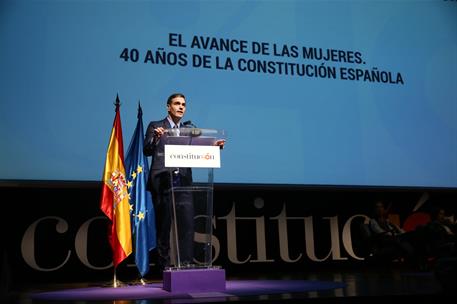
At event entitled "The progress of women. 40 years of the Spanish Constitution"
Pedro Sánchez argues that equality between men and women "is non-negotiable"
President's News - 2018.12.19
Images of the arrival of president Sanchez and of the beginning of the event | Pool Moncloa / Jorge Villar - 19.12.2018 16:38:00





Reina Sofía National Art Museum, Madrid
The President of the Government, Pedro Sánchez, attended the event entitled "The progress of women. 40 years of the Spanish Constitution", where he sought to pay "just tribute" to these "admirable and admired" women, such as the recently deceased Carmen Alborch, who have fought for equality when women were denied the most basic of rights. The event was also attended by the Vice-President of the Government, Minister for the Presidency, Parliamentary Relations and Equality, Carmen Calvo, whose department organised the event.
After a few words in memory of the teacher, Laura Luelmo, murdered a few days ago in Huelva, President of the Government Sánchez stated that the 40th anniversary of the 1978 Spanish Constitution has served to reflect on the achievements made in these years. Pedro Sánchez remarked that Spain has ceased to be a country anchored in the past and is now at the forefront of new rights and liberties, highlighting that it has now become a modern country, with women actively participating in public life "after 40 years of a sexist, misogynist dictatorship".
Equality, a priority for the government
The President of the Government underlined that, thanks to the Constitution, more progress has been made on equality in the last 40 years than in the previous 20 centuries. He remarked that in the constituent legislature, women barely accounted for 6% of all MPs. Today, he said, Spain is the country of the historic feminist movement on 8 March, of the State Pact to Combat Gender-based Violence and with the greatest presence of women in a cabinet.
The fight for equality between men and women is at the heart of the government's Agenda for Change, added Pedro Sánchez, highlighting that this has formed part of the government's priorities since the outset. Evidence of this is that the Ministry and State Secretariat for Equality have been recovered, and that a Directorate-General for Non-discrimination and Diversity has been set up. In short, the "commitment to women and equality is real and tangible".
The President of the Government also listed some of the measures approved to date to make further progress on equality. Among others, he highlighted the rise in widowhood pensions, the recovery of contributions from non-professional carers of people subject to long-term care, free assisted reproduction for lesbians and single women, the firm and clear commitment to child education for those aged 0 to 3, and the extension of paternity leave to up to five weeks.
Pedro Sánchez underlined that "equality between men and women is not negotiable" and that it is not possible to turn back on this now, but rather we must move towards more equality, more feminism and more women in public life. He also referred to the serious problem of the low birth rate in Spain, something that should not surprise us if we look at the daily and persistent problems that women with children have to face, since society continues to ask too much from them.
The President of the Government ended his speech by referring to the phrase by Clara Campoamor, "liberty is learned by exercising it", and highlighted that "you don't need to ask for permission or express your gratitude for exercising your rights".
"Spanish women will not retreat"
For her part, the Vice-President of the Government, Minister for the Presidency, Parliamentary Relations and Equality, Carmen Calvo, began her speech by recalling that "celebrating 40 years of the Constitution and celebrating democracy is exactly the same: it is an historic achievement of such magnitude that we should constantly remember this, and harness all the energy that this country has available to tackle both the present challenges we are facing and those looming". Carmen Calvo declared that "Spanish women are not going to budge an inch on the achievements made, and we are clear as to the path that democracy must continue to take in response to our problems, to the obstacles that we must overcome to exercise the rights recognised to the benefit of our liberties".
The minister ended her speech by stressing that "women have learned in the 20th and 21st Centuries what the Nordic feminists had been saying: half of everything belongs to us. We are a constant revolution in our vision of the world, one of compassion, solidarity and influence. A large part of the responses that this world will give in tackling the major challenges we are facing will depend on liberty and equality".
The event, presented by Pepa Bueno, took place in the Reina Sofía National Art Centre Museum, and was also attended by the ministers Nadia Calviño, Margarita Robles, Dolores Delgado, María Jesús Montero, Mª Luisa Carcedo, Magdalena Valerio, and Fernando Grande-Marlaska. During the event, recognition was given to the work to enhance equality by Nuria Espert, actress; Victoria Prego, journalist; María Dolores Pelayo Duque, Member of the Upper house for Tenerife in the constituent legislature; Emilia Caballero, founder of the association of women jurists 'Themis', and Arantxa Unda, chosen by Forbes in 2017 as the most influential person under the age of 30 in the world of healthcare.
Non official translation