




Brussels (Belgium)
Decisions were taken at the Summit to strengthen the single currency, which is now 20 years old. Specifically, the leaders finally agreed to implement fiscal support for the Single Resolution Fund - one of the main pillars of the Banking Union - which will help contribute to financial stability. Leaders also approved the reform of the rescue fund - the ESM - providing it with more robust and effective instruments in cases of financial crises, thus sending out a message of confidence to the market. They also held an intense debate on the fiscal pillar of the Monetary Union.
For the first time, the Euro Summit agreed to work on setting in motion a single budget to foster competitiveness and convergence of Euro countries. To this end, the Government of Spain advocated more ambitious fiscal proposals to strengthen the Eurozone, including a common unemployment insurance scheme to send out a signal that the Monetary Union is also capable of advancing on protecting citizens, particularly the most vulnerable. Pedro Sánchez called for a budget for the Monetary Union and expressed his government's willingness to ensure a stabilisation instrument for the Eurozone for periods of crisis, stressing that over the coming months the government will continue working on this goal at the Eurogroup and with the European Commission.
A structural migratory phenomenon
As regards migration, the President of the Government recalled the sustained migratory pressure Spain has been under and stressed the "key" role of Morocco in managing these flows in the Western Mediterranean route. Pedro Sánchez underlined the need to strengthen cooperation with the Moroccan authorities, increasing resources to this end, and recalled "the important step" adopted by the European Union, at Spain's request, to allocate 140 million euros to Morocco to this end. The President of the Government added that the migratory phenomenon is a structural reality, and as such the European Union should make a commitment and provide aid to Morocco. European leaders also tackled the reform of the Common European Asylum System which, according to the Government of Spain, must be "balanced", combining the responsibility and solidarity of Member States.
As regards climate change, Spain, together with other countries including France, Portugal, Denmark and the Netherlands, achieved a specific statement in the Conclusions of the European Council, on the need for the EU to present its strategy to implement the Paris Agreement in 2020. The leaders also agreed that, in the first half of next year, the Council should establish the political priorities for a decarbonised Europe in the future.
During the second session of the European Council, Pedro Sánchez also declared Spain's commitment to the need to extend the Single Market to adapt it to the new digital era. The President of the Government called for the adoption of a "robust social dimension, which conveys to citizens that the Single Market is much more than just a market". As regards security and defence, the leaders agreed to make progress on a common defence strategy, and to fight fake news, a "real and growing threat to our democracies", on which we "must take all the measures possible to combat it", said Pedro Sánchez. The Council also called for everyone to fight racism, xenophobia and anti-Semitism.
To end, Pedro Sánchez stressed the value of citizen consultations as an "exercise in democratic dialogue with our citizens" - in Spain, consultations have been carried out in 48 cities, in which some 6,000 people have participated - and recalled the need to continue proposing these dialogues in the future, recognising their importance to be aware of people's concerns and aspiration regarding Europe and the European Union.
Non official translation
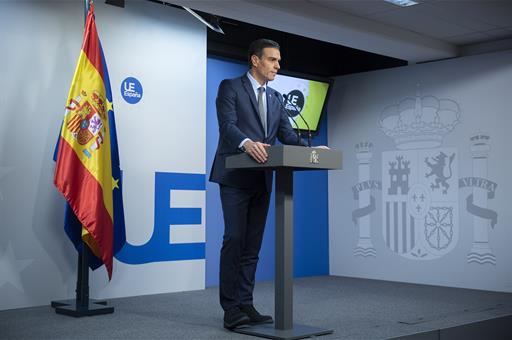
Pool Moncloa / Borja Puig de la Bellacasa