Mariano Rajoy offers his collaboration and "constructive, open and realistic dialogue within the framework of the law" to the next Regional Government of Catalonia
President's News - 2017.12.22





Moncloa Palace, Madrid
The President of the Government stressed that the regional elections, "once the principle of legality had been restored", were held with all the proper guarantees and the involvement of all political parties. Furthermore, the day unfolded "with normality and calm", while the legal representatives and authorised officials were able to fulfil the duties allocated to them by law.
Mariano Rajoy also pointed to the high turnout, "a reflection of the civic response from the people of Catalonia to the existing political situation and the future challenges now facing Catalonia".
As for the result, he congratulated Inés Arrimadas and her party, "which has won the elections in terms of both the number of seats and the number of votes". He went on to add that the downside is that "those of us who wanted change have not obtained enough seats to implement those changes". Mariano Rajoy recalled that, in any case, the pro-independence supporters have continued to lose support: from 76 members of parliament and 48.76% of the votes at the 2010 elections to 70 members of parliament and 47.49% of the votes at Thursday's elections.
Cooperation and plurality
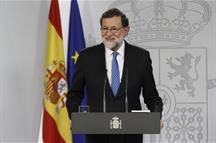 Pool Moncloa/ JM CuadradoThe President of the Government believes that the results show that "Catalonia is not monolithic but in fact plural, and we should all encourage this plurality as a virtue and source of wealth". Repairing the cracks caused by radical attitudes in Catalan society will take time and "should be the first obligation for all political stakeholders", he said. This "reconciliation" should be sought "hand-in-hand with the law and a respect for the rights of all, both majorities and minorities".
Mariano Rajoy called on the political parties of Catalonia to offer "solutions which provide governability". He also trusts that this marks the beginning of a period in Catalonia "based on dialogue and not confrontation, on cooperation and not on imposition, on plurality and not on unilaterality".
He stressed that the Government of Spain offers "its full collaboration and greatest willingness to engage in constructive, open and realistic dialogue, provided that this falls within the framework of the law, to whatever regional government is formed now in Catalonia with a view to resolving the problems of the Catalan people and building a framework of certainty and security". He said that this will be the only possible way to maintain growth and job creation in Catalonia, recover the investments and companies lost, and improve "the wellbeing and wealth of the people, which, at the end of the day, must be the goal for any government worth its salt".
Application of Article 155
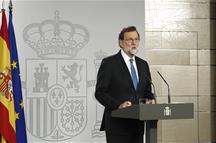 Pool Moncloa/ César P SendraThe President of the Government said that Article 155 of the Spanish Constitution was applied in Catalonia reasonably, prudently and intelligently, in consensus with a majority of the Upper House of Parliament, majority support from the political parties and European backing.
Mariano Rajoy argued that it was triggered in light of "an exceptional situation, and that exceptional situations in a democracy should be short-lived". In this regard, he justified the calling of snap elections "with the fundamental goal, which was indeed achieved, of restoring legality".
When asked about the withdrawal of these measures, the President of the Government replied that they will cease to apply on the date set by the Upper House of Parliament; in other words, when there is a new regional government in place in Catalonia".
Early elections ruled out
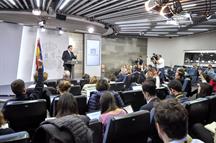 Pool Moncloa/ JM CuadradoThe President of the Government stressed that he has no intention to call early general elections and that he will try to ensure that "the legislature concludes as and when scheduled, which will be in mid-2020". "A legislature lasts for four years because people cannot be constantly forced to vote over and over again", he added.
In his opinion, "the Government of Spain is governing calmly, with the economic recovery consolidating itself and jobs being created".
Constitutional reform
The President of the Government said that his position on a reform of the Spanish Constitution has not changed, irrespective of the elections in Catalonia. "A precise reason must be made clear, the goals must be defined and the way in which it is to be done must be established. If anyone wants the Spanish Constitution to be reformed so that national sovereignty or the unity of Spain can be destroyed, it is obvious that they cannot count on the support of the President of the Government of Spain".
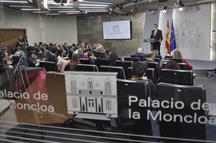 Pool Moncloa/ JM CuadradoFurthermore, Mariano Rajoy said that the legal situation of Carles Puigdemont and other persons elected as members of parliament does not depend on Thursday's voting but rather on the decisions taken by the justice system. "Politicians must operate within the law, just like any other citizen of the country, and it is not the justice system that must be subject to political strategising", he said.
He then reiterated his willingness to engage in dialogue with whoever holds the position of President of the Regional Government of Catalonia.
As regards the public accounts, the President of the Government believes that the result of the elections in Catalonia will not affect the negotiations surrounding the General State Budget, which are due to begin next Monday.
Non official translation
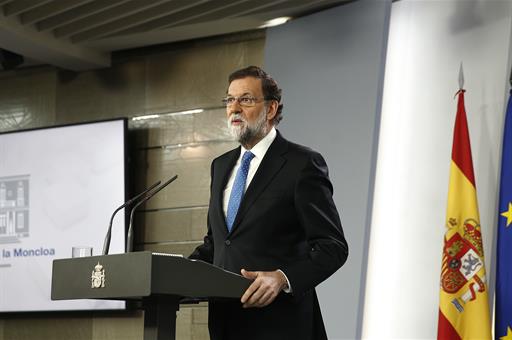
Pool Moncloa/ César P Sendra