At the government control session in the Lower House
Mariano Rajoy indicates that Jihadi counter-terrorism pact is "good" for Spain and "open to all political parties"
President's News - 2015.2.11






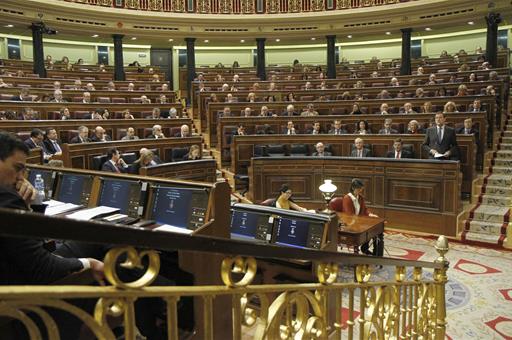
Lower House of Parliament, Madrid
During the government control session in the Lower House of Parliament and in response to a question from the MP, Cayo Lara, on the need to adopt an agreement on poverty, which, according to him, is more urgent than signing an agreement to combat Jihadi terrorism, Mariano Rajoy asserted that the agreement to combat terrorism is "pure common sense" and "a good decision", as is the pact on this issue agreed between the two main political parties. After adding that this is a pact "open to all political parties", he pointed out that it is "absolutely compatible with signing an agreement to combat poverty".
Similarly, the President of the Government asked MP Cayo Lara for "a little balance in his opinions" because "we are clearly improving". He also reminded him of some of the decisions adopted by the government to combat poverty which have proved to be "very positive". By way of example, he stated that economic growth in Spain is already positive which, in turn, generates "well-being and wealth". Furthermore, in 2014, 487,000 fewer people were unemployed and pensions were guaranteed and raised for some 9.2 million people.
 Pool MoncloaAccording to Mariano Rajoy, in the last three years, 100 billion euros have been allocated to paying unemployment benefits, the PREPARA Plan has been extended and, in December 2014, an agreement was signed with the trade unions to help those people "in the worst situation". As regards the poverty figures in Spain, the President of the Government underlined that, according to the figures published by Eurostat, 2013 was a turning point and poverty ceased to rise.
Optimistic but prudent economic forecasts
The parliamentary spokesperson for the CiU [Convergence and Union] political party, Josep Antoni Duran i Lleida, asked the President of the Government about the government's economic forecasts because, in his opinion, they are overly optimistic. In response, Mariano Rajoy reminded him that his government has always been prudent in its projections on the economy, which is shown by the fact that they were all exceeded in 2014, "both in terms of employment figures and in terms of economic growth". He also highlighted that, in principle, the forecasts for 2015 are positive, and hence "this is a fact that should inspire us all".
For the present year, the government has calculated economic growth of 2%, although the IMF, the European Commission and FUNCAS [Spanish Savings Banks Foundation] all calculate that it will be higher.
Mariano Rajoy added that the latest figures published (consumption, investment, car and property sales and loans) are all positive. Meanwhile, prices are controlled and "our economy is more competitive". Hence, he stated that we can be "moderately optimistic" although "there is still a lot to do".
The education reform guarantees equal opportunities
 Pool MoncloaIn response to a question from the Socialist MP, Pedro Sánchez, the President of the Government defended the education reforms undertaken during the present term of office.
He underlined that the aim of these reforms is "to guarantee equal opportunities" because an education model with a school drop-out rate in excess of 26%, which is where it stood in 2011, "is unacceptable for parents, for children, for the country, for taxpayers and for our citizens as a whole". Mariano Rajoy added that "it would be irresponsible" to do nothing, since this only reduces equal opportunities.
According to the President of the Government, it was necessary to take decisions because too many negative PISA Reports on education in Spain had been issued and because there were also "too many young people in Spain who couldn't find a job due to a lack of qualifications". Mariano Rajoy defended "public, free and universal education", but also "quality education that gives people the opportunity to find work".
The President of the Government assured that the education reforms have already had their first positive effects, such as the increase in the number of pupils on Vocational Training courses. To close, he reminded Pedro Sánchez that Andalusia has been the autonomous region to suffer the most education cuts, and it is the region with the third lowest number of teachers in public centres.
Pool Moncloa