President of the Government attends G20 Summit in Brisbane (Australia)
President's News - 2014.11.12





This G20 Summit represents the culmination of the Australian Presidency of this important informal forum on global economic governance in 2014. Australia succeeded Russia in the G20 Presidency, which held its summit in Saint Petersburg on 5 and 6 September 2013, and precedes the Turkish Presidency in 2015, which will hold its summit in Istanbul, probably in November next year.
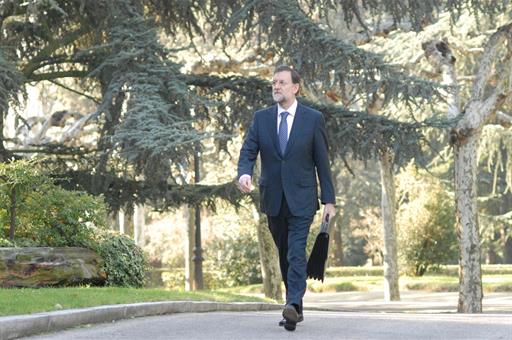
This summit is expected to be attended by the Heads of State and Government of the 19 G20 Member States, plus the European Union, as a member in its own right and represented by the new President of the European Commission, Jean-Claude Juncker, and by Herman Van Rompuy, the President of the European Council until 1 December. Spain, represented by the President of the Government, is once again attending in its status as "permanent guest".
Top leaders of the most important international organisations will also attend to offer technical assistance, studies and support to the G20, including the Financial Stability Council, set up by the G20 in 2009 in response to the financial crisis of 2008, and which, since then, coordinates the work of the national financial authorities and international bodies that establish regulatory standards, supervision and sector financial policies; the International Labour Organization; the International Monetary Fund; the OECD, which has achieved an outstanding leading role in the work of providing technical support to the G20, particularly on matters of international taxation; the United Nations, whose work in relation to the G20 is focused on matters relating to development cooperation; the World Bank, whose work in relation to the G20 is focused on energy and infrastructure; and the World Trade Organisation, which focuses on matters related to international trade.
Another five Heads of State or Government of "guest countries" invited by the Australian Presidency will also attend: Mauritania, in its capacity as the Rotating Presidency of the African Union; Myanmar, in its capacity as the Rotating Presidency of ASEAN; Senegal, in its capacity as Rotating Presidency of the New Partnership for Africa's Development (NEPAD); New Zealand and Singapore, the latter two countries on direct and discretional invitations from the Australian Presidency for their specific ties that bind these countries.
Summit programme
The meeting of the Heads of State and Government of the G20 will take place on Saturday 15 and Sunday 16 November 2014 at the Brisbane Convention and Exhibition Centre, structured in a programme of three work sessions on a plenary basis, a working dinner on Saturday 15 November and a working lunch on Sunday 16 November.
It is also expected that the Australian Presidency of the G20 will offer a formal reception at the Gallery of Modern Art in Brisbane on Saturday 15 November before the working dinner, and a cultural show at the Queensland Art Gallery following the dinner.
The summit will begin on Saturday 15 November with a reception and welcome for the Heads of State and Government by the Australian Prime Minister, Tony Abbott, in the entrance hall of the Brisbane Convention and Exhibition Centre, followed by the first work session, focusing on the global economy, which will seek to provide a response to the issue of the work being done by the G20 to offer results on issues of growth and employment.
Worthy of mention is the first speech by the President of the Government at this first session as a result of the interest shown by the leaders of the G20 in the impressive programme of reforms and job creation in Spain, who was invited to speak by the Australian Presidency.
The second work session, on Sunday 16 November, will revolve around the capacity for recovery and economic flexibility, among others to be tackled such as financial regulation and the international tax system.
The third work session will focus on energy, which will give the Heads of State and Government an opportunity to debate the rapid transformation of energy markets and the importance of the energy sector for growth.The issue of climate change will also be discussed at this session.
The results of the meeting will be drafted in a Communiqué, an Action Plan and supporting documents, with the aim of reflecting the work headed up by Australia during 2014 in its exercise of the Presidency of the G20.
The G20 has become one of the main forums for international relations, perhaps the most important now that the economy is the focus of a good part of international activity. Its creation responded, in part, to the need to provide a response to the serious international financial crisis that broke out in 2008, and in part to the suitability of joining together the G8 countries with the main emerging economies in one forum.
G20, main international economic forum
Its starting point was the Washington Summit in November 2008, followed by the London Summit in April 2009 and the Pittsburgh Summit in September of the same year. Five further summits have been held since then: Toronto 2010, Seoul 2010, Cannes 2011 and Los Cabos 2012, Saint Petersburg 2013 and this upcoming Brisbane Summit in 2014.
This forum has been developing over the course of the last few years in two directions: firstly, it has evolved from bringing together the Finance Ministers and Governors of Central Banks, to becoming a forum of leaders, Heads of State and Government, although the Finance Ministers continue to meet regularly in what is now known as the 'finance circuit'.
Furthermore, since the initial meetings, heavily focused on providing an urgent response to the international economic crisis, things have changed to a period of reforms focused on the medium and long term for which a process of institutionalisation policies has been necessary, converting the G20 since the Pittsburgh Summit into 'the main international economic forum'.
The G20 is, hence, an informal and flexible forum, without a written charter that governs its constitution and operation, the conclusions from which tend to be of a political or technical nature, with declarations from the different summits or documents approved in preliminary meetings.
Pool Moncloa