"There will be greater economic growth and increased net job creation in 2015", says Mariano Rajoy
President's News - 2014.10.14





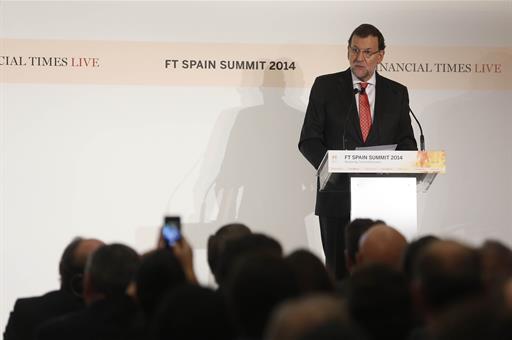
FT Spain Summit 2014, Madrid
Mariano Rajoy stressed that, thanks to the process of fiscal consolidation and reform undertaken by his government and the progress achieved in the European Union, "we are better off than we were in 2012 and 2013, and worse off than we will be in 2015".
In his speech at the conference entitled "Restoring Competitiveness" organised by the Financial Times, the President of the Government said that nobody is talking about a break-up of the Euro or a bail-out for the Spanish economy any more, while a good portion of the imbalances in the Spanish economy have now been rectified and "sound foundations have been laid for the future". The most important fact, he added, is that Spain has posted four consecutive quarters of growth after an "extremely long" recession and that net job creation has been achieved.
Mariano Rajoy explained that, at 30 September 2014, there were 356,258 more people paying National Insurance contributions than 12 months previously. Furthermore, the latest Labour Force Survey - on Q2 2014 - reflects a year-on-year employment increase of almost 200,000 people. As regards the number of people registered unemployed, "there are fewer people registered as unemployed than in December 2011".
Current challenges
Mariano Rajoy stressed that this improvement in the labour market "is not enough and we must therefore persevere and keep working".
In this regard, he said that Spain will meet its public deficit target for this year - set at 5.5% of GDP - and the government will further develop the structural reforms, placing special emphasis on those related to the public administration services, market unity, worker training and lowering taxes (both Personal Income Tax and Corporate Income Tax).
Within the scope of the European project, he advocated priority for the single energy market - through inter-connections with France, the digital market and the financial services market. He also suggested that steps be taken towards greater fiscal integration and improved liquidity conditions in Spain and the European Union as a whole.
Positive outlook
The President of the Government believes that if current policies are maintained, "Spain will remain on the path of economic growth". More specifically, GDP will increase by 1.3% this year and by 2% next year, according to government forecasts. Mariano Rajoy also expects the foreign trade sector to maintain its "positive" results in 2014 thanks to increased competitiveness.
Domestic consumption, he added, "is improving and will continue to do so", boosted by the tax reform "that is going to leave 9 billion euros in the hands of taxpayers over two years" and by the improved labour market. Furthermore, in the private sector alone, foreign investment has increased this year by two points of GDP when compared with last year, in other words, some 20 billion euros. In terms of employment, Mariano Rajoy expects 2014 to end with an increase of 0.7% and stressed that there will be "further net job creation" next year.
Mariano Rajoy believes that "the situation remains complicated" but "the worst is behind us". "Spain can now say it is firmly on the path of economic recovery and has successfully maintained the fundamental pillars of the Welfare State", he said.
Dialogue on Catalonia
During the dialogue and discussion after his speech, the President of the Government said on the matter of Catalonia that the best choice now would be to look forward. "We need to get over a few issues we have experienced recently. We need dialogue, we need to talk. There are many of us who sincerely and whole-heartedly wish to live together because we have achieved many great things together. The bigger you are the better, because you will enjoy greater influence and more people will listen to what you have to say and the more they will spread the word", he said.
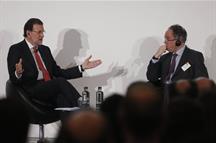 Pool MoncloaMariano Rajoy insisted that he has forward-looking offers for Catalonia and recalled that, for the time being, the Government of Spain has only been informed of a referendum that is not legal. "We can talk about anything, I can talk about anything, I have never refused dialogue, but I think the most important thing at the moment is for us to be capable of building a project together", he added. He also said that the people of Spain created a Constitution in 1978 that represents a guarantee for their rights and freedoms, and that has enabled them to enjoy the most decentralised State model in the world.
In terms of economic affairs, Mariano Rajoy recognised that unemployment continues to be "our main priority and our most fundamental objective". Although certain data in this regard are moving in the right direction, the path must continue to be one of persevering with an overall economic policy because jobs are not created "with a single decree or a single measure". As regards the difficulties being experienced by certain major EU countries, he admitted that he was not pleased by the latest economic data to be released because "the lion's share of our economic relations comes from Europe as a whole".
As regards the debate over austerity in the EU, he underlined the importance of controlling the public deficit although he praised the initiative from the new President of the European Commission, Jean-Claude Juncker, to present an investment plan worth 300 billion euros. "I hope that can be further defined, and quickly. But, I repeat, the economy must be the sum of many parts, having clean public accounts is essential", he said. Furthermore, he is convinced that the Euro is the only way forward and advocated both the European welfare model and the traditional party system.
Pool Moncloa