Mariano Rajoy proposes creation of European authority to harmonise fiscal policies
President's News - 2012.6.2
1. Images of President of the Government at Economic Circle of Sitges | 2012.6.2
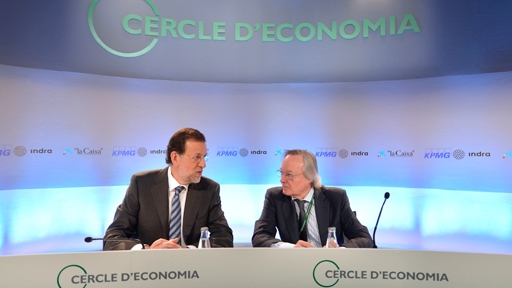






Economic Circle, Sitges (Barcelona)
During his speech at the closing ceremony of the Economy Business Association conference in Sitges, Mariano Rajoy made clear the need to implement initiatives to dispel any doubts and uncertainties regarding the Eurozone.
In the medium term, "the European Union should strengthen its common institutional architecture so that investors regain confidence in the single currency". According to the President of the Government, "this means taking steps towards integration while ceding aspects of our sovereignty, particularly at a fiscal level".
To that end, Mariano Rajoy proposed the creation of a European authority to steer the fiscal policy of the Eurozone, harmonise fiscal policies of the Member States and centralise oversight of public finance. In addition to managing European debt, "it will act to prop up confidence in the euro that is so vital at this time".
Steps towards economic and monetary union
 Pool Moncloa
In this respect, he considers the proposal of the President of the European Commission, José Manuel Durao Barroso, to take further steps towards economic and monetary union within a specific and credible timeframe, to be essential. "We consider his reflection on the need to integrate banking supervision, deposit guarantee funds and the creation of instruments for the direct capitalisation of European banks to be particularly judicious features of this proposal", added Mariano Rajoy.
In his speech, he explained that the success of the European Monetary Union requires that "two essential conditions" be met: fiscal stability to avoid pressure on the currency and flexible markets to be able to create internal adjustment mechanisms currently lacking in the EU.
In order to meet these two conditions, the Spanish Government's actions will be focused on five main pillars, according to Mariano Rajoy: budgetary stability, economic reforms that help enhance competition and the flexibility of the Spanish economy, structural reforms at a European level, a solution to the problem of financing and injecting liquidity, and the consolidation of European integration to dispel doubts and uncertainties regarding the Eurozone.
Bankia
In a discussion following his speech, Mariano Rajoy pointed out that the nationalisation of Bankia has taken place to provide support to the entity, apply clean-up measures and then sell it off. The President of the Government stressed that "what has happened to Bankia and other Spanish entities is similar to what has happened in other countries such as the Netherlands, the United Kingdom or the United States".
As regards the assessment to be made by two independent evaluators and the International Monetary Fund of the Spanish financial system, Mariano Rajoy pointed out that the objective is to guarantee there are no doubts regarding the solvency of the Spanish bank. "It is a question of guaranteeing solvency and of ensuring security that no-one can put in doubt and thus ensure its future", underlined Mariano Rajoy.
As regards the fiscal compact proposal for Catalonia, the President of the Government expressed his willingness "to talk about this matter when the time is right", although he warned that the priority at this time is to exit the crisis.