Oscar López calls for the adoption of European regulations to protect children in the digital world: "The time has come to take action"
News - 2026.9.11
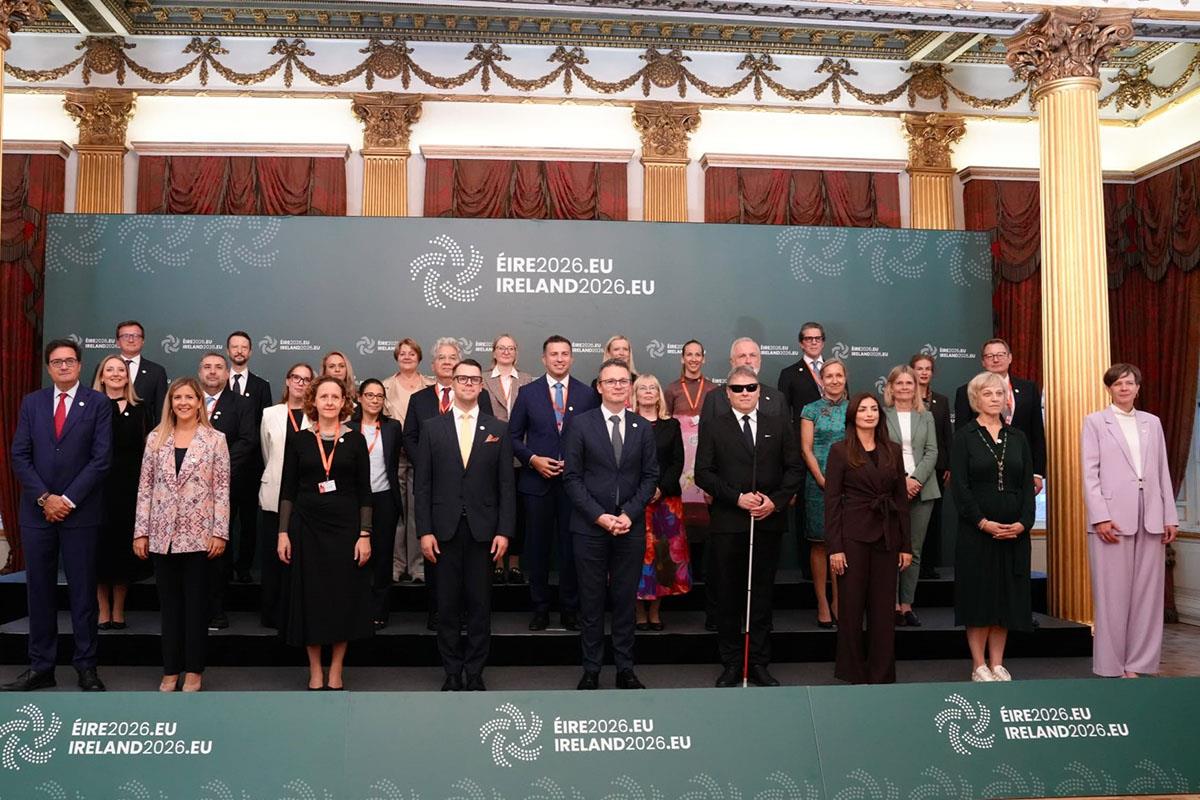 The Minister for Digital Transformation and Civil Service, Óscar López, in the group photo of the EU Conference on the Protection of Children Online held in Dublin






The Minister for Digital Transformation and Civil Service, Óscar López, has urged the European Union to introduce specific legislation to protect children in the digital sphere. "The time has come to take action," he argued at the Conference on the Protection of Children Online, which is taking place in Dublin as part of Ireland's presidency of the Council of the EU.
López has conveyed the Government of Spain's support for the European Commission's report on the safety of children online, drawn up by a panel comprising more than 300 experts from across the EU, whose main conclusion is that children require specific protection in the digital environment. In this regard, he highlighted the recommendation to harmonise the minimum age for accessing social media at European level, for service providers to be held to account, and for them to offer what is known as 'security by design' - that is, interfaces that respect children's rights and wellbeing, particularly with regard to scrolling, notifications and parental controls.
Furthermore, he has argued that age verification systems should strike a balance with the right to privacy, as is the case with the Digital Wallet that Spain is currently developing.
"We must take action because European children spend up to six hours a day in front of screens," explained the minister, citing the experts' report, before pointing out that, in countries such as Spain, children are accessing pornographic content as young as 11. López has argued that Spain has been one of the most proactive countries in Europe - and indeed on the international stage - in pushing for specific legislation to protect children in the digital environment. In the specific case of Spain, he expressed the hope that a law will soon be passed in Parliament that will prohibit children under the age of 16 from accessing social media and will promote algorithmic transparency.
The President of the European Commission, Ursula von der Leyen, has confirmed that she will present a proposal on the protection of children on social media on 16 September, during the State of the Union address.
The Dublin meeting, held under the Irish presidency of the EU, aims to build on the work carried out by the panel of experts and address the report's findings, with an agenda that includes a number of panel discussions and presentations, as well as technical workshops.
During his address at the conference, the minister also called on the European Union to join the international coalition to protect children in the age of Artificial Intelligence, which Spain spearheaded alongside France and Kenya as part of the United Nations Global Dialogue on AI Governance held last July in Geneva. An alliance that already has some twenty memberships, including UN member states and agencies such as UNESCO and UNICEF, and which aims to ensure that the development of AI respects and incorporates children's rights in relation to safety and health, as stipulated in the Convention on the Rights of the Child.
Ensuring that AI respects children's rights
The international coalition to protect children in the age of AI, launched by Spain, France and Kenya last July during the UN Global Dialogue on AI Governance, was endorsed by around twenty countries and organisations: Austria, Brazil, Bulgaria, Canada, the Republic of Korea, the Czech Republic, El Salvador, Estonia, France, Indonesia, Italy, Japan, Kenya, Luxembourg, Morocco, the Netherlands, UNICEF and UNESCO.
This coalition aims to foster coordination between governments, United Nations agencies, technology companies, civil society organisations, child welfare experts and education professionals to "ensure that the development and deployment of AI respect the safety, healthy development and rights of all children, as recognised in the Convention on the Rights of the Child".
In the approved document, the signatories recognise that the rapid roll-out of AI systems is transforming the digital environments in which children learn, communicate and interact. These technologies create new opportunities but also amplify risks such as manipulation, harmful content, the generation of pornography and child sexual abuse material via deepfakes and the algorithmic targeting of children.
Ensuring that AI systems are safe by design requires coordinated action between governments, industry, civil society and international organisations. To this end, the coalition signatories commit, first and foremost, to "developing AI systems that are safe, reliable, trustworthy, respectful of children's rights and people-centred".
Non official translation