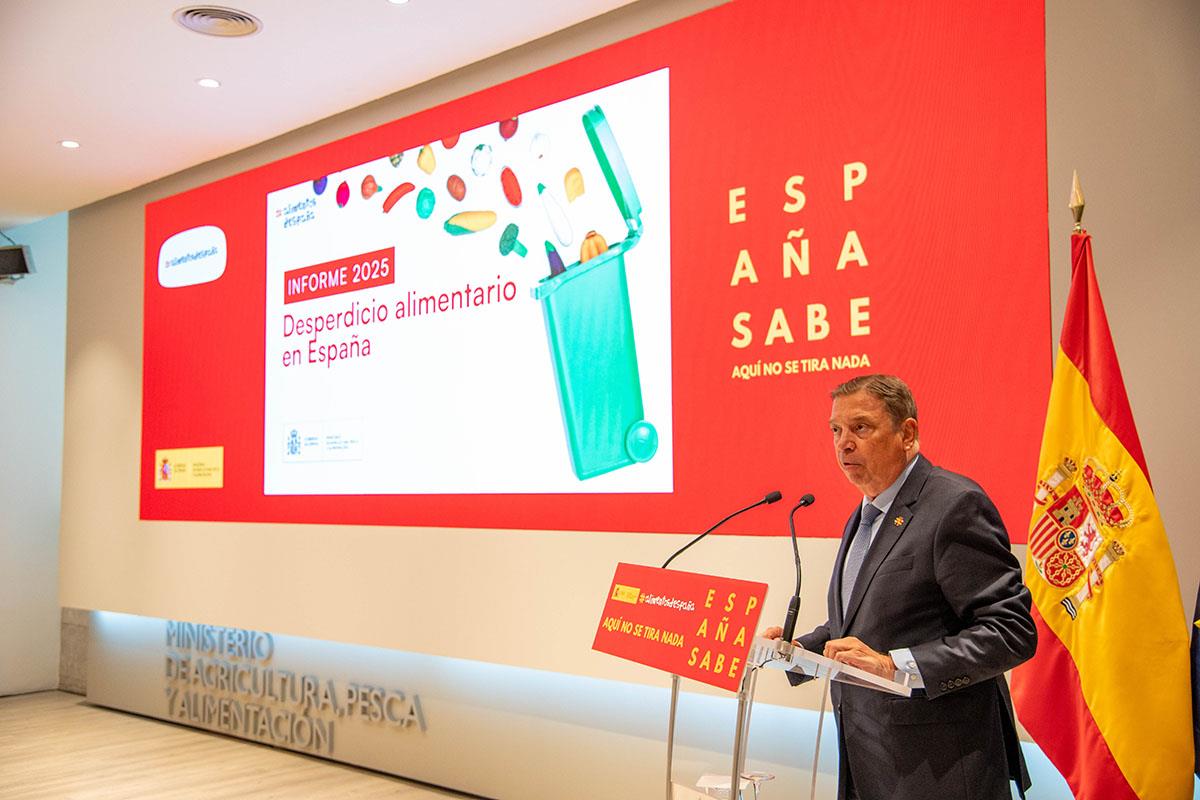
 The Minister for Agriculture, Fisheries and Food, Luis Planas, during the presentation of the 2025 Annual Report on Food Waste





Spain is building on the progress made in recent years in the fight against food waste. According to data from the 2025 Annual Report on Food Waste, the total volume of food wasted, both at home and away from home, stood at 1,129.91 million kilos or litres, 0.4 per cent more than in 2024. Despite this slight year-on-year increase, the medium-term trend remains positive. In 2025, 19.2 per cent less was wasted than in 2020, which means that 269.18 million kilos or litres were saved from being thrown away. On average, each resident in Spain wasted 24.3 kilos or litres over the course of the year, 0.3 per cent less than in 2024.
During the presentation of the report, the Minister for Agriculture, Fisheries and Food, Luis Planas, emphasised that the figures show a positive trend, although he pointed out that efforts must continue to make the most of food a daily habit. According to Planas, "the most expensive food is that which ends up in the bin".
Planas emphasised that food waste has not only economic but also social and environmental consequences, and highlighted the importance of taking action at every stage of the food supply chain, with a particular focus on households.
The home: the main challenge to address
Households account for the majority of the food waste recorded. In 2025, they accounted for 97.5 per cent of the total, amounting to 1,101.8 million kilos or litres.
Household waste, however, continues to follow the downward trend seen since 2020, with a cumulative reduction of 19.2 per cent compared with that year. Unused food and drink are one of the main sources of waste in households. These include, in particular, fresh fruit and vegetables, whilst a significant proportion consists of meals which, once prepared, are not actually eaten.
The report highlights the importance of improving procurement and menu planning, calculating portion sizes accurately and managing food storage more effectively. It is also essential to organise the fridge properly and to pay attention to the dates shown on the labels. In this regard, Planas pointed out that the use-by date and the best-before date are not the same, and highlighted the need to continue making progress in providing information to and raising awareness amongst consumers.
Progress outside the home
Outside the home, food waste accounts for 2.5 per cent of the national total, amounting to 28.12 million kilos or litres, and has fallen by 20.4 per cent since 2020. Furthermore, the proportion of people who say they waste food away from home has fallen to 41.5 per cent, the lowest figure in the last four years.
By age group, consumers aged between 25 and 34 have the highest rate of waste outside the home, whilst those under 25 have the highest rate of beverage waste. People over the age of 50, on the other hand, continue to behave in the most responsible manner.
The law as a catalyst for change
Planas highlighted the role of the Food Loss and Waste Prevention Act, passed in 2025, as a "catalyst for change" to advance the prevention of food loss and waste and the efficient use of food.
The legislation has spurred initiatives that can be regarded as success stories, such as supermarkets with pioneering strategies, platforms for donating surplus food, the transformation of food into new products, soup kitchens and projects that generate social and environmental value.
The prevention of food waste is also one of the areas linked to the objectives of the National Food Strategy, particularly with regard to the sustainability of food systems.
New awareness campaign: 'We don't throw anything away here'
Luis Planas has launched the new institutional campaign 'Nothing is thrown away here', which forms part of the 'España sabe' strategy. The campaign focuses on households, where the greatest scope for improvement lies, and adopts a friendly, everyday and practical tone. Through everyday situations, it aims to move from raising awareness to taking action and to show how to prevent waste in our daily lives: by planning our shopping more effectively, storing food properly and making the most of what we already have.
The campaign will be publicised nationwide in the media during the first half of October and will coincide with key events for the agri-food sector, such as Fruit Attraction, which is to be held in Madrid from 6 to 8 October.
The campaign forms part of the new "España sabe" platform, which brings together various communication initiatives to showcase Spanish food. The actress Leonor Watling will be the brand ambassador and the central figure in the various communication initiatives.
Non official translation