Social Security contribution revenue rose by 7.4% year-on-year, reaching €93.957 billion
News - 2026.7.31






Revenue from Social Security contributions recorded a 7.4% year-on-year increase based on data accumulated up to June of this year, reaching €93.957 billion (€6.453 billion more than the previous year).
Revenue from the Intergenerational Equity Mechanism (MEI), in force since 1 January 2023, showed a year-on-year increase of 26.2%, reaching €2.996 billion; these funds are allocated entirely to the Social Security Reserve Fund.
If we take the figures for the last financial year not affected by the pandemic - 2019 - as a benchmark, the increase in contributions stands at €32.661 billion (up 53.3%).
A comparative monthly analysis shows that contribution revenue in June totalled €15.793 billion, an increase of €5.485 billion compared to the same month in 2019.
Overall, the Social Security accounts show a surplus of €18.675 billion as at 30 June 2026. This figure is derived from the difference between recognised assets from non-financial operations totalling €130.402 billion (a 7.8% increase) and recognised liabilities of €111.727 billion (a 7.2% year-on-year increase).
Meanwhile, data from the Social Security Funds up to May - which include information from the State Public Employment Service (SEPE) and the Wage Guarantee Fund (FOGASA) in addition to the Social Security system itself - show a positive balance of €4.593 billion in national accounting terms, equivalent to 0.3% of GDP.
In cash-basis terms, the System's net revenue reached €128.965 billion, an increase of 8.3% compared to the previous year, while payments rose by 7.2%, totalling €111.556 billion.
Non-financial revenue
As previously mentioned, in the first six months of this year, social security contributions totalled €93.957 billion, representing a 7.4% increase over revenue for the same period the previous year (an increase of €6.453 billion).
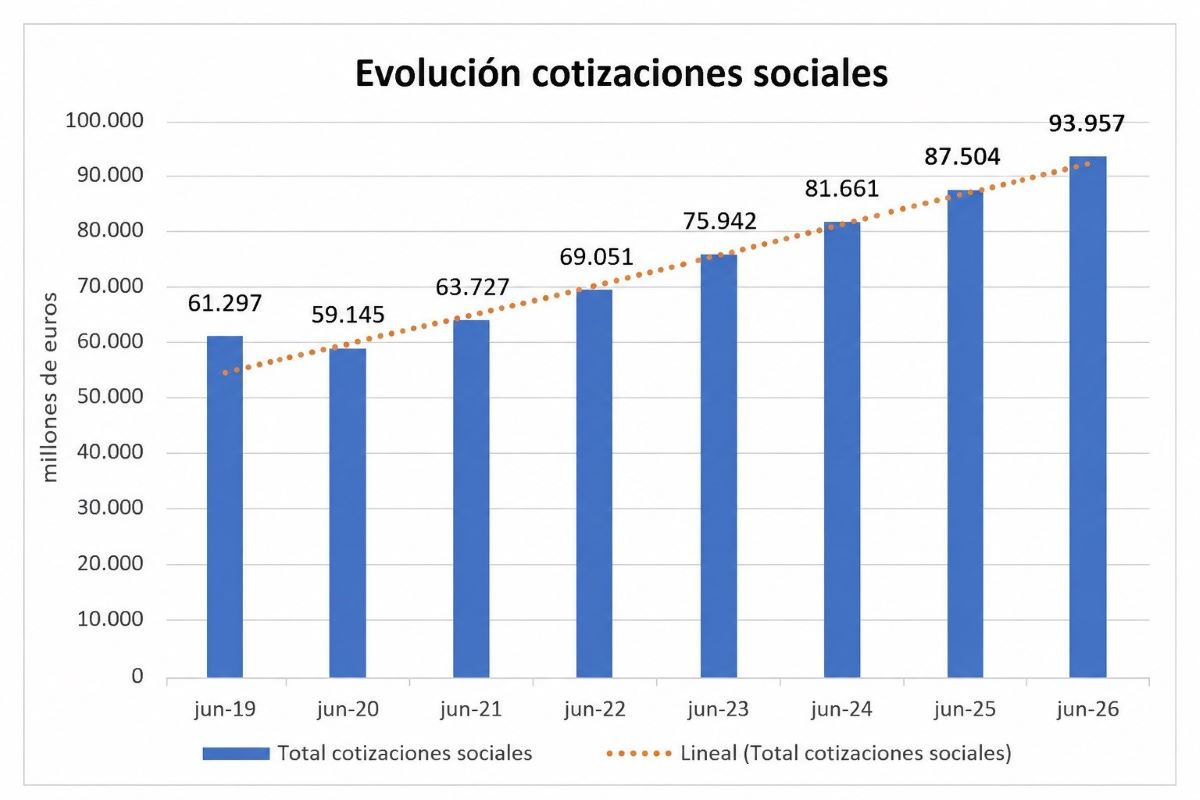
This growth was driven by the trend in contributions from employed workers, which saw a year-on-year increase of 7.5%, reaching €88.725 billion (€6.201 billion more than in the previous year).
By scheme, these contributions from employed workers are distributed as follows: the General Scheme accounted for an accumulated total of €72.032 billion, while the Special Schemes for Self-Employed Workers, Maritime Workers and Coal Miners accounted for a combined total of €6.806 billion.
Furthermore, contributions from unemployed individuals stood at €5.233 billion, representing a year-on-year increase of 5.1% (€252 million more than the previous year in absolute terms).
The total amount of transfers received by the Social Security system stands at €35.583 billion, representing a year-on-year increase of 10.1%.
Non-financial spending
Financial benefits paid to families and institutions total €105.170 billion, 9.3% higher than in the same period of 2025. This figure accounts for 94.1% of the Social Security system's total expenditure.
The most significant item relates to contributory pensions and benefits, totalling €95.212 billion - an increase of 6.8% compared to the same period of the previous year.
A detailed analysis of the contributory sector highlights the following:
- Spending on permanent disability, retirement, widow's and orphan's pensions, pensions for dependents, and supplements to contributory pensions aimed at reducing the gender pay gap rose by 6% to €82.610 billion. This increase is due to the rise in the number of pensions (1.5%), an increase in the average pension amount (4.6%), and the general 2.7% revaluation of contributory pensions for the 2026 fiscal year.
- Spending on temporary incapacity benefits rose by 10.3%, reaching €9.503 billion. Meanwhile, benefits for childbirth and childcare, shared responsibility for the care of infants, risks during pregnancy and breastfeeding, as well as those intended for the care of children with cancer or other illnesses, totalled €2.723 billion, representing a 21.8% increase.
With regard to the non-contributory sector, spending on pensions and non-contributory benefits, including top-ups to bring contributory pensions up to the minimum level, totalled €8.043 billion, 13.8% higher than in the same period of the previous year. This increase is primarily due to the general 11.4% revaluation established for the 2026 fiscal year. Of this total, €6.251 billion (up 13.4%) is allocated to non-contributory pensions and minimum pension supplements, and €3.708 billion (up 15.2%) to subsidies and other benefits; of the latter amount, €3.498 billion corresponds to the Minimum Basic Income (IMV) and family benefits, representing a 16.2% increase compared to the previous year.
Non official translation

Woman working in front of a computer