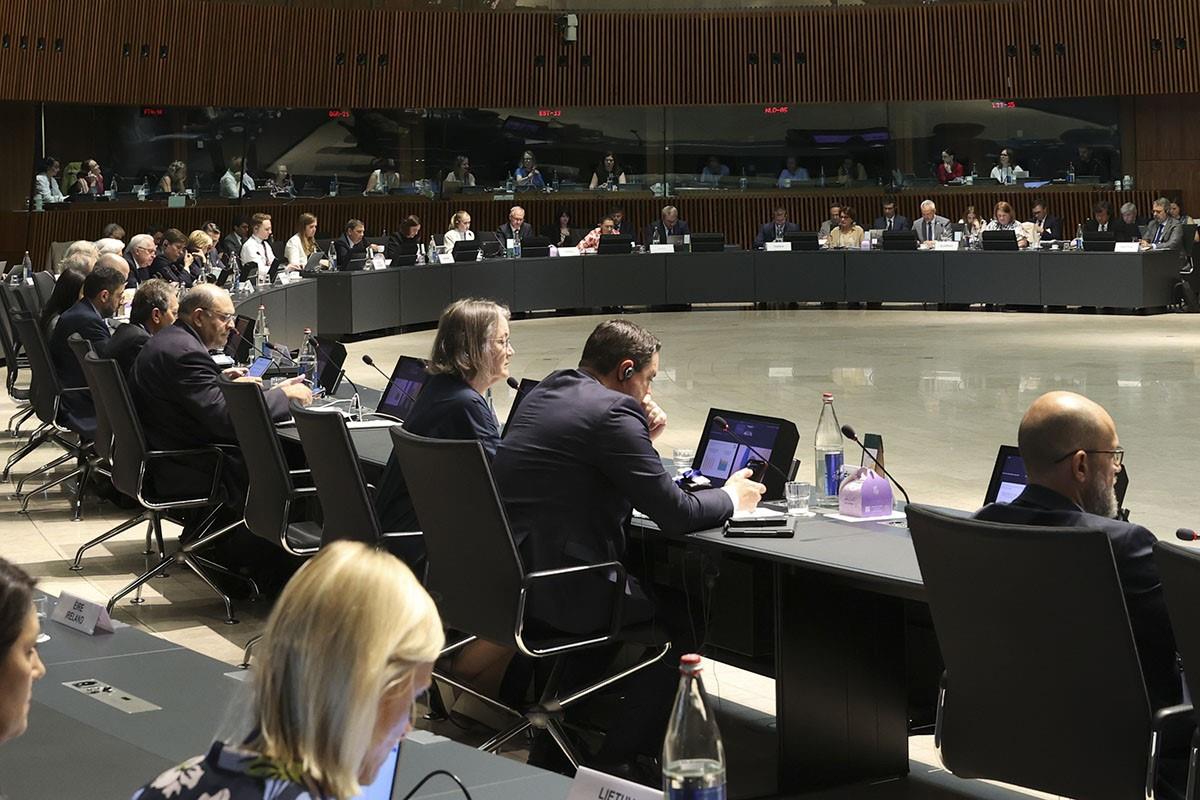
 The Minister for Agriculture, Fisheries and Food, Luis Planas, at the European Council of Ministers for Agriculture and Fisheries held in Luxembourg





Luis Planas acknowledged some progress in the negotiations for the new Multiannual Financial Framework at the European Council, but considers it still insufficient, because Spain's objective remains to increase funding for the Common Agricultural Policy (CAP) and, at a minimum, maintain the same levels as in the current period without national co-financing for interventions.
At the Council of Ministers for Agriculture and Fisheries held in Luxembourg, Planas referred to the progress made on the structure of the EU budget for the period 2028-2034, although an agreement is not expected to be reached until the end of the year, at which point the final budget for the CAP post-2027 will be known. In addition to increasing the funding allocated in the Commission's initial proposal, Spain is calling for there to be no national co-financing, as has been proposed, and for the common nature of the CAP to be preserved in order to achieve a competitive agricultural sector that is prepared for the challenges of the future.
The minister also acknowledged progress made during Cyprus's six-month rotating presidency in ensuring that the CAP regulation includes all its substantive elements and thus restores its own legal personality as a sectoral policy, another of Spain's demands. "That is not yet the case, but we are close to achieving it," the minister said. The Commission's initial proposal set out national plans in which CAP measures were combined with other EU policies.
"We have already reiterated on numerous occasions that we need an autonomous and robust CAP, capable of responding to the new priorities: food security, environmental and climate sustainability, the profitability of farms and generational renewal", said the minister, adding that, to this end, it is essential to provide this policy with its own set of regulations.
The Spanish minister expressed his opposition to the European Commission's proposal to establish national co-financing percentages for interventions supporting specific agricultural sectors and warned that moving in this direction could jeopardise the EU's single market.
At the Luxembourg Council, Luis Planas also expressed Spain's dissatisfaction with the European Commission's proposal on fertilisers, which he considers "utterly insufficient", given that, on the one hand, it proposes reallocating funds and shifting responsibility for reprogramming unspent funds to the Member States; and, on the other hand, it proposes increasing funds for the Crisis Reserve, sums which reach farmers far too late. He pointed out that Spain has allocated 500 million euros in aid to farmers for the purchase of fertilisers, the most significant support measure taken so far by an EU Member State during this crisis.
He explained that the geopolitical situation is very worrying, and that, even if the peace agreement between the United States and Iran were to be implemented immediately and shipping traffic through the Strait of Hormuz were to resume, it would take several months for prices to return to normal. He therefore reiterated the need for the Commission to put in place more decisive support measures "that will enable fertilisation levels to be maintained, which in turn means maintaining agri-food production levels".
Non official translation