Yolanda Díaz advocates in Geneva for defending the founding values of the International Labour Organisation in the face of the current situation
News - 2026.6.9
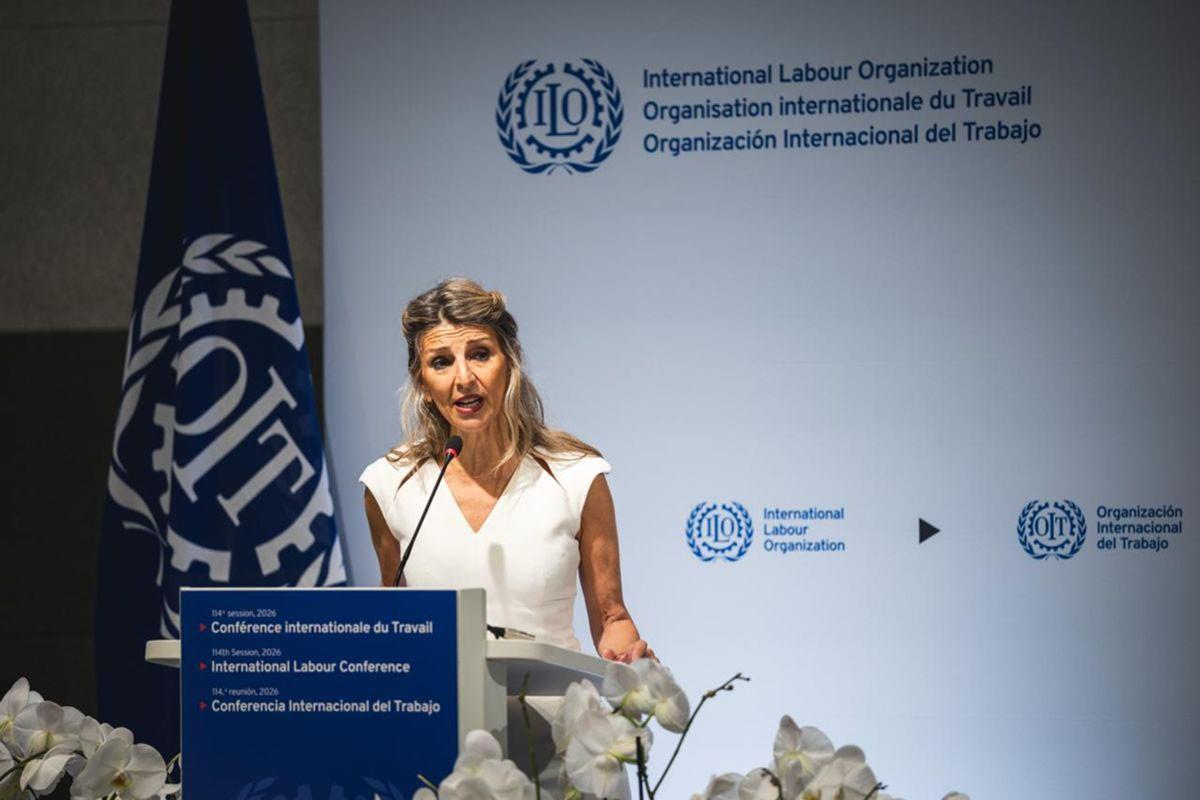 The Minister for Labor and Social Economy, Yolanda Díaz, at the ILO International Labour Conference





Yolanda Díaz emphasised the role of the International Labour Organisation (ILO) as a space for building "a global labour civilization, which we are still far from achieving, but which would be much more primitive without the existence of fundamental principles and standards in the workplace".
"We take the ILO seriously, and that is why we feel justified in saying that the ILO must take itself seriously. The ILO's mandate is in crisis, but if labour is not a commodity, neither can the organisation that represents labour be a commodity", said the minister in Geneva, where she advocated for defending the ILO's founding values in the face of the current complex global situation.
Yolanda Díaz stressed that the ILO "is going through financial turbulence that we cannot ignore", but that it cannot emerge from this by jeopardising its founding values. "Ensuring the ILO's mandate is our real mission: we will do so with more or fewer resources, but the sentiments of justice, peace and security are not for sale".
The Second Vice-President of the Government of Spain has travelled to Geneva to participate in the 114th International Labour Conference of the ILO 2026, the annual meeting where representatives of governments, employers and workers from the ILO's 187 Member States discuss issues related to the world of work. This year's meeting focuses on decent work in the platform economy, the transformative agenda for achieving gender equality in the workplace, and social dialogue and tripartism.
Major challenges facing the world of work and the ILO
During her address to the plenary session at the Palais des Nations, Yolanda Díaz offered several reflections on the role of the ILO. First, she highlighted its value as a platform for defending the global working population, emphasising that its essence and greatest strength lies in tripartism: "We can envision the future of work in many ways, but not without social dialogue".
If tripartism is a fundamental characteristic of the ILO, "its standard-setting action is no less so. An ILO without standards is an ineffective organisation in the face of the major digital and green transformations we have to govern. We can discuss how these standards should be structured, perhaps with greater attention to regional specificities, but not the standards themselves", she stated.
The Vice-President also called for a serious, urgent and collective reflection on the possibilities of Artificial Intelligence (AI) and its impact on the world of work. "Automation, robotics and AI are transforming the very structure of work. To prevent technology from becoming a step backwards, we must turn AI into an opportunity, and systems must be designed with people in mind, not just performance".
Fourthly, the Minister for Labour reiterated in her address that the ILO must view businesses and productivity with a humanistic perspective, "precisely from that people-centred perspective". For this reason, she added, "sustainable businesses are another of our major challenges".
Finally, Díaz emphasised the need to continue working towards equal rights for women and men in the workplace. "Embracing the values of feminism and building upon them the concept of decent work" is another key mandate of the ILO".
Success of Spanish social dialogue
The Vice-President recalled that Spain has made social dialogue its hallmark and has fostered, over the last six years, a major reform of its labour legislation through agreements between unions, employers and the government. "The results confirm the success of Spanish social dialogue: more workers with rights than ever before, the highest number of women employed in our history, a 25% reduction in the gender pay gap and the eradication of the abusive use of temporary contracts", she stated.
The Minister for Labour concluded her remarks by celebrating the opportunity and the pride for Spain of once again participating in this major event of multilateral labour relations, something that "reaffirms our country's commitment to decent work, human rights and economic democracy." We have a very busy agenda, meeting with social partners, ILO officials and partner countries to promote policies that put workers at the centre".
Regulating platforms
Upon arriving at the headquarters of the International Labour Organisation (ILO), the Vice-President emphasised the importance of this annual meeting at a time she considers "key due to the global crisis we are experiencing in multilateralism, a time of great significance, and the major challenges we have an obligation to address, linked to decent work but also to the climate emergency and the digital transition worldwide". For Díaz, the ILO "more than ever" has to champion decent work. "We are talking about an ILO that solves problems with governance that works hand in hand with employers, but also hand in hand with the world of work".
The minister explained that the Geneva meetings are discussing the development of a minimum standard common to all countries to regulate digital platforms worldwide: "The Government of Spain is promoting this and trying to get it approved. The debate is very delicate, but Spain has a great deal of experience, as we were the first regulator of the so-called Rider Law. It is a norm that, in the spirit of the ILO, was negotiated and agreed upon by employers, workers and government, and therefore draws on the best of the ILO tripartism".
For Díaz, it is not a question of limiting platforms, but of regulating them. "At last year's conference, we reached an agreement, a standard to regulate this matter, and what we're doing at this conference is analysing that standard. Positions are controversial among different countries, reflecting different interests, and also stemming from the opposing logic between employers and workers. In any case, the key is that we have minimum regulations for both workers and companies".
Yolanda Díaz pointed out that the use of artificial intelligence and mathematical formulas in business management "is generating enormous inequalities. We cannot work in the 21st century with 19th century working conditions and this is what is happening. It doesn't matter whether the boss is digital or physical. Beyond the form of business organisation, there must be a guarantee of labour rights. It is also essential that competition between companies using algorithms be completely fair".
Non official translation