Spain sets a new record, surpassing 22.1 million registered workers in the original series, after adding 224,000 in April
News - 2026.5.5





Employment reaches a new milestone: the average number of registered workers (original series) has surpassed 22.1 million for the first time, reaching 22,105,831. The labour market added 223,685 workers in the last month, making it the third largest increase for the month of April since records began. The year-on-year increase is 517,192 registered workers (+2.4%).
"We've had four consecutive years of adding half a million members per year," explained the Minister for Inclusion, Social Security and Migration, Elma Saiz. "This is very positive news, and it includes several figures that we should highlight. In April, almost 10.5 million women were registered with Social Security, the highest figure in the series. Furthermore, the number of foreign workers registered continues to break records, approaching 3,250,000."
Specifically, the number of foreign workers in the original series stands at 3,248,247, which is 250,939 more than a year ago, representing 14.7% of the total.
The employment performance of women stands out, with 10,489,362 employed women. Specifically, there are 250,821 more women registered with Social Security than a year ago, and 1.8 million more than in 2018, representing a 21.1% increase.
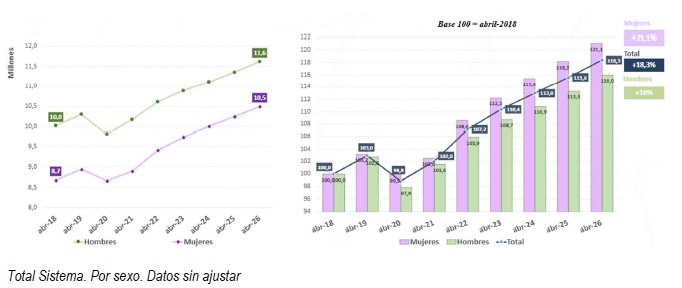
Women account for 47.5% of the total, one percentage point higher than in 2018. Their presence in the labour market is growing at a rate of 2.5% compared to 2025. At the same time, male employment is also reaching a record high, with 11,616,469 registered workers, after adding 266,371 in the last year and 1,447,473 since 2018.
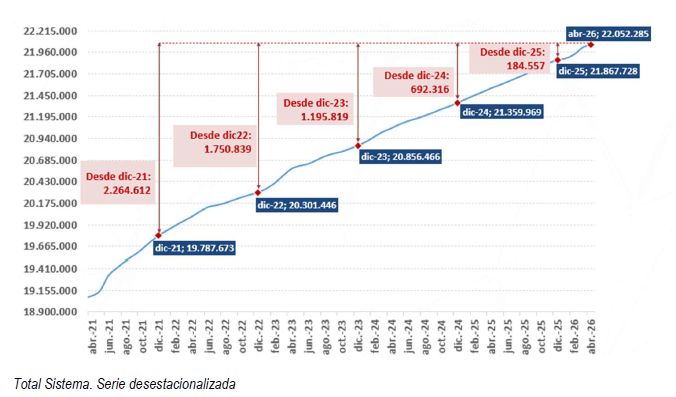
In seasonally adjusted terms, this marks 63 consecutive months of growth.
The seasonally adjusted total remains at 22 million. With almost 2.3 million more registered workers since the labour reform came into effect, the total number of employed individuals has reached 22,052,285.
"We are transforming our country's labour market. Its situation has improved considerably compared to 2018. If we discount seasonality and calendar effects, Social Security has consolidated its position above 22 million registered workers, after adding nearly 3.5 million employed individuals since 2018," Elma Saiz pointed out. "We have reached a record figure after 63 consecutive months of employment growth."
Regarding the daily registration figures, these have remained above 22.2 million from 27 to 29 April. The highest level was reached on 27 April (22,212,429).
Affiliation by sector
Overall, average affiliation has shown a year-on-year increase of 2.4%, a percentage significantly exceeded in some sectors of the General Social Security Scheme, such as Agriculture, Livestock, Forestry and Fishing (+7.05%), Construction (+5.5%), Water Supply and Sanitation (+5%), and Publishing, Broadcasting and Content Production and Distribution Activities (+5%). The following sectors have also exceeded this average increase: Arts, Sports and Entertainment Activities (+4.9%), Transport and Storage (+4.1%), Health Care Activities (+3.9%) and Real Estate Activities (+3.5%).
In the case of self-employed workers, whose total number grew by 1.3% year-on-year, the increases were significant in Energy Supply (+18.1%), Telecommunications, Computer Programming, Consulting and IT Infrastructure (+11.7%), and Real Estate Activities (+11.7%).
Overall, the number of self-employed workers stands at 3,444,973, which is 15,439 more than a year ago and 198,119 more than in 2018.
Greater job growth among young people and those over 55
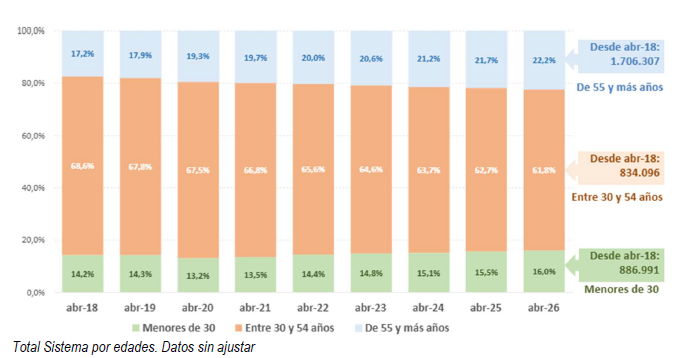
Looking at employment trends over the last eight years reveals greater growth among older age groups, particularly those aged 55 and over, as well as among younger workers. Employment among older workers has grown by 53.2% and among younger workers by 33.5% since 2018, representing increases of 34.9 and 15.2 percentage points, respectively, exceeding the overall growth rate of 18.3%.
In April 2026, those over 55 years of age represent 22.2% of the total workforce (5 percentage points higher than in 2018), and those under 30, 16%, compared to 14.2% in April eight years ago.
Stability and quality of employment
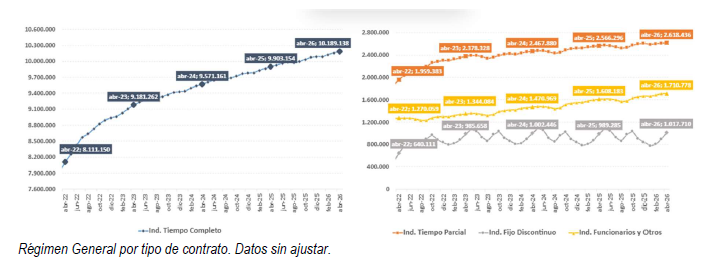
Since April 2021, there has been a major transformation in the types of contracts in our labour market: there are 4,866,333 more workers with permanent contracts and 1,847,426 fewer with temporary contracts. There are increasingly more stable jobs. The largest increase is among full-time permanent contracts, with 285,984 more than a year ago. Meanwhile, part-time contracts increased by 52,141.
The weight of temporary workers stands at 11.6%, down from 30% in April 2019. This improvement is even greater among workers aged 55 and over, who have a temporary employment rate of 9%, compared to more than 21.2% seven years ago.
Furthermore, it is noteworthy that the increase in workers with permanent contracts is concentrated mainly among full-time employees, who now total 15,536,063.
Non official translation