The Minister for Culture, along with the King and Queen, attends the presentation of the 2025 Cervantes Prize to Gonzalo Celorio
News - 2026.4.23
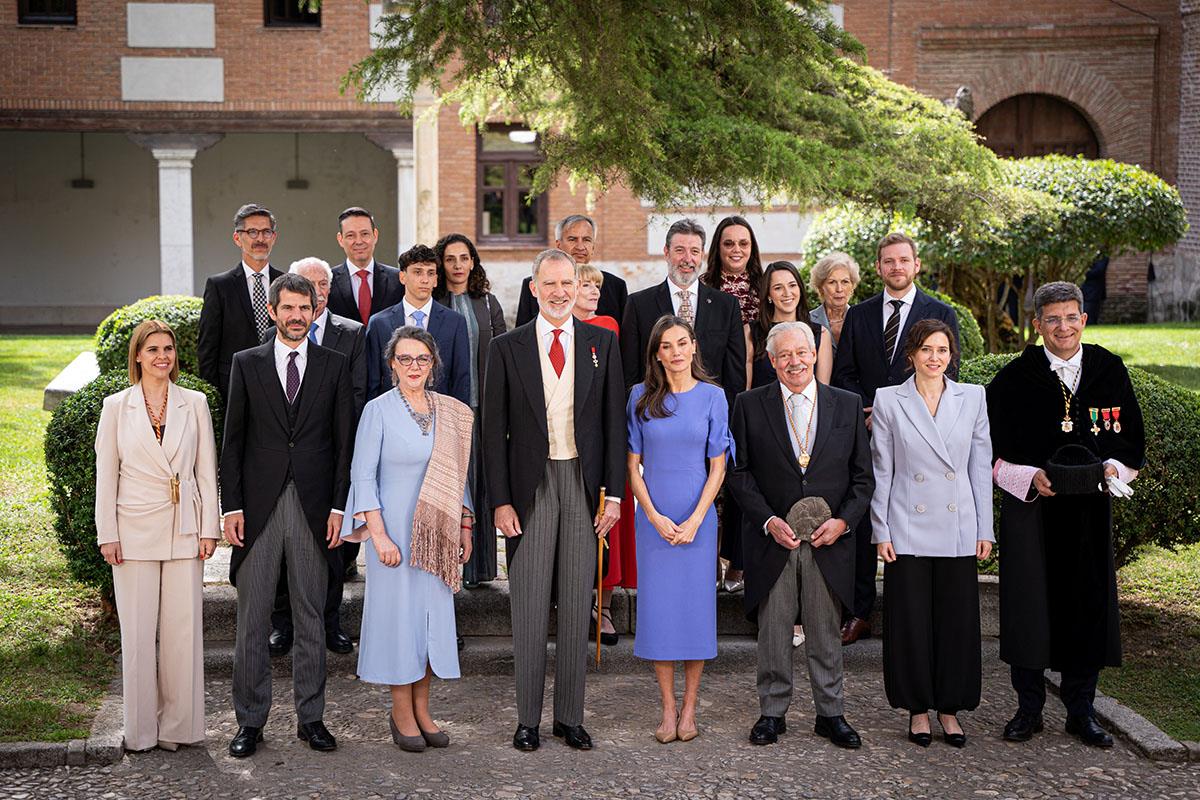 King Felipe VI and Queen Letizia, the Minister for Culture, Ernest Urtasun, and the award winner, Gonzalo Celorio, along with other participants in the event





The writer Gonzalo Celorio received the 2025 Miguel de Cervantes Prize for Literature in the Spanish Language from the King and Queen. The ceremony, held in the Paraninfo of the University of Alcalá, in Alcalá de Henares (Madrid), included speeches by the award-winning author, the Minister for Culture, Ernest Urtasun, and King Felipe VI. Numerous personalities from politics and culture were present at the ceremony.
The jury, which met on 3 November, awarded the prize to Gonzalo Celorio for "his exceptional literary work and intellectual contributions, which have profoundly and consistently enriched the Spanish language and Hispanic culture." According to the official statement, "For over five decades, Gonzalo Celorio has cultivated a literary voice of remarkable elegance and profound reflection, combining critical lucidity with a narrative sensibility that explores the nuances of identity, emotional development, and loss. His work is simultaneously a record of modern Mexico and a mirror of the human condition."
The decision also notes that "his books resonate with irony, tenderness, and erudition, tracing an emotional and cultural map that has influenced generations of readers and writers. Celorio embodies the figure of the complete writer: creator, teacher, and passionate reader. He is the builder of an invaluable legacy that honours the Spanish language and keeps it alive in its highest form: that of the word that thinks, feels, and endures."
Cervantes Prize
The Cervantes Prize was first awarded in 1976 to Jorge Guillén, and since then 51 authors have been honoured, seven of them Mexican. In 1979, the prize was awarded ex aequo to Jorge Luis Borges and Gerardo Diego. Since then, the order of convocation stipulates that the prize may not be divided, declared void or awarded posthumously.
By awarding this prize, which includes a cash prize of 125,000 euros, public recognition is given annually to a writer whose body of work has contributed to enriching the Hispanic literary legacy.
Any author whose literary work is written entirely, or in substantial part, in Spanish is eligible for the Cervantes Prize. Candidates for the Prize are put forward by the Academies of the Spanish Language, authors who have won prizes in previous editions, institutions which, due to their nature, objectives or content, are linked to literature in the Spanish language, and by the members of the Jury.
Gonzalo Celorio
Gonzalo Celorio was born in Mexico City in 1948. He is a novelist, essayist, chronicler, and one of the most prominent figures in contemporary Mexican literature. With a doctorate in Hispanic Language and Literature, specialising in Latin American Literature from the Faculty of Philosophy and Letters at the National Autonomous University of Mexico (UNAM), he has developed an extensive academic and teaching career. Since 1974, he has taught at various institutions, including the Universidad Iberoamericana, the National Polytechnic Institute, and El Colegio de México.
He has held numerous academic and cultural positions, such as Academic Secretary and Director of the Faculty of Philosophy and Letters at UNAM (1998-2000); Director of Literature at the National Institute of Fine Arts; Coordinator of Cultural Outreach at UNAM (1989-1998); and Director General of the Fondo de Cultura Económica (2000-2002). He is currently a professor of Latin American literature at the Faculty of Philosophy and Letters of the National Autonomous University of Mexico (UNAM), where he directs the extraordinary chair 'Masters of the Spanish Exile'. He is a full member of the Mexican Academy of Language, of which he was director (2019-2023), and also a corresponding member of the Royal Spanish Academy and the Cuban Academy of Language.
Among his most acclaimed works are the novels 'Amor propio', 'El viaje sedentario', 'Y retiemble en sus centros la tierra', 'El metal y la escoria' and 'Mentideros de la memoria', as well as the essays 'Los subrayados son míos' and 'Cánones subversivos'.
His career has been distinguished with numerous awards, such as the Cultural Journalism Prize of the National Institute of Fine Arts (1986) for 'Los subrayados son míos'; the Prix des Deux Océans (1997, Biarritz Festival) for 'El viaje sedentario'; the National IMPAC/CONARTE/ITESM Novel Award (1999) for 'Y retiemble en sus centros la tierra'; the National University Prize in the field of Artistic Creation and Cultural Extension (2008); the National Prize for Sciences and Arts in Linguistics and Literature (2010); the Mazatlán Prize for Literature (2015) for 'El metal y la escoria'; and the Xavier Villaurrutia Award for Writers (2023) for 'Mentideros de la memoria'. He also received the Order for National Culture, awarded by the Cuban Ministry of Culture in 1996.
His work, characterised by erudition, stylistic rigour, and reflection on memory, identity, and the Hispanic American literary tradition, places him among the most important authors in contemporary Mexican literature.
Jury
The jury, which met on 3 November, was chaired by María José Gálvez, Director General of Books, Comics and Reading at the Ministry of Culture.
The jury also included Aurora Gloria Egido Martínez (Aurora Egido), representing the Royal Spanish Academy; Bruno Rosario Candelier, representing the Dominican Academy of Language; Ana María Gallego Cuiñas, representing the Conference of Rectors of Spanish Universities (CRUE); José Luis Mauricio Carrera Guerrero (Mauricio Carrera), representing the Union of Universities of Latin America and the Caribbean (UDUALC); and Raquel Caleya Caña, representing the Cervantes Institute. María del Carmen Marín López (Karmentxu Marín), representing the Federation of Associations of Journalists of Spain (FAPE); Pablo Rubén Villalobos Hernández, representing the Latin American Federation of Journalists (FELAP); María Teresa Alves de Araújo (Teresa Araújo), representing the International Association of Hispanists (AIH); Araceli Iravedra Valea, representing the Spanish Association of Literary Critics (AECL); Manuel Rico Rego, representing the Association of Writers of Spain (ACE); Constantino Bértolo Cadenas (Constantino Bértolo), representing the Ministry of Culture; Luis Mateo Díez Rodríguez (Luis Mateo Díez), the writer awarded in the 2023 edition; and Álvaro Pombo, the writer awarded in the 2024 edition.
List of award-winning authors
- 1976 Jorge Guillén
- 1977 Alejo Carpentier
- 1978 Dámaso Alonso
- 1979 Jorge Luis Borges
- Gerardo Diego
- 1980 Juan Carlos Onetti
- 1981 Octavio Paz
- 1982 Luis Rosales
- 1983 Rafael Alberti
- 1984 Ernesto Sábato
- 1985 Gonzalo Torrente Ballester
- 1986 Antonio Buero Vallejo
- 1987 Carlos Fuentes
- 1988 María Zambrano
- 1989 Augusto Roa Bastos
- 1990 Adolfo Bioy Casares
- 1991 Francisco Ayala
- 1992 Dulce María Loynaz
- 1993 Miguel Delibes
- 1994 Mario Vargas Llosa
- 1995 Camilo José Cela
- 1996 José García Nieto
- 1997 Guillermo Cabrera Infante
- 1998 José Hierro
- 1999 Jorge Edwards
- 2000 Francisco Umbral
- 2001 Álvaro Mutis
- 2002 José Jiménez Lozano
- 2003 Gonzalo Rojas
- 2004 Rafael Sánchez Ferlosio
- 2005 Sergio Pitol
- 2006 Antonio Gamoneda
- 2007 Juan Gelman
- 2008 Juan Marsé
- 2009 José Emilio Pacheco
- 2010 Ana María Matute
- 2011 Nicanor Parra
- 2012 José Manuel Caballero Bonald
- 2013 Elena Poniatowska
- 2014 Juan Goytisolo
- 2015 Fernando del Paso
- 2016 Eduardo Mendoza
- 2017 Sergio Ramírez
- 2018 Ida Vitale
- 2019 Joan Margarit
- 2020 Francisco Brines
- 2021 Cristina Peri Rossi
- 2022 Rafael Cadenas
- 2023 Luis Mateo Díez
- 2024 Álvaro Pombo
- 2025 Gonzalo Celorio