Social Security exceeds 3,210,000 foreign contributors, adding more than 235,000 in the last year
News - 2026.4.15






March marked a new record for foreign workers, both in seasonally adjusted terms and average contributors. Specifically, discounting the calendar effect, Social Security now has 3,210,759 registered foreign workers, after adding 234,685 in the last 12 months. In terms of average employment, the register shows 3,151,563 employed individuals, 230,358 more than in the same month of 2025.
"The employment of foreign workers continues to show extraordinary growth that has a positive impact on the whole; workers from other countries represent a significant 14.4% of contributors. Their contribution to our labour market is key. It supports sectors like hospitality, where one in three workers is from another country, and it boosts entrepreneurship, as the number of self-employed foreigners already exceeds half a million," explains Minister Elma Saiz.
Overall, the number of foreign registered workers has increased by more than 852,000 since March 2022. In fact, 42.9% of the jobs created since the implementation of the labour reform correspond to foreign workers.
The year-on-year change for this group is 7.9% when adjusted for calendar effects, well above the 2.5% for overall employment.
Average contributors
Social Security registered an average of 3,151,563 contributors in March, representing an increase of 74,722 workers compared to the previous month.
Of the total, 1.8 million are men, while the number of women is approaching 1.4 million. The presence of female workers from other countries is increasing overall and represents 43% of all foreign workers. Around 30% of foreign workers come from European Union countries.
Morocco remains the country with the most national insurance contributors, with 387,584, followed by Romania (343,003), Colombia (264,236), Venezuela (218,337), Italy (208,174), China (126,998), Peru (105,223), and Ukraine (80,256).
Among these nationalities, the increase in Venezuelan contributors stands out, totalling more than 20% in the last year, followed by Peruvians (18.7%) and Colombians (17.7%).
General Social Security Scheme
While they represent 14.4% of all registered workers, the contribution of foreign workers is particularly significant in some sectors of the General Social Security Scheme. In Hospitality, they represent 29.1% of contributors; in Agriculture, 26.9%; in Construction, 24.3%; in Transportation, 17.6%; and in Administrative Activities, 17.5%. In the Special System for Domestic Workers, they represent 42.3%, and in the Agricultural System, 39.4%.
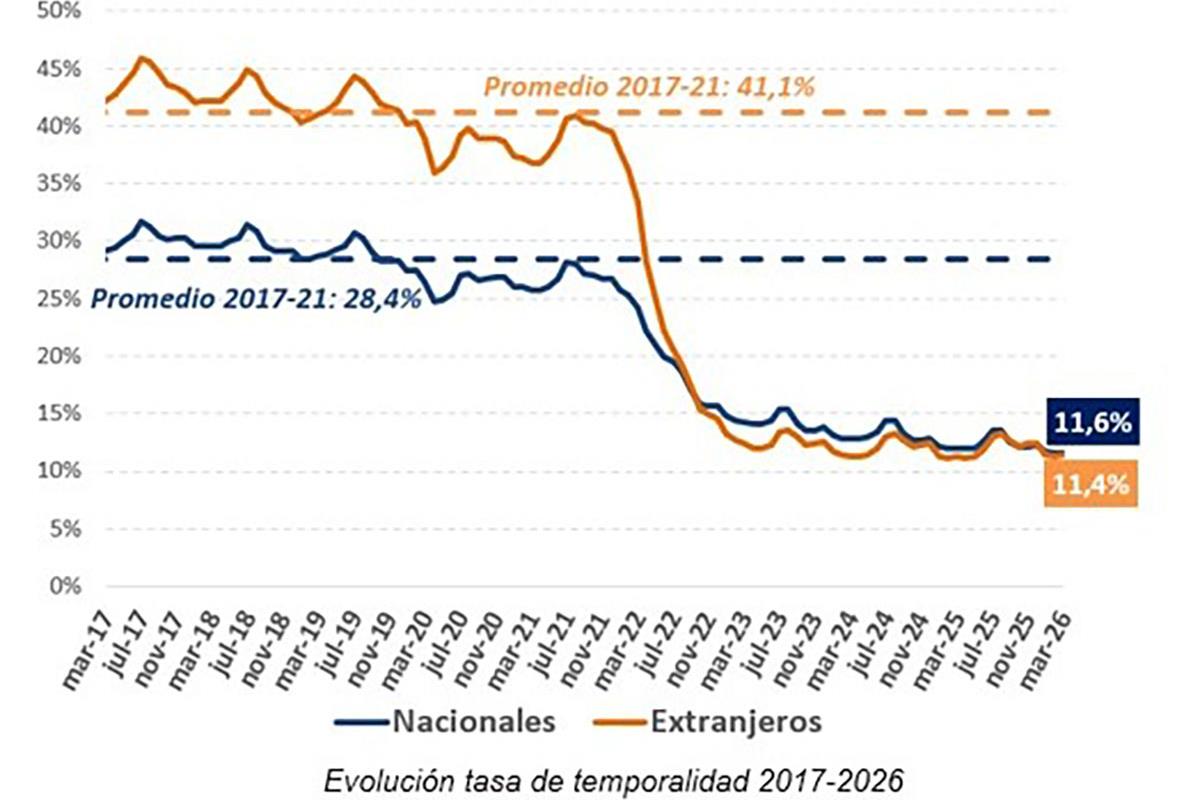
Furthermore, it is important to highlight the high percentage of foreign workers with permanent contracts, 88.6% of the total, which is even higher than that of Spanish workers (88.4%). When compared to the average percentage for the period 2017-2021, prior to the labour reform (58.9%), the figure is even more striking.
Meanwhile, the temporary employment rate for this group of workers has fallen to historic lows, with the percentage of foreign workers with temporary contracts dropping to 11.4%, also below that of Spanish nationals (11.6%). This percentage contrasts sharply with the average for the 2017-2021 period, which reached 41.1% of the total.
Entrepreneurship in high-skill sectors
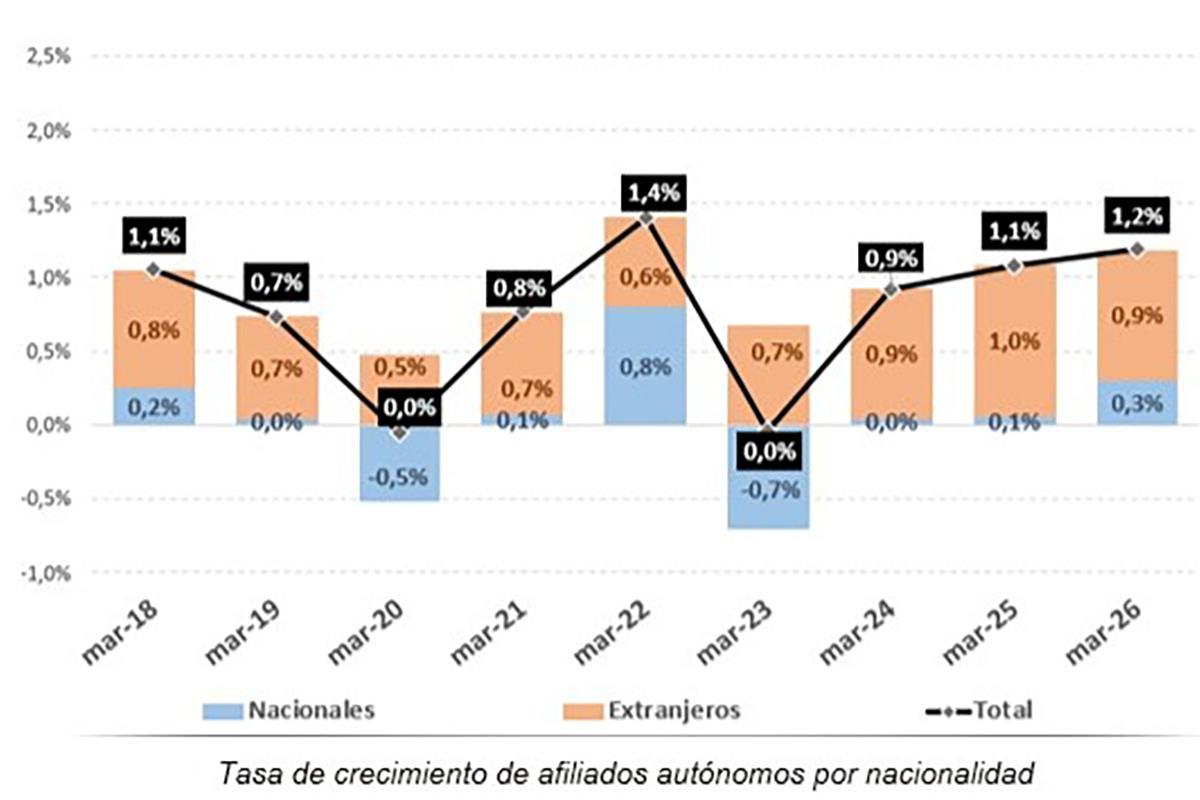
There are now more than half a million self-employed workers with non-Spanish nationality, specifically 506,067. Their growth in the last 12 months is particularly significant, reaching 6.3%, while the overall number of self-employed workers has increased by 1.2%.
It is worth noting the growing presence of foreign workers who are starting businesses in highly skilled sectors such as Telecommunications and Computer Programming, where they now represent 31.7% of those registered in this sector, meaning they are now one in three entrepreneurs.
Non official translation

Waiter working