More than 3.5 million migrant women in Spain account for 43% of the total number of foreign national insurance contributors
News - 2026.3.6






In the framework of International Women's Day, which is celebrated every 8 March, the OPI, which is part of the State Secretariat for Migration, has updated the figures for foreign women in Spain. These figures reflect the labour and demographic contribution of foreign women in Spain, including their growing presence in education and academia, and reinforce their strategic role in the country's economic and social development.
According to the OPI, a total of 3,581,558 women had valid residency documentation in Spain as of 30 September 2025, which represents 48% of the total number of documented persons. Of these, 41% are from EU countries (1,459,397).
If we observe the distribution of foreign women with valid residence by nationality, the largest group is that of women from Romania (531,041), followed by women from Morocco (414,171) and women from Italy (227,886). As for the geographical distribution of these women in Spain, 68% are concentrated in four autonomous communities: Catalonia (21%), Community of Madrid (17%), Andalusia (15%) and Valencia (15%).
In the period between 2015 and 2024, just over 724,000 women obtained citizenship by residence, 55% of the total number of people naturalised this way.
Key contribution to the labour market
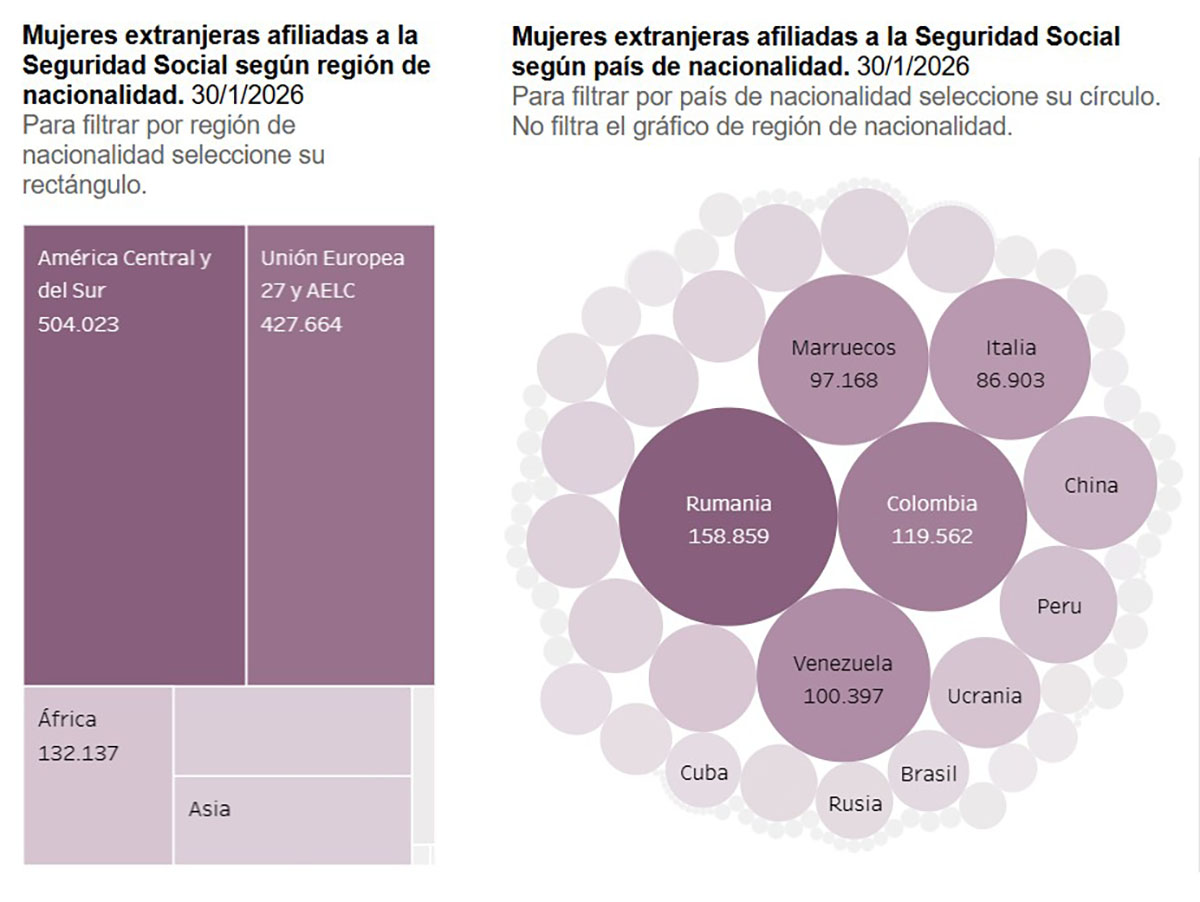
The national insurance contributor data for January 2026 show a total of 1,294,259 foreign women contributors, which consolidates the structural weight of migrant female employment in the Spanish labour market, and demonstrates their growing contribution to the sustainability of the social protection system. These women represent 43% of the total number of foreign contributors.
In terms of contribution, it is foreign women from Central and South America that account for the largest share. A total of 39% of women contributors in Spain (504,023) come from these countries. This is followed by women with EU and EFTA nationality, at 33% (427,664).
If we look at nationalities, women from Romania constitute the largest group with 12%, followed by women from Colombia (9%), and Venezuela and Morocco with 8%.
The general scheme accounts for the majority (70%) of foreign contributors, and for 42% of the total number of foreigners included in this model (men and women).
The volume of foreign female contribution confirms their strategic role, and their contribution is particularly relevant in a context of demographic ageing and the need for generational reinforcement, contributing directly to the balance and sustainability of the Social Security system.
Growing presence of migrant women in education and academia
The OPI data show a general upward trend in the type of residence permit for study purposes in our country. The latest statistics published by the Observatory on the flow of this type of authorisations showed an increase of 92% in the number of women who, over the decade 2014 to 2024, obtained a residence permit for study purposes in our country.
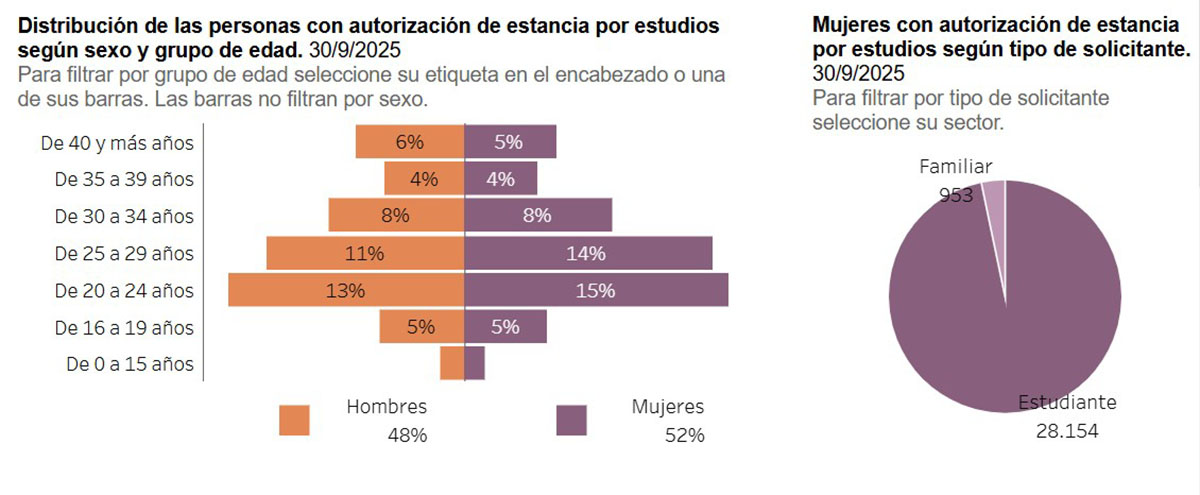
According to the OPI, as of 30 September 2025, a total of 29,107 women had a study permit in force in Spain, which represents 52% of the total number of people with this type of permit.
A total of 29% of women with authorisation to stay for study purposes are in the 20-29 age bracket.
With regard to the most representative nationalities, Colombian nationals are the first with 14% of the total number of foreign women with this type of authorisation in force, as of 30 September 2025. Colombia is followed by Peru (10%) and China (7%), and Morocco, the US, Mexico and Ecuador, with 6% of the total.
According to the data analysed by the OPI, the provinces where foreign women with valid study permits reside are mainly Madrid (33%), Barcelona (20%) and Valencia (12%).
Non official translation
Woman working