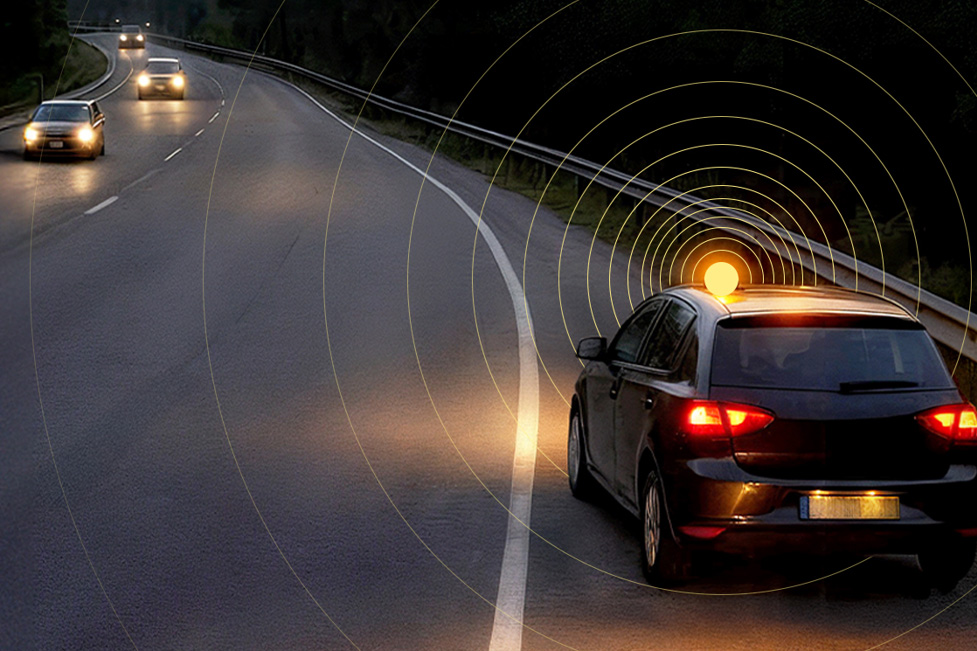





The Council of Ministers, in its meeting of 16 March 2021, approved a Royal Decree to regulate roadside assistance services. The main change included replacing the two triangles placed in front of and behind a vehicle immobilised after a breakdown or accident with a light device mounted on the top of the vehicle. The regulation established its mandatory use starting 1 January 2026.
The Official State Gazette published a new Royal Decree on 20 December 2022, modifying and supplementing this regulation, primarily regarding technical aspects, certification, and connectivity of the devices (beacons).
Until now, drivers have been able to use both triangles and beacons with or without connectivity. However, from 1 January 2026, only V16 devices connected to the DGT 3.0 platform will be legal.
What is the Connected V16 beacon?
It is a small, yellow beacon equipped with connectivity and capable of emitting a high-intensity, 360º light intermittently and continuously for at least 30 minutes. It incorporates a battery with a minimum lifespan of 18 months, regardless of whether it's rechargeable or not.
What is the purpose of the V16 beacon?
To prevent drivers from having to get out of their vehicles when they have a breakdown to place warning triangles, walking along the road or shoulder. Every year in Spain, around 25 people are killed by vehicles while trying to set up warning triangles.
It increases the safety of drivers and passengers because the connectivity allows for both visual visibility of the broken-down vehicle and virtual visibility, since other drivers in the area receive a warning via navigation systems, mobility apps, and variable message signs that there is a vehicle stopped on the road.
Which vehicles are required to carry it?
Passenger cars, vans, buses, multi-purpose vehicles, lorries and non-special vehicle combinations are required to carry it. For motorcycles, it is not mandatory, but it is advisable for safety reasons.
The beacon must be stored fully charged in the glove compartment or another easily accessible location inside the vehicle.
How do I attach the V16 beacon?
After stopping the vehicle on the road or shoulder, the driver must turn on the beacon and attach it from inside the vehicle to the roof. If this is not possible, as is the case with buses and lorries, it can be placed on the door. The vehicle's hazard warning lights must also be activated.
The V16 beacon usually includes a powerful magnet that allows it to adhere to metal surfaces. If the vehicle has an aluminium body or a glass roof, it may not adhere as strongly as on steel surfaces.
What should the driver do after activating the beacon?
Once the vehicle is immobilised and the beacon is activated, the driver and occupants must assess whether or not it is possible to leave the car safely.
The General Traffic Regulations establish as a general rule that they must leave the vehicle whenever there is a safe place outside the roadway. They must exit the car on the side opposite the flow of traffic without walking or remaining in the lanes or shoulders that make up the roadway. If traffic conditions do not allow the occupants to leave the vehicle safely, they must remain inside with their seatbelts fastened.
How does the Connected V16 beacon work? Do I need an app or a mobile phone?
After activation, the beacon emits a light signal and automatically transmits the exact location of the disabled vehicle to the DGT 3.0 platform.
The device includes an internal GPS chip and a non-removable SIM card that handle the connection. Simply turn it on. There is no need to use a mobile phone or any app.
Telephone companies will not charge individuals anything for the connectivity service, as legislation mandates a minimum connectivity availability of 12 years, the cost of which is included in the V16 device's sale price.

What power source does it use and how long does the battery last?
The V16 beacon operates using an internal power source that varies depending on the model. Some devices use non-rechargeable alkaline batteries, while others use USB-rechargeable lithium batteries. In all cases, they must guarantee a minimum of 30 minutes of continuous operation after activation. They must also have a minimum standby autonomy of 18 months.
How far away is the connected beacon visible?
Under optimal conditions, the beacon is visible from a distance of 1,000 meters. Since the beacon is connected to Traffic Management Centres, these centres will broadcast information about the accident or breakdown to other vehicles travelling in the area via navigation systems, mobility apps, or on-board computers. Drivers of older cars that do not have this type of technology can get information through the variable message signs on the roads.
If the accident or breakdown occurs inside a tunnel, will the device send the signal to the DGT?
Yes. The V16 beacon works even in conditions without conventional coverage thanks to its connection via specialised IoT communication networks. In cases where even these networks are unavailable, the beacon will continue to function as a visual signal and will store the data to send it when the connection is restored.
Does the beacon alert emergency services or a tow truck?
The Connected V16 is not a system for alerting emergency services or a tow truck. Its function is to signal and transmit the vehicle's exact position to prevent road accidents. The driver or occupants must report the incident to the emergency services if needed, or to the insurance company's roadside assistance service.
Does the V16 transmit my personal data?
No. The beacon only works if the user activates it and does not transmit the driver's personal data, record speed, or identify the vehicle's license plate. It is not associated with a person, phone number, or license plate. New vehicles will not come with the beacon installed. Furthermore, it is not necessary to provide any data or register the device. DGT does not ask for any data.
Which model of V16 beacon should I buy?
Beacons must be approved and certified by IDIADA or LCOE, which are the authorised technical laboratories that verify that the models comply with regulations. There are more than two hundred models of connected V16 beacons on the market at various prices. Not all beacons advertised as connected are approved, so it is recommended to consult the updated list of certified brands and models on the DGT website.
Can I still use unconnected V16 beacons?
No. Unconnected V16 devices will not be valid as a means of signalling immobilised vehicles from 1 January 2026, as indicated by the regulations.
Can I still use warning triangles?
No. The connected V16 beacon is the only recognised means of signalling stationary vehicles from 1 January 2026.
Vehicles registered in other countries travelling through Spain under international traffic regulations may use warning triangles.
Can I use the V16 outside of Spain?
The beacon is valid for vehicles registered in Spain travelling through countries that are signatories to and ratifies the Vienna Convention on Road Traffic, which includes approximately 86 nations across various continents.
What is the penalty for not carrying the V16 beacon?
The fine for not carrying the beacon is €80, the same amount levied against drivers who failed to carry warning triangles.
Non official translation