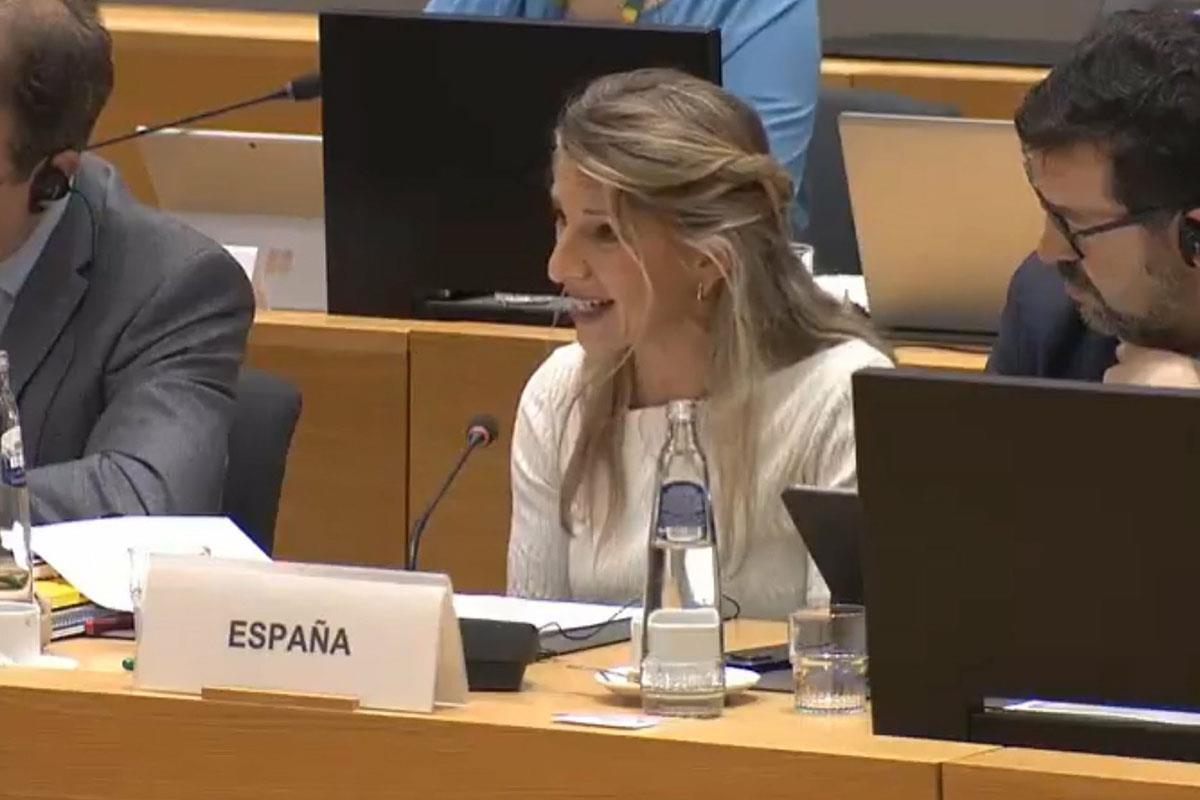
 The Second Vice-President and Minister for Labour and Social Economy, Yolanda Díaz, speaks at the Employment, Social Policy, Health and Consumer Affairs Council (EPSCO)





The Second Vice-President and Minister for Labour and Social Economy, Yolanda Díaz, has expressed her disagreement in the debate on the simplification and application of regulations being discussed at the Employment, Social Policy, Health and Consumer Affairs Council (EPSCO), which is being held in Brussels, and has called for a more social Europe, which will make it a relevant player and a point of reference in social matters in the world.
On the report "Achieving simplification, implementation and enforcement in the employment and social areas", aimed at promoting competitiveness in the European Union by reducing administrative burdens and regulatory complexity, which was discussed in this forum, the minister was categorical in assuring that there is no over-regulation.
"We are far from achieving a social Europe," warned Díaz, who described it as "unacceptable" that "labour and social protection rights, as well as their guarantees, can be considered as bureaucratic burdens."
According to the vice-president, true competitiveness and innovation in Europe comes from continuing to implement the Social Pillar, for example by recognising the right to digital disconnection or promoting democracy in business, as well as protecting workers from climate change. "We cannot under any circumstances accept the neoliberal idea that labour rights are an impediment to the proper development of markets," insisted Díaz, who encouraged her European counterparts to have more ambition to lead the world in the conviction that decent work with rights is the only admissible path.
"No less Europe, more Europe than ever: social, green and feminist, proclaiming the values of decent work and human rights in the world," concluded Díaz.
Decent housing as a basis for social inclusion
Another of the points addressed by the Council was the "Promotion of social inclusion and cohesion through coherent social and housing policies". In this regard, the vice-president called for the continued implementation of mechanisms to identify imbalances in social rights and, in this regard, she defended the Spanish-Belgian proposal to implement the Social Convergence Mechanism in order to prioritise a joint and not isolated evaluation of social spending, including investment in affordable housing.
Díaz called for strengthening the instruments linking inclusion and affordable housing in order to make progress in this area. She also stressed the urgency of focusing on social policies in the face of the current challenge of access to housing in all EU countries. Social objectives cannot be "subordinated to economic goals", said Díaz.
Disappointment with the Porto Social Forum
The minister also expressed her disappointment at the lack of conclusions to her EU colleagues at the Porto Social Forum in September, which ended without a joint declaration. "We still need to strengthen the European Pillar of Social Rights," said Díaz, who also demanded greater political impetus and a more demanding social agenda in order to continue translating social policies into tangible policies, with a real impact on people's lives.
Bilateral meeting with German minister
Following her address to the Council, the vice-president held a bilateral meeting with the German Labour Minister, Bärbel Bas, who was attending an EPSCO Council meeting for the first time since her appointment.
Bas and Díaz explored ways of collaboration on social and labour issues and agreed on the need to strengthen alliances to defend a strong social Europe.
Non official translation