Annual meeting of railway operators, manufacturers and engineers
Óscar Puente anticipates the plan to acquire new trains and ratifies his commitment to High Speed at 350 kilometres per hour
News - 2025.11.27
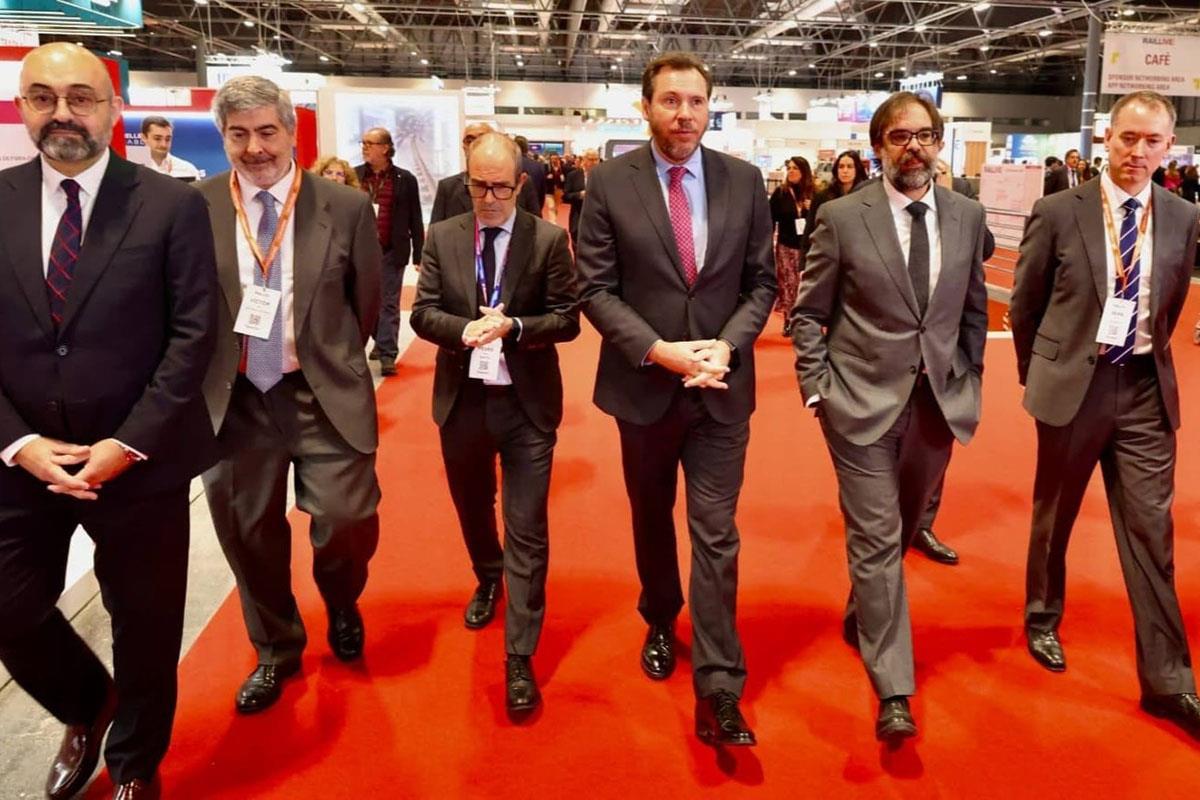 The Minister for Transport and Sustainable Mobility , Óscar Puente, during the inauguration





The Minister for Transport and Sustainable Mobility, Óscar Puente, has inaugurated the new edition of the Rail Live 2025 fair, held at IFEMA, Madrid, which brings together more than 9,000 attendees from 70 countries, 300 speakers and dozens of leading companies in the railway sector. During his speech, the minister claimed Spain's role as an international benchmark in railway technology and stressed that the country is going through 'the best moment in its history' as far as the railway is concerned.
During his speech, Puente highlighted the evolution of the Spanish railway system in the last decades. "We started at the back of the pack and today we are a world benchmark because we have cutting-edge technology that is at the forefront of innovation," he said, pointing to the development of the High Speed Railway as the origin of an "efficient, mature and technologically advanced railway ecosystem", in which high levels of public investment "have allowed companies to acquire knowledge, capitalise financially and grow inside and outside Spain."
The development of the railway network in our country has come from the hand of more than 600 Spanish companies, 75% of which are SMEs that knew how to make "a virtue out of necessity" and respond, with R&D, to the urgencies derived from the Spanish gauge. This was the case with the technology of the gauge changers and the sliding track systems that made it possible for trains to run on different gauges.
Spain is also a pioneer in other systems, such as ERTMS, which ensures the interoperability and circulation of trains from different manufacturers and which is already installed on more than 3,000 km of track in Spain, and the DaVinci rail traffic management tool, which has already been implemented in several countries. And it will also be the birth of high-speed trains at 350 kilometres per hour, thanks to a new sleeper patent that allows the speed of trains to increase due to its aerodynamic configuration.
Investor effort for high speed
The increase of the high-speed train to 350 kilometres was the focus of an important part of the minister's speech, who reminded that the two feasibility studies have already been put out to tender in order to make this great railway milestone a reality, which will be launched on the Madrid-Barcelona line. The choice of this line is due, firstly, to the fact that the route "already allows reaching 350 km per hour without changing the infrastructure" and, secondly, to the fact that it promises to correct the "saturation problems resulting from the enormous growth in demand". He also recalled the plan to acquire a new fleet for the coming years, which will enable this leap to 350 km per hour to be made.
In this sense, the minister underlined that one of the greatest current challenges is the age of the rolling stock, with an average of more than 20 years old. For this reason, the Government has set in motion the purchase of more than 500 new trains, 300 of which are for Cercanías, and is already working on a continuous renewal plan that will allow the incorporation of new fleet on a regular basis and not en bloc.
Regarding the extension of the Spanish railway network, Óscar Puente reiterated the 16,000 kilometres of track it has. Of this, 4,091 is for high-speed trains, 750 of which has been put into service in recent years. In addition to this, a further 436 kilometres is already under construction and in the near future 301 kilometres is planned. "With this boost," the minister predicted, "by 2030, 90% of the Spanish population will be connected by high speed.
Puente defended that the success of the Spanish railway system is not only explained by the more than 70 billion euros invested in the high-speed network, but also by the "high level of our public engineering and the strength of a competitive and innovative business ecosystem capable of projecting cutting-edge technological solutions to the world."
"Whoever does not want to see that the railway in Spain is experiencing the best moment in its history is simply not looking far enough ahead," said the minister, who called to keep on working to consolidate this leadership as a legacy for the next generations.
Meeting with leading railway companies
Rail Live is an annual exhibition (congress and trade show) dedicated to the rail industry and its challenges, with particular reference to how new technologies are shaping the future of the industry. It brings together operators, infrastructure managers, rolling stock manufacturers, their suppliers and researchers who seek to promote rail as the main mode of transport for passengers and freight.
The fair brings together more than 9,000 professionals from 70 countries, with 300 exhibitors, more than 200 speakers and 100 hours of content. The programme covers 12 core industry topics: signalling, cybersecurity, asset management, sustainability, energy, mega-projects and artificial intelligence, among others.
The Minister for Transport toured the various exhibitors of leading Spanish companies in the sector, such as Mafex, Stadler, Talgo, CAF, Renfe, Alstom, Adif, Ineco, Indra, Hitachi Rail and Siemens.
Non official translation