The Government presents the emergency training plan designed for non-university education centres
News - 2025.9.11
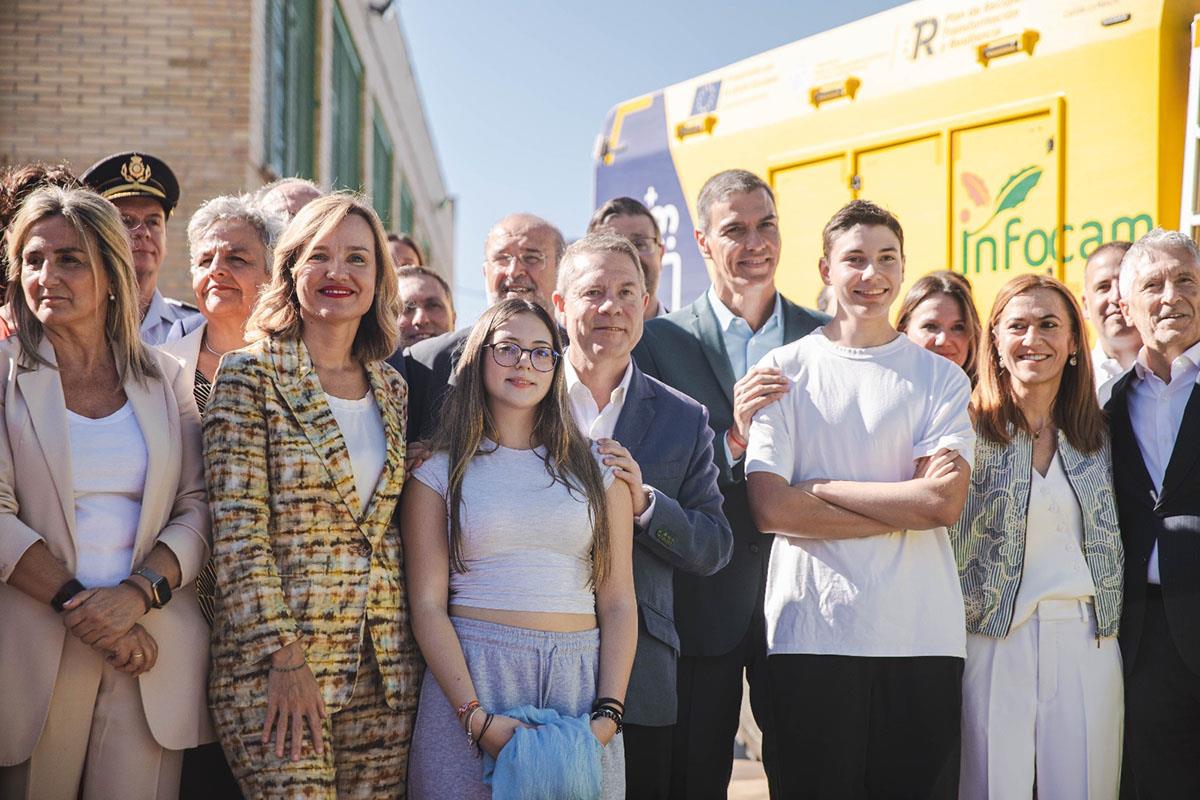 The Minister for Education, Vocational Training and Sports, Pilar Alegría, Pilar Alegría, the President of Castilla-La Mancha, Emiliano García-Page, and the President of the Government of Spain, along with other attendees at the event





The programme makes it compulsory for all non-university centres to incorporate the prevention of climate, technological and social risks into their curriculum.
The aim of the plan, which was presented at the Fernando Zóbel Secondary School in Cuenca and which will begin to be taught from this academic year 2025-2026, is to provide schools with a plan that incorporates the knowledge, skills, attitudes and values required to deal with emergency situations resulting from natural causes or human action in a safe and effective manner.
The President of the Government of Spain pointed out that some autonomous regions, such as Castilla-La Mancha, have been implementing this type of training plan for some time, but not on a compulsory basis. "We have designed this plan as a matter of urgency as a result of all the Civil Protection crises and emergencies that we have been suffering for many years," said Sánchez, who considered that "we need the civic culture and human security of the population as a whole". He also pointed out that the plan has the "agreement, consensus and active participation of all the institutions and operators working in Civil Protection", and that the government will continue to make progress in this culture of protection.
Thanks to this plan, designed jointly by Education, Home Affairs and the autonomous communities, students will receive training on how to act in the event of specific risks such as floods, earthquakes, tidal waves and tsunamis, volcanic eruptions, extreme weather events, forest fires and industrial, chemical, nuclear and dangerous goods transport accidents.
They will receive training on prevention, warning systems, emergency systems, and the difference between information and misinformation in emergency situations.
They will also learn how to identify risk situations in the environment and in large concentrations of people and what self-protection measures to take in each situation. Reactions to an emergency will also be addressed and guidance on emotional support will be provided.
More than eight million students and almost 800,000 teachers from 25,000 schools will be able to access the materials prepared, consisting of videos, infographics and teaching guides, produced with different approaches for different educational levels, respecting the principles of inclusion and accessibility, and will be available in Spanish, Catalan, Basque, Galician and Valencian.
In the pre-school stage - three, four and five years old - schoolchildren will learn to recognise an alarm and the first signs of danger, and will learn the basic principles of safety. In later years, they will learn that if there is a risk of flooding, they should try to move to a higher floor or higher ground; or that if the ground shakes, they should take cover under their desks, among other examples.
The Autonomous Communities and schools may supplement the minimum training contained in this plan with specific materials on the risks associated with the characteristics of each territory, which will be specified in relation to the priorities determined by the risk maps of each geographical area.
Moreover, it will be up to the autonomous regions to plan how and when this training is provided. A minimum of two hours will be taught over the course of the school year in the Pre-school and Primary stages, and in all other non-university education stages, there will be a minimum of four hours.
The training will be given by members of the Civil Protection emergency intervention and assistance services of the autonomous communities and local authorities, as well as volunteers from the national Civil Protection system, and teachers from schools.
The National School of Civil Protection, in collaboration with the training services of the Ministry of Education and the autonomous regions, will provide the necessary prior training for all personnel who will be in charge of teaching in schools, with volunteers having to pass the mandatory course.
The Ministry has allocated 240,000 euros to the plan for the development of materials, teaching guides, infographics and videos available to schools.
Non official translation